Clear Sky Science · en
Graphene quantum dot membranes with tailorable pores for efficient gas separation
Why Cleaning Gases with Smart Filters Matters
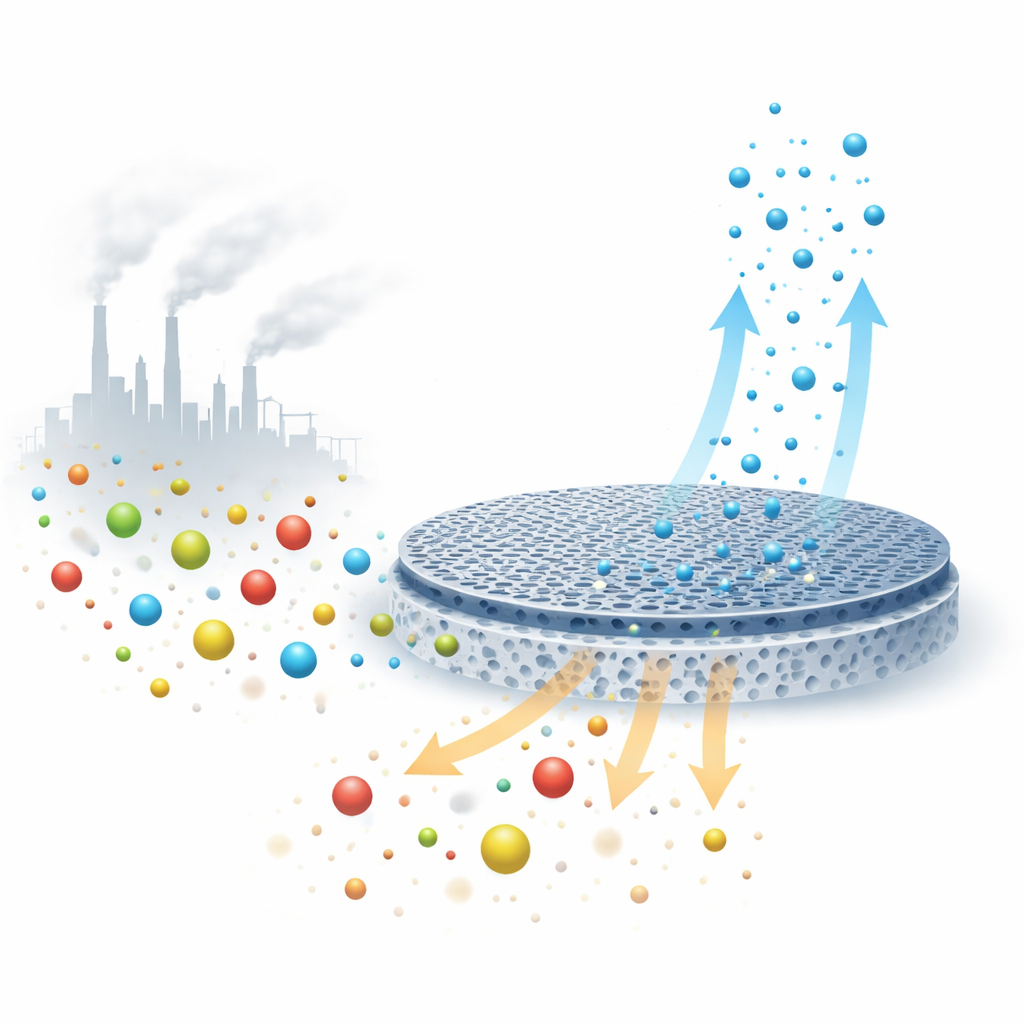
From power plants to natural gas wells, industry produces huge volumes of gas mixtures that must be cleaned or separated before use. Today this is often done with energy-hungry methods like distillation or chemical scrubbers. The article describes a new kind of ultra-thin “smart filter” made from tiny specks of graphene, called graphene quantum dots, whose pores can be adjusted after the membrane is made. This tunable filter can let carbon dioxide slip through much more easily than other gases, promising cheaper carbon capture and more efficient fuel processing in the future.
Building a Filter from Tiny Carbon Tiles
The researchers start with graphene quantum dots—nanometer-sized fragments of carbon with a solid, graphitic core and many chemical groups on their surface. These dots are produced by gently baking common citric acid, then dispersing the resulting particles in water. When this liquid is sprayed onto a heated ceramic support, the droplets dry instantly and the quantum dots stack into a continuous, ultrathin layer. Because each dot is only a few nanometers across, the overall layer behaves like a mosaic of tiny tiles whose gaps and connections can form extremely narrow passages for gas molecules.
Turning a Blank Sheet into a Selective Sieve
Right after spraying, the graphene-dot layer is basically airtight. To turn it into a working filter, the team heats it in an inert atmosphere while placing a polymer rich in amine groups, polyethyleneimine, upstream. As this polymer decomposes, it releases small amine molecules that seep into the membrane and chemically bond the dots together. This “post-regulation” step does two things at once: it opens ultra-small pores as unstable pieces burn off, and it decorates the pore walls with nitrogen-containing groups that have a strong attraction to carbon dioxide. By simply choosing the heating temperature and how much polymer to use, the scientists can dial the pore size and chemistry without rebuilding the membrane from scratch.
Letting Carbon Dioxide Through, Holding Others Back
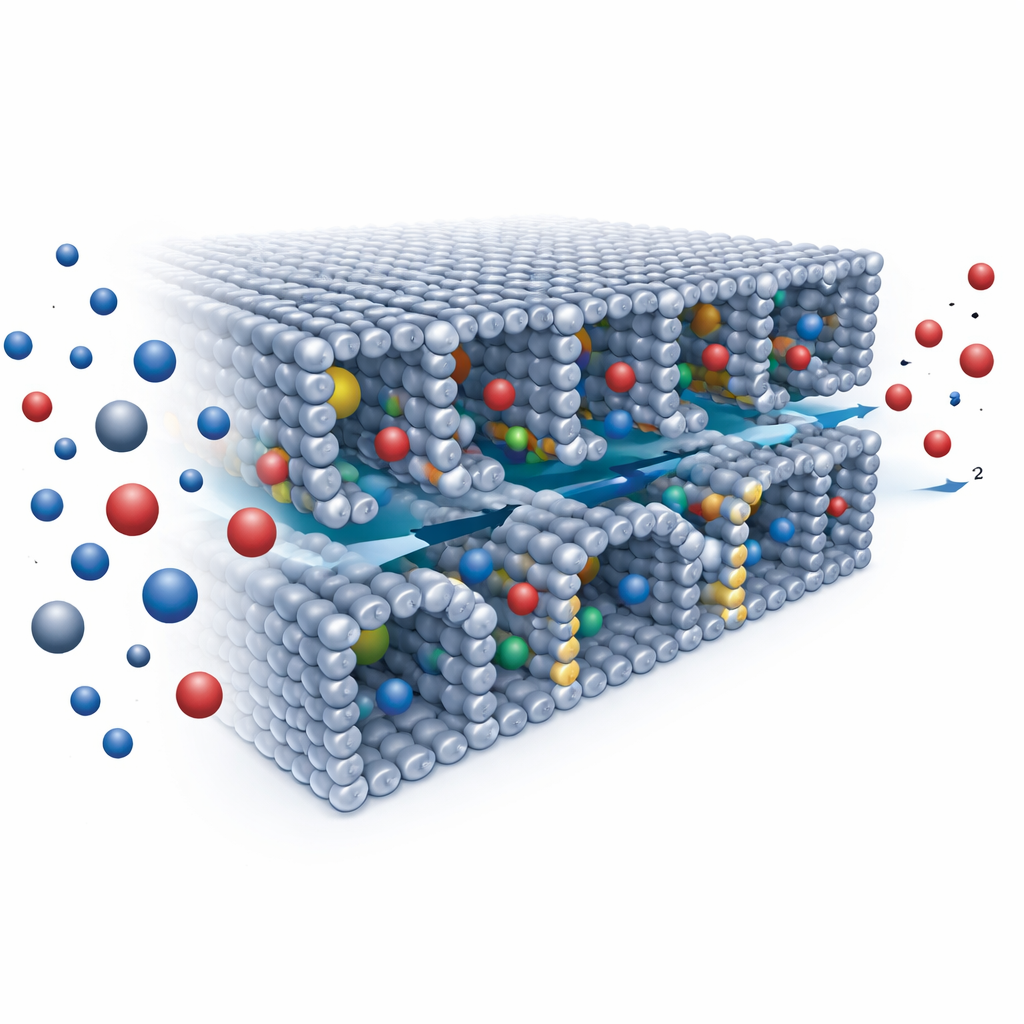
When tested with mixtures of carbon dioxide and common gases like nitrogen and methane, the tuned membranes show both fast flow and strong preference for carbon dioxide. At an optimal treatment temperature around 350 °C, the film reaches very high carbon dioxide permeance—well above industrial targets—while still separating it from nitrogen and methane by factors of 40 to 50. Experiments reveal why: carbon dioxide sticks more strongly to the amine-decorated pores, and key pore sizes cluster around about 0.35 nanometers, just big enough for carbon dioxide to pass but tight for slightly larger molecules. As the membrane is heated more aggressively, some pores widen, flow increases, and selectivity drops, giving a smooth way to trade speed for sharpness of separation depending on the application.
Reaching Harder Gas Mixtures with the Same Filter
The same tuning strategy extends beyond carbon capture. By pushing the heat treatment to higher temperatures, the pores become large enough to distinguish between very similar hydrocarbon molecules such as propylene and propane—a notoriously difficult pair to separate with conventional methods. At these higher settings, the membrane allows propylene to pass several times more readily than propane, mainly because the slightly larger molecule is sterically hindered by the adjusted pores. Importantly, all of this is achieved by modifying a standard “primitive” graphene-dot membrane after it is made, rather than inventing a new material for each gas pair.
What This Could Mean for Cleaner Industry
In everyday terms, the researchers have created a single, extremely thin carbon-based filter that can be “retuned” like a radio, shifting its sweet spot from carbon dioxide capture to tougher hydrocarbon separations just by changing heat-treatment conditions and cross-linking chemistry. The marriage of tiny, uniform graphene building blocks with pore-creating heat treatment and carbon-dioxide-loving surface groups yields membranes that are both very fast and very selective. If such customizable, robust filters can be scaled up and proven durable in real-world plants, they could cut the energy cost of cleaning exhausts and processing fuels, making industrial gas handling both greener and more flexible.
Citation: Zhang, X., Feng, Q., Zhang, L. et al. Graphene quantum dot membranes with tailorable pores for efficient gas separation. Nat Commun 17, 3434 (2026). https://doi.org/10.1038/s41467-026-69938-4
Keywords: graphene quantum dot membranes, gas separation, carbon dioxide capture, tunable nanopores, membrane technology