Clear Sky Science · en
Upper-ocean stratification changes control ENSO amplitude shift under sustained global warming
Why shifting Pacific rhythms matter
The El Niño–Southern Oscillation (ENSO) is one of Earth’s most powerful climate rhythms, swinging between warm El Niño and cool La Niña phases that reshape rainfall, storms, and marine life around the globe. As the planet warms, scientists expect ENSO to change—but not in a simple way. This paper asks a deceptively basic question with big consequences: how does the layering of warm and cool water in the upper ocean control whether future El Niño events become stronger, weaker, or simply different?
How the Pacific pendulum is changing
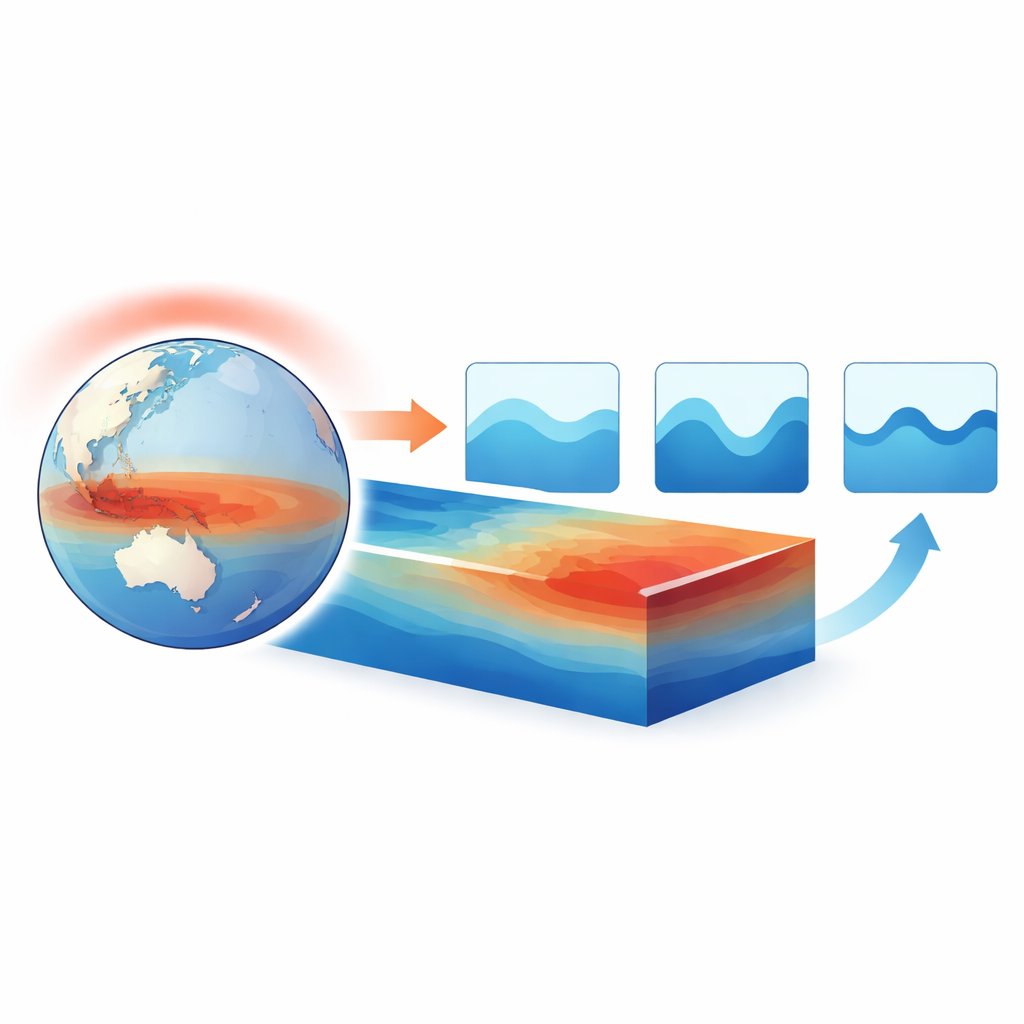
Climate models used for international assessments suggest that ENSO’s strength does not simply ramp up or fade away under continued greenhouse gas emissions. Instead, its ups and downs follow a three-stage pattern over the coming centuries. In simulations examined here, ENSO-related temperature swings in the central Pacific are relatively weak from about 1940 to 1990, grow larger through the mid and late 21st century, and then shrink again after around 2100—even though global warming continues. Understanding why this non‑monotonic behavior appears is crucial for anticipating future droughts, floods, and heat extremes linked to El Niño and La Niña.
The hidden architecture of the upper ocean
ENSO depends sensitively on the background state of the tropical Pacific Ocean. The authors focus on three aspects: how sharply the ocean is layered by density (stratification), the usual pattern of surface currents and temperatures, and the depth and sharpness of the thermocline—the transition zone between warm surface waters and colder waters below. Using eight climate models that all show the three‑stage ENSO pattern, they describe how these features evolve under a high‑emissions scenario from 1900 to 2300. Over time, the upper 100–150 meters become more strongly layered, surface currents weaken, the equatorial upwelling that brings cool water to the surface diminishes, and the thermocline shoals and sharpens.
A stripped‑down model to isolate key players
To untangle cause and effect, the study employs an intermediate coupled model that represents only the essential physics of air–sea interaction needed to generate ENSO. Crucially, this model can be run with prescribed background ocean conditions taken directly from the larger climate models. The team constructs separate climatologies for three representative periods—mid‑20th century, late‑21st century, and late‑23rd century—and uses them to drive the simplified model. Despite its relative simplicity, this framework faithfully reproduces the observed three‑stage shift in ENSO strength: weak, then strong, then weak again. That success allows the authors to perform controlled experiments in which they swap in or out just one background component—stratification, surface fields, or thermocline structure—while holding the others fixed.
How ocean layering steers wind energy
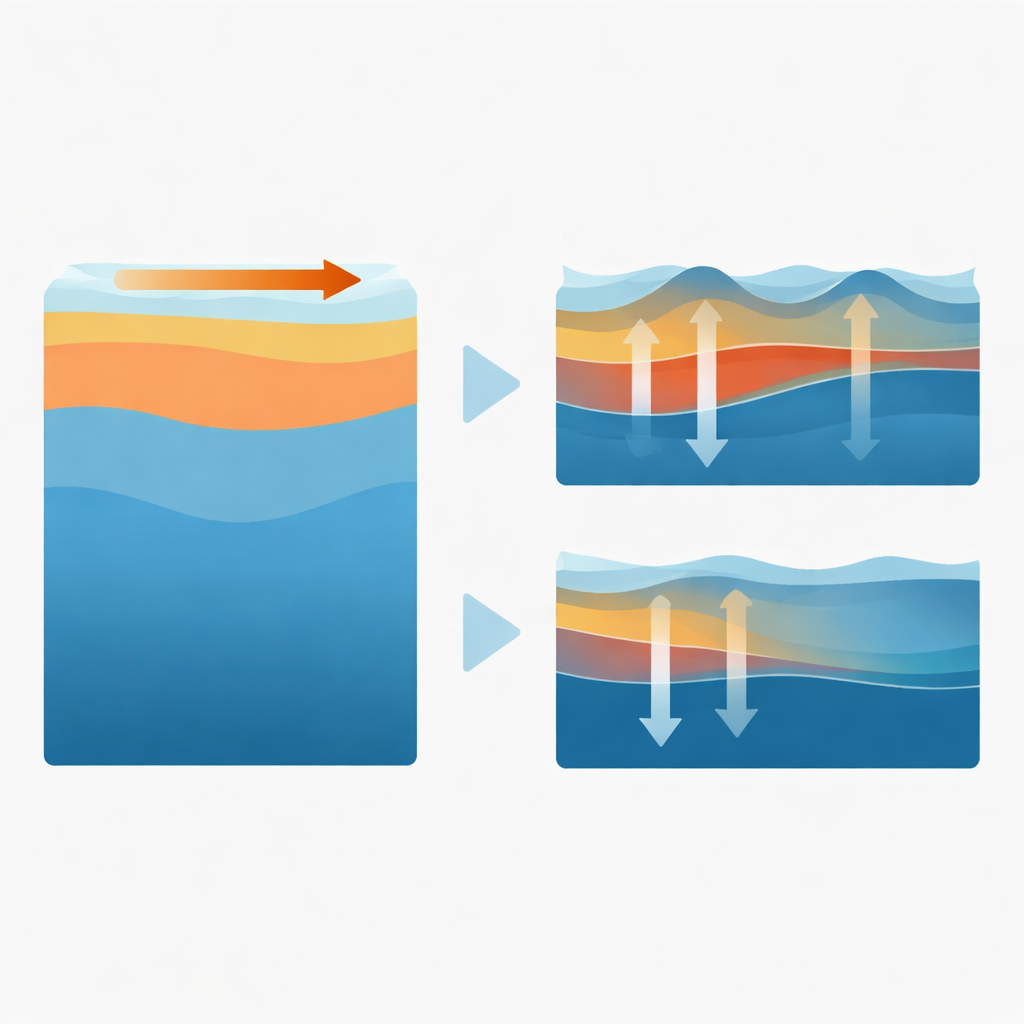
The heart of the analysis lies in how winds over the Pacific project their energy into vertical vibration patterns, or modes, of the ocean. These modes describe whether wind forcing mainly stirs the surface layer or displaces the thermocline at depth. As climate warming reshapes the density profile, the strength of wind coupling to the first few modes changes in distinct ways across the three periods. From the historical era to the late‑21st century, stronger stratification boosts the coupling of winds to both surface‑focused and thermocline‑focused modes, amplifying the feedbacks that grow El Niño and La Niña events. After 2100, however, additional strengthening of the surface layer is accompanied by a relative weakening of deeper stratification. This redistributes wind energy: the leading surface‑intensified mode weakens while a deeper mode strengthens in the western and central Pacific. The two effects partly cancel at the surface, making the ocean less responsive to the same wind anomalies and thereby reducing ENSO amplitude.
Balancing amplifiers and brakes
Sensitivity experiments reveal that stratification is the main amplifier of ENSO variability, while changes in background surface currents, temperatures, and thermocline structure mostly act as brakes. During the late‑21st century, the amplifying effect of increased stratification outweighs the damping influences, producing stronger El Niño and La Niña swings. By the late‑23rd century, the vertical rearrangement of stratification weakens its net boost to ENSO, while the damping from altered surface flow and thermocline properties continues or grows. The overall result is a smaller response of sea‑surface temperatures to wind, even in a more stably layered ocean.
What this means for our climate future
To a non‑specialist, the central message is that how the ocean is layered—not just how warm it is—strongly shapes future El Niño behavior. The study shows that a thicker cap of warm water does not automatically mean wilder ENSO swings; instead, subtle shifts in how wind energy is distributed between surface and deeper layers can first intensify and later suppress the Pacific’s natural oscillation. By providing a clear, quantitative framework that links evolving ocean structure to ENSO strength, this work helps explain seemingly contradictory model results and offers a roadmap for testing how robust these projections are across a wider range of climate scenarios.
Citation: Zhang, RH., Chen, M., Gao, C. et al. Upper-ocean stratification changes control ENSO amplitude shift under sustained global warming. Nat Commun 17, 3126 (2026). https://doi.org/10.1038/s41467-026-69931-x
Keywords: El Niño–Southern Oscillation, ocean stratification, tropical Pacific, climate change, climate modeling