Clear Sky Science · en
Responsive interlayer spacing in staggered metal-organic framework nanosheet membranes
Smart Filters for Cleaner Water
Imagine a water filter that can be tightened or loosened on demand just by switching on a light. This study reports exactly that kind of smart material: ultra-thin, stackable sheets that form membranes whose internal spacing can be gently adjusted with ultraviolet and visible light. By controlling how far apart these sheets sit from one another, the researchers can fine‑tune which dye molecules are blocked and how quickly water flows through, pointing toward more efficient and adaptable filtration technologies for polluted water and industrial processes. 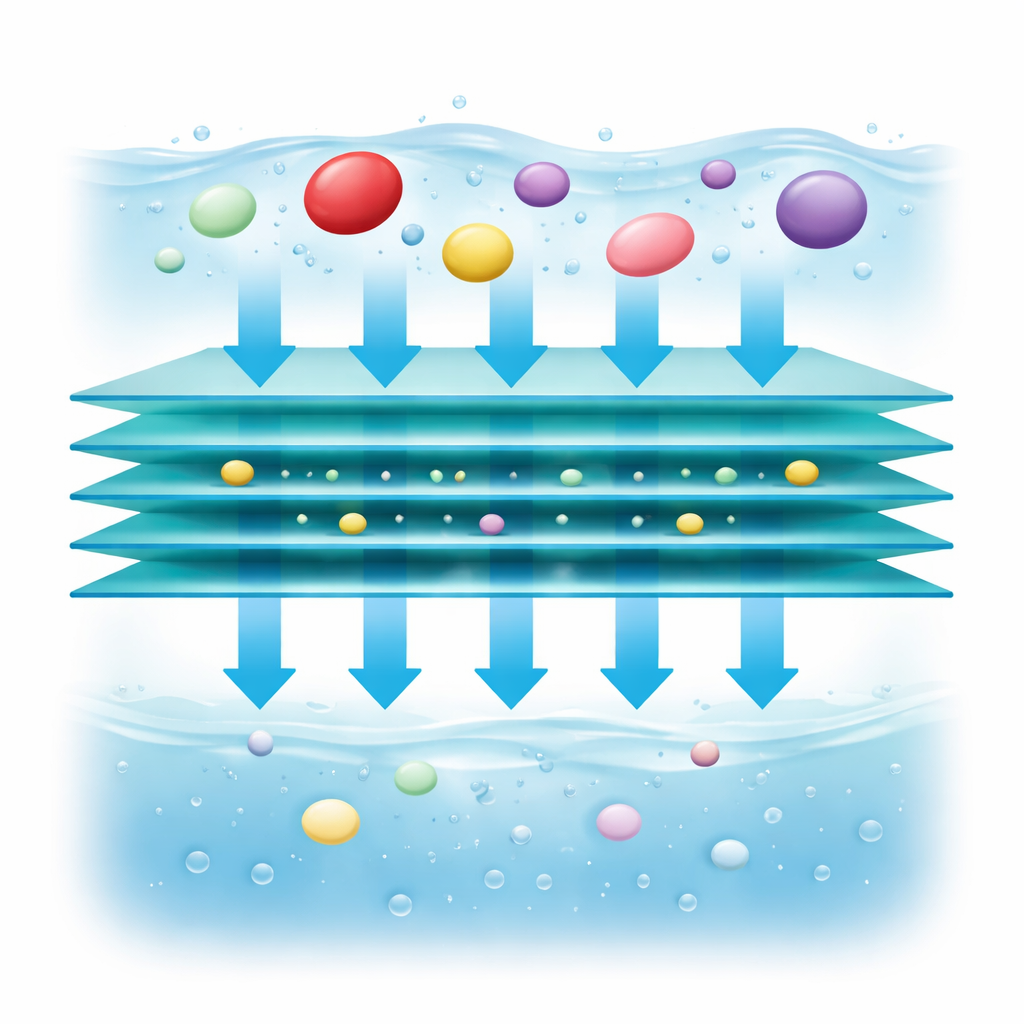
Why Flat Building Blocks Matter
Many of today’s most exciting materials are only a few atoms thick. When such two‑dimensional layers are stacked, tiny changes in how they overlap—such as the distance between layers or the twist angle—can dramatically change their properties, from electrical behavior to how they interact with light and fluids. In contrast to flat carbon sheets like graphene, metal–organic framework (MOF) nanosheets are porous, containing regularly arranged tunnels that molecules can pass through. When these porous sheets are stacked into a membrane, water and dissolved molecules must navigate both the pores and the spaces between layers, making layer spacing a powerful handle for controlling separation. But adjusting this spacing in a precise, reliable way has been difficult, especially for rigid MOFs that do not naturally flex.
Designing a Light-Tunable Membrane
The authors tackled this challenge using a zirconium‑based MOF called NUS‑8, which can be synthesized as well-dispersed nanosheets in liquid. They developed a post‑synthetic treatment that attaches special single‑point “add‑on” molecules to open metal sites on the sheet surfaces. One add‑on is azobenzene, a light‑sensitive group that straightens in one form and bends in another when exposed to ultraviolet or visible light. The other is tetraphenylethylene, a non‑switchable fluorescent group used as a comparison. By coordinating these molecules onto the surfaces, the team gently pried the sheets slightly farther apart and allowed limited sliding between layers, while preserving the original crystal framework and its orderly pores. Measurements using x‑ray diffraction and scattering confirmed that the distance between stacked sheets increased by a fraction of a nanometer after modification, signaling that the add‑on molecules had inserted into the interlayer region.
Seeing How the Layers Stack and Flow
To understand how this chemical tuning changes structure, the researchers used advanced electron microscopy under very low electron doses. For the untouched NUS‑8, they observed neatly aligned clusters arranged like a hexagonal grid. After adding azobenzene or tetraphenylethylene, the clusters in neighboring layers became slightly misaligned and rotated, generating moiré patterns—visual fingerprints of twisted stacking. This showed that the new side groups disrupt perfect registry between sheets, weakening their direct contact and favoring a looser, more adjustable arrangement. At the same time, gas‑sorption measurements indicated that modified materials retained significant surface area and in some cases developed larger effective pores, which can help guest molecules move more easily through the membrane. 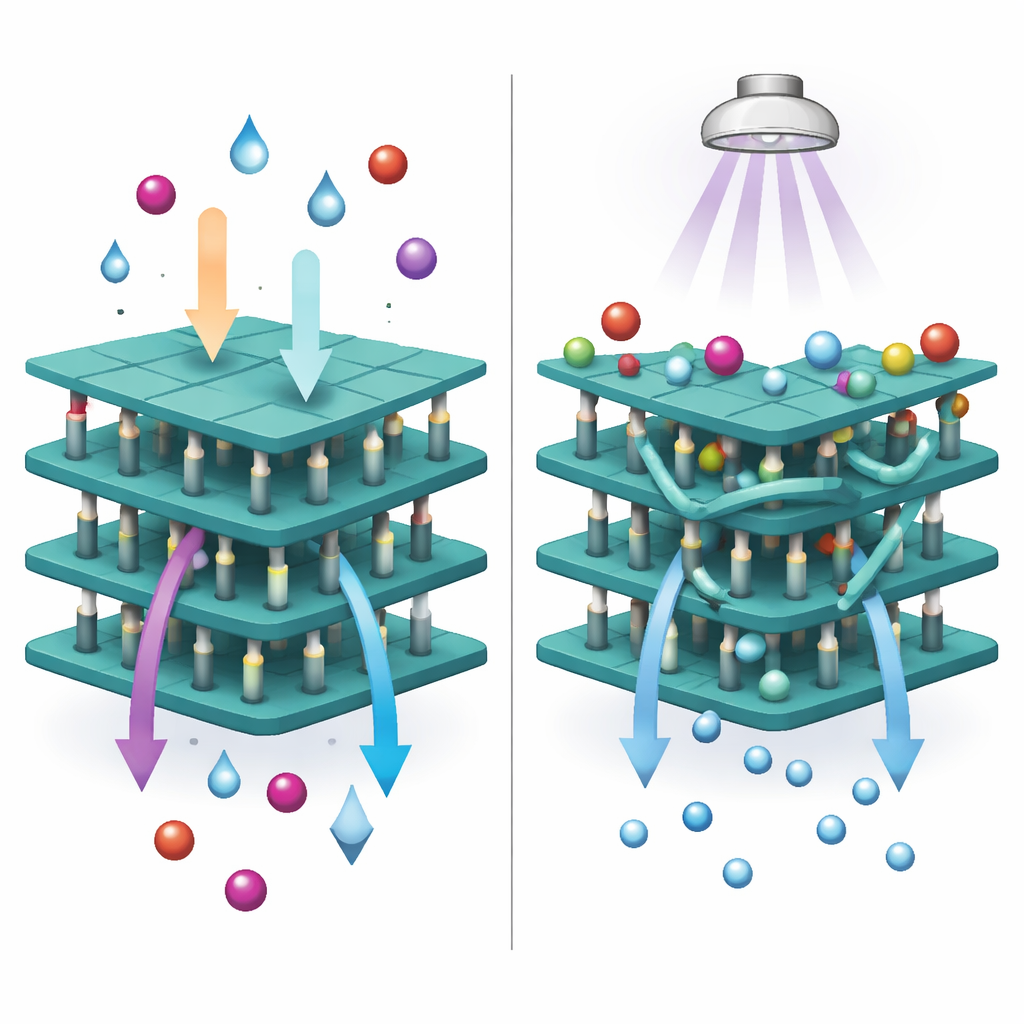
From Structure to Smarter Filtration
The practical payoff appears when these nanosheets are formed into thin, continuous membranes on polymer supports. Thanks to their excellent dispersibility, the suspensions can be spread over large areas into uniform coatings only a few hundred nanometers thick. In dye‑filtration tests, the azobenzene‑modified membranes allowed water to pass far more quickly than unmodified NUS‑8 while still rejecting over 95% of large dye molecules such as Congo red and acid fuchsin. When the azobenzene groups were switched with ultraviolet light from their straight to bent form, the interlayer spacing shrank slightly. This subtle contraction made it harder for bulky dye molecules to slip through, nudging the rejection upward while modestly slowing the water flux. The non‑switchable tetraphenylethylene membranes did not show this light‑induced change, confirming that the effect stems from the azobenzene motion rather than from the MOF itself or the fabrication process.
What This Means for Future Technologies
In essence, this work shows that a rigid, crystalline MOF can be endowed with a controllable, light‑responsive gap between its layers simply by attaching suitable molecules to its surface. These nanosheet membranes combine high water throughput, strong rejection of pollutant dyes, mechanical flexibility, and the ability to fine‑tune performance with light rather than moving parts or harsh chemicals. Such responsive filters could help meet demanding separation needs in water treatment, chemical manufacturing, and sensing, where the ideal trade‑off between speed and selectivity can change over time. The study also outlines a broadly applicable design strategy for turning other layered porous materials into smart membranes whose internal architecture can be adjusted on command.
Citation: Peng, X., Han, L., Wu, X. et al. Responsive interlayer spacing in staggered metal-organic framework nanosheet membranes. Nat Commun 17, 3179 (2026). https://doi.org/10.1038/s41467-026-69929-5
Keywords: metal-organic framework membranes, light-responsive filtration, 2D nanosheet materials, water purification, photo-switchable pores