Clear Sky Science · en
Solid-liquid interface synthesis of selective (111)-oriented Cs2AgBiBr6 perovskite crystals
Why crystal direction matters for future electronics
Many of the gadgets we rely on, from solar panels to light sensors, depend on crystals that move electric charges in a controlled way while surviving heat, light and moisture. In this study, researchers show how to coax a promising, lead-free crystal into growing with a particular internal orientation that makes it tougher and more reliable. By engineering how tiny droplets of solution touch a surface, they steer the crystal into its most robust form, opening a path to greener, longer-lived optoelectronic devices.
Building safer light-harvesting materials
Traditional perovskite crystals have dazzled scientists with their performance in solar cells and detectors, but most of them contain toxic lead and can break down under real-world conditions. The team focuses instead on a lead-free material called Cs2AgBiBr6, a double perovskite made from cesium, silver, bismuth and bromine. Inside this crystal, silver- and bismuth-centered building blocks alternate in a rigid framework that is naturally more stable than many earlier perovskites. The key insight is that not all crystal faces behave the same: one particular orientation, known as the (111) facet, packs atoms more tightly and is predicted to resist ion movement and degradation better than other faces.
Guiding crystals with tiny droplets and special surfaces
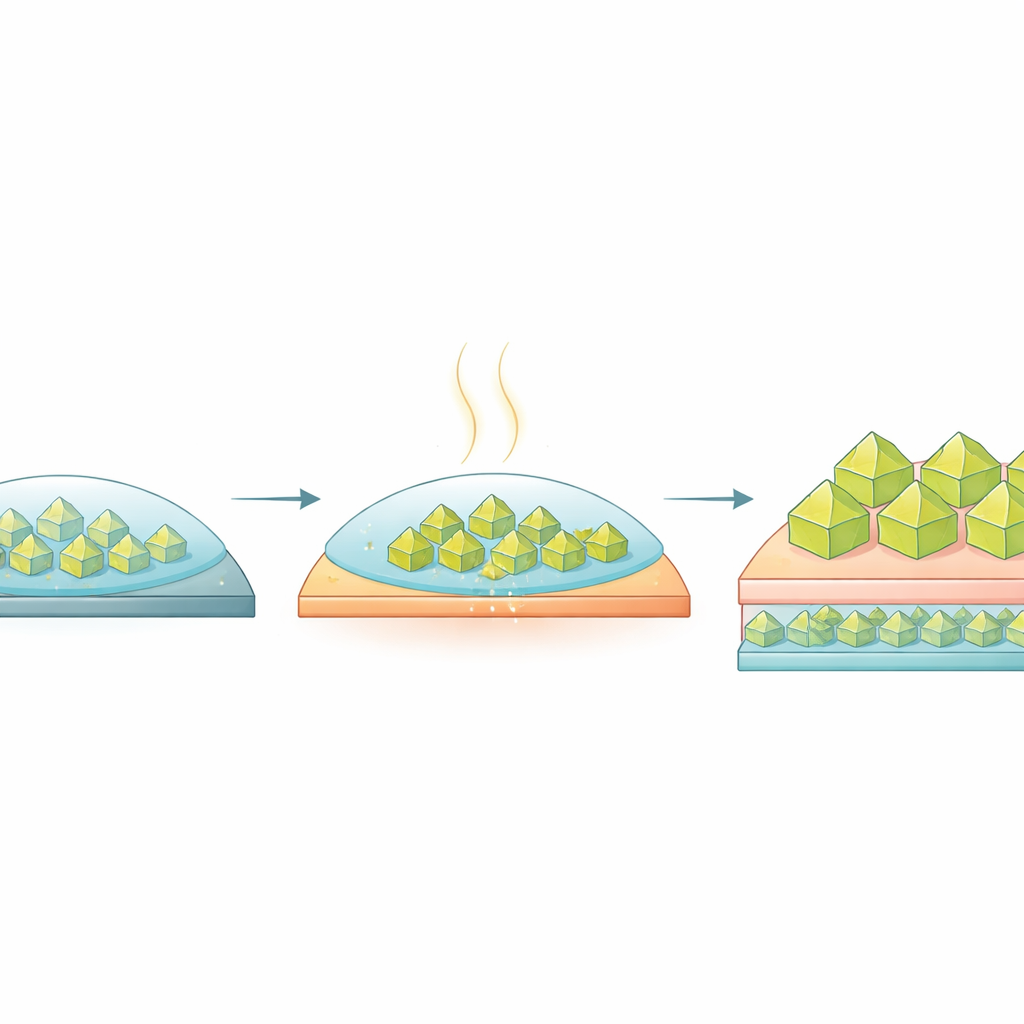
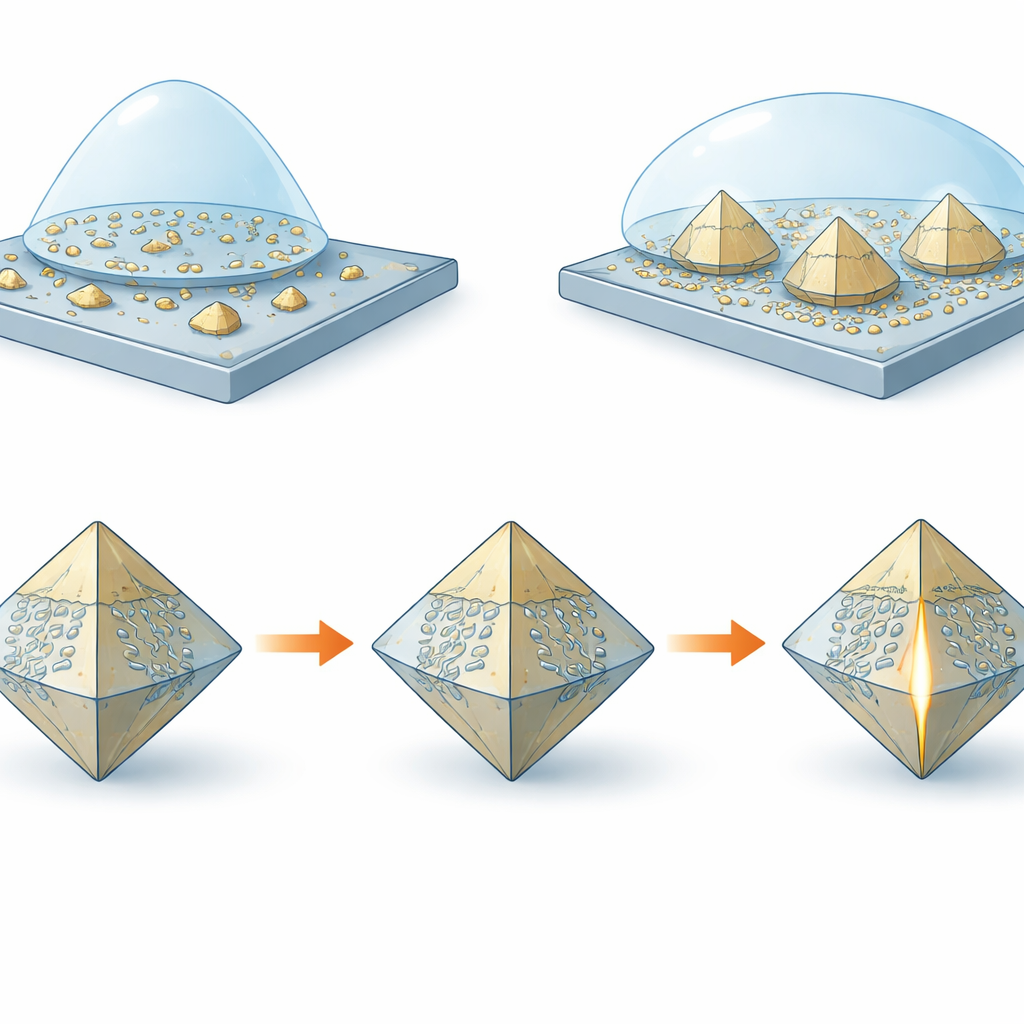
Instead of letting crystals form randomly from a liquid, the researchers control growth at the thin boundary where a microdroplet touches a solid surface. They place small droplets of the crystal solution on different substrates and gently warm them so the solvent evaporates slowly, then anneal the solid crystals at higher temperature. On ordinary, water-loving surfaces, the result is a mix of crystal shapes and orientations. On water-repelling, high-energy surfaces such as PDMS and treated glass or plastic, however, nearly all crystals grow in the desired (111) orientation and adopt neat octahedral shapes. The hydrophobic surfaces push the liquid away but concentrate the dissolved ingredients at the interface, lowering the barrier for (111) facets to form and turning random growth into a highly selective process.
Making tougher crystals by calming their atoms
Even in a stable material, subtle shifts of ions inside the lattice can trigger long-term damage. Calculations show that in Cs2AgBiBr6, bromide and silver ions are the most mobile, but that the (111) faces make their motion much harder than other directions. Experiments tracking tiny current spikes confirm the ionic nature of the material, while long-term X-ray measurements reveal that crystals exposing other facets fade away over weeks, leaving the (111)-oriented ones intact. To further tame internal stress, the team heats the crystals to 200 °C and lets them relax. After this treatment, their diffraction peaks become sharper, their light emission shifts slightly toward higher energy and narrows, and charge carriers live more than four times longer before recombining, all signs of a cleaner, better-ordered lattice with fewer defects.
Turning orientation control into better devices
To test whether this structural tuning pays off in real components, the researchers build simple two-electrode photodetectors directly on different crystal faces. Under the same visible light, devices based on the (111) facets produce the strongest photocurrent while keeping the background “dark” current at just a few trillionths of an ampere. Their sensitivity peaks around green light and exceeds that of devices made from other orientations, and they switch on and off faster as well. Over a month in humid air, the (111)-based detectors retain most of their initial performance, reflecting the resistance of their tightly packed surfaces to water and wandering ions.
What this means for everyday technology
This work shows that by carefully choosing the surface beneath a growing droplet, scientists can reliably grow lead-free perovskite crystals that present their most durable face to the outside world. The favored (111) orientation slows down harmful ion motion, reduces defects and, when combined with a simple heat treatment, delivers more stable and sensitive light detectors. In the longer term, this strategy of using interface energy to “aim” crystal growth could help designers craft safer, longer-lived solar cells, sensors and other optoelectronic devices without sacrificing performance.
Citation: Hong, E., Li, Z., Deng, M. et al. Solid-liquid interface synthesis of selective (111)-oriented Cs2AgBiBr6 perovskite crystals. Nat Commun 17, 3095 (2026). https://doi.org/10.1038/s41467-026-69926-8
Keywords: lead-free perovskites, crystal orientation, optoelectronic devices, photodetectors, interface engineering