Clear Sky Science · en
Dual-role iron species in photoelectrocatalytic radical trifluoromethylation with trifluoroacetates
Why adding a tiny group can transform a medicine
Many of today’s blockbuster medicines work better because chemists have attached a tiny three‑fluorine unit, written as CF3, to their molecular framework. This small add‑on can help drugs survive longer in the body, slip through cell membranes, and latch more tightly onto their targets. The new study describes a cleaner, more flexible way to install CF3 units onto complex drug‑like molecules using only cheap ingredients, visible light, and a modest electric current.
A small tweak with big effects
Fluorine‑rich groups have become essential tools in modern drug design. Replacing a single hydrogen atom on an aromatic ring with a CF3 group can dramatically change how a molecule behaves in the body—improving stability, solubility, and absorption. A striking case is the cancer and antiviral agent trifluridine, made by transforming the natural nucleoside deoxyuridine with a single CF3 substitution, which boosts DNA uptake about 400‑fold. Because of such benefits, reactions that directly convert plain aromatic C–H bonds into C–CF3 bonds are highly prized, especially for “late‑stage” tweaks of complex molecules near the end of a synthesis.
Turning a cheap feedstock into a valuable tool
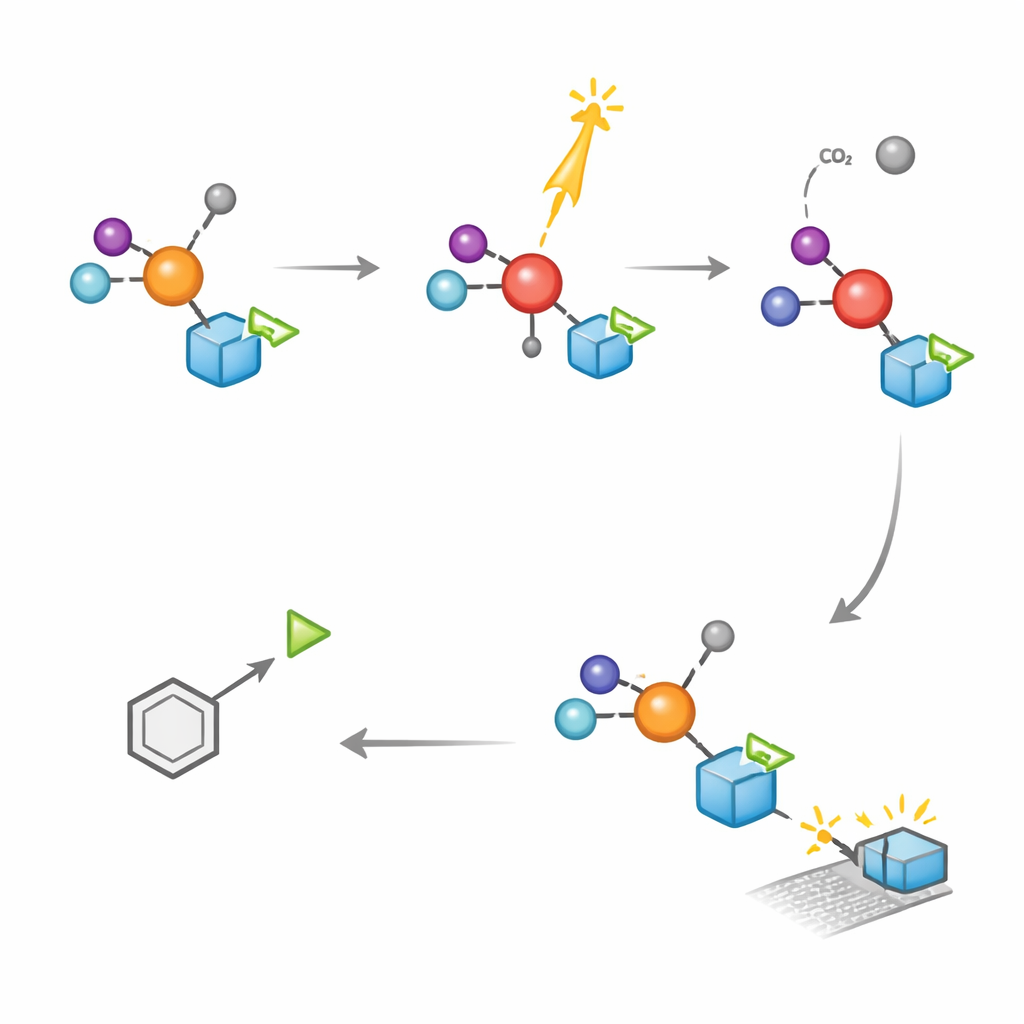
Traditionally, chemists rely on special CF3 reagents that are effective but often costly, sensitive, or hard to scale up. A more attractive source is trifluoroacetate, an abundant and inexpensive material that already contains the CF3 unit. However, freeing CF3 from trifluoroacetates typically demands harsh conditions because these salts are very hard to oxidize. The authors’ earlier work showed that iron complexes activated by light can sidestep this problem: the trifluoroacetate binds directly to iron and, when excited, breaks apart to release a CF3‑bearing fragment that quickly sheds carbon dioxide. That method worked well but still needed a stoichiometric inorganic oxidant to keep the iron catalyst running, creating waste and limiting scalability.
Light, electricity, and iron working together
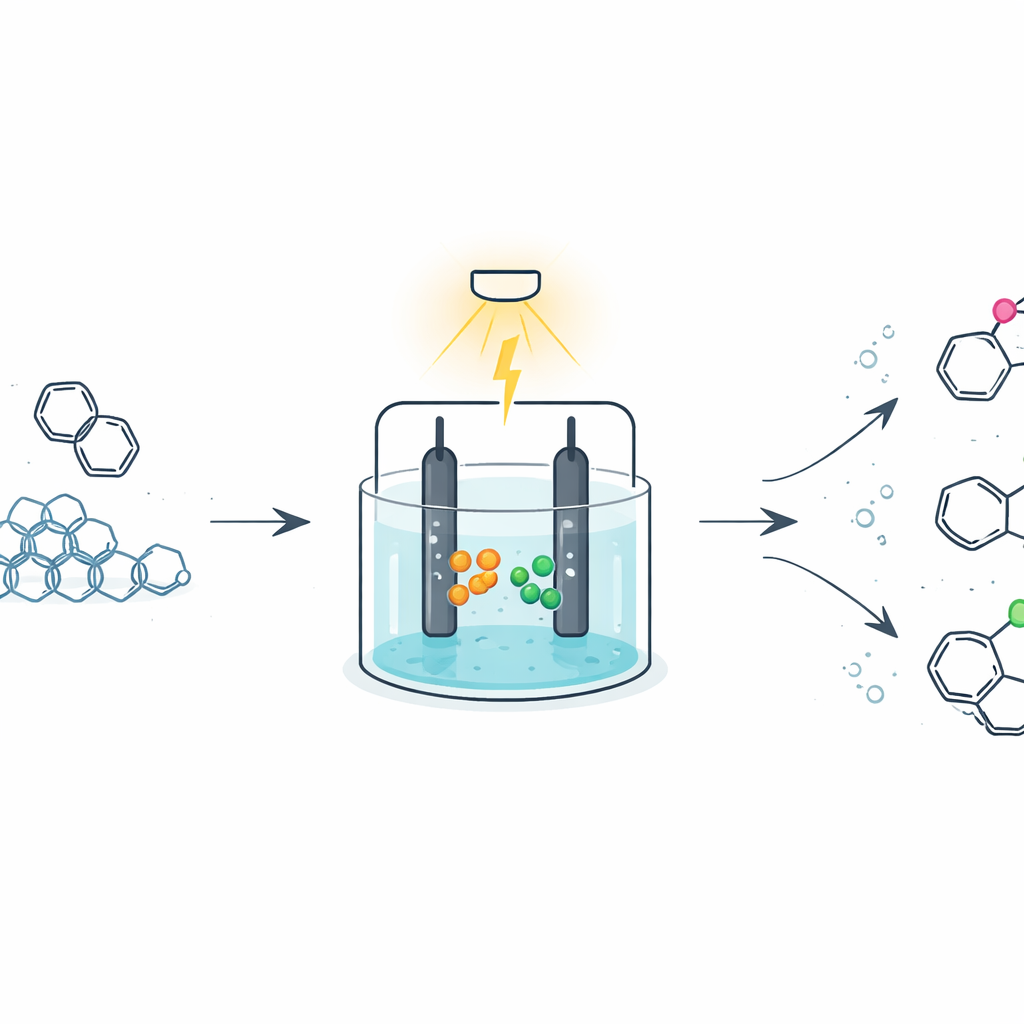
The new approach replaces the sacrificial oxidant with electricity. The team designed a “photoelectrocatalytic” system in which iron plays two jobs at once. Under the reaction conditions, several iron species form in solution. Some of them, after oxidation at the anode, are primed to absorb visible light and trigger the breakup of bound trifluoroacetate into CF3 radicals, which then add to aromatic rings. Other iron species act as redox mediators: they shuttle electrons between less reactive iron complexes and the electrode, ensuring that the pool of photoactive forms is constantly replenished. Careful electrochemical and spectroscopic measurements showed how acid, ligands, and applied voltage steer this network of iron species and confirmed that both the light‑driven step and the electrochemical step are essential.
Reaching challenging and drug‑like molecules
With conditions tuned—moderate temperature, violet light, and a fixed cell voltage in a simple undivided cell—the method cleanly trifluoromethylates a wide range of aromatic and heteroaromatic compounds. Electron‑rich rings that are easily damaged under other oxidative methods, such as pyrroles and indoles, can be modified by dialing down the applied potential. The authors showcase CF3 installation on important building blocks and real molecules, including caffeine, the bronchodilator doxofylline, the muscle relaxant metaxalone, the natural product melatonin, and even the direct, one‑step synthesis of the drug trifluridine from deoxyuridine. In all cases, the only byproducts detected are carbon dioxide and hydrogen gas, highlighting the atom‑economical nature of the process.
Peering under the hood
To understand why the system works so broadly, the researchers mapped how different iron complexes behave under light and voltage. Cyclic voltammetry revealed two key redox couples associated with ligated and non‑ligated iron species, whose stability depends on the presence of trifluoroacetic acid. Light‑absorption studies showed that iron bound directly to trifluoroacetate undergoes rapid photodecarboxylation, especially in its simpler, non‑ligated form. Other iron complexes, rich in bipyridine ligands, proved adept at mediating electron transfer and probably assist the final rearomatization step that restores the aromatic ring after CF3 addition. By correlating reaction yields with electrode potentials and monitoring hydrogen evolution, the team built a coherent picture of how light‑driven bond cleavage and electrochemical turnover are woven together.
Cleaner recipes for future medicines
In practical terms, this work delivers a tunable and scalable recipe for attaching CF3 groups to complex molecules using cheap iron salts and widely available trifluoroacetates, powered by light and electricity instead of heavy oxidants. To a non‑specialist, the key message is that chemists now have a more sustainable way to “upgrade” drug candidates late in development, potentially improving their behavior in the body without redesigning entire syntheses. The dual‑role iron system shows how combining catalysis, photochemistry, and electrochemistry can open cleaner routes to valuable medicines and other functional molecules.
Citation: Fernández-García, S., Cuadros, S., Bosque, I. et al. Dual-role iron species in photoelectrocatalytic radical trifluoromethylation with trifluoroacetates. Nat Commun 17, 2983 (2026). https://doi.org/10.1038/s41467-026-69922-y
Keywords: trifluoromethylation, photoelectrocatalysis, iron catalysis, medicinal chemistry, radical chemistry