Clear Sky Science · en
Idiotype-specific CD4+ T cells chronically stimulate autoreactive B cells to develop into B lymphomas in mice
When Friendly Fire Turns into Cancer
Our immune system normally protects us from infections and rogue cells, but sometimes it misfires and attacks the body itself, causing autoimmune disease. Doctors have long noticed that people with such chronic immune attacks face a higher risk of developing certain blood cancers, especially B cell lymphomas. This paper uses an intricate mouse model to reveal a step‑by‑step chain of events that can link long‑lasting autoimmunity to the later emergence of lymphoma, offering a concrete biological story behind this clinical observation. 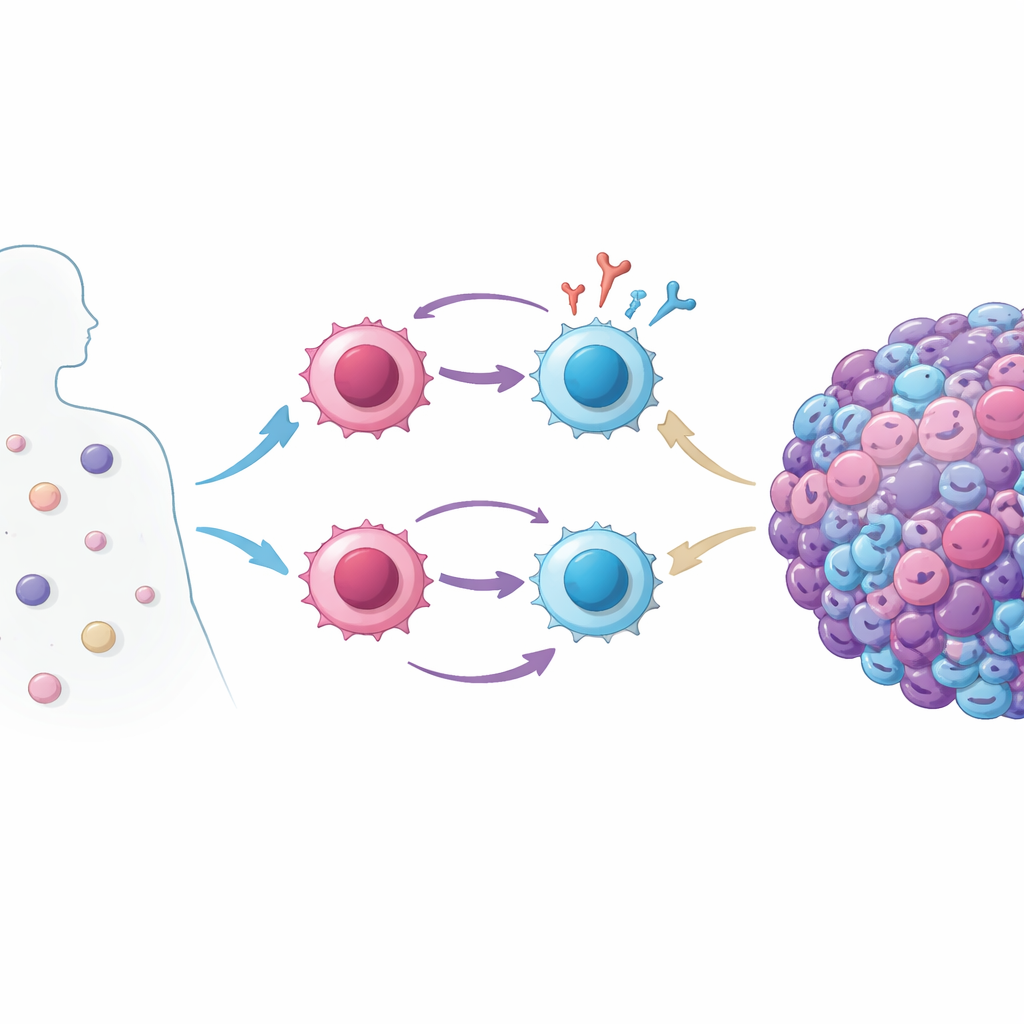
A Special Conversation Between Two Immune Cells
The study focuses on two key immune players: B cells, which make antibodies, and CD4 “helper” T cells, which guide and stimulate other immune cells. In most situations, helpers recognize pieces of invading germs, not pieces of the body. But here the researchers engineered mice so that a small fraction of B cells carried a distinctive, mutated antibody tip, and another group of T cells could recognize a short fragment of that very tip. This creates an unusual closed loop: B cells carry a built‑in “flag” from their own antibody, and helper T cells are wired to see that flag. When such B and T cells meet, the T cells repeatedly stimulate those B cells, not because of an outside infection, but because of this internal, self‑generated signal.
From Mistaken Self‑Attack to Full‑Blown Autoimmunity
In young adult mice that carried both the special B cells and the matching helper T cells, the team observed early signs of immune misdirection. Over time, many of these animals produced autoantibodies—antibodies that bound strongly to components found in the cell nucleus, especially histones and nucleosomes, which package DNA. The blood of affected mice contained patterns of these autoantibodies reminiscent of human conditions like systemic lupus. The response intensified with age, and females were more strongly affected than males, echoing the female bias seen in many human autoimmune diseases. Importantly, both the B cells displaying the special antibody fragment and the matching helper T cells showed high levels of activation and proliferation, suggesting a persistent, self‑reinforcing interaction.
Chronic Stimulation and the Birth of Lymphomas
As the mice aged further, a striking change occurred: between one and two years of life, many developed large tumors in the spleen and lymph nodes. Detailed examination showed that about 60 percent of these were B cell lymphomas that closely resembled major human subtypes such as diffuse large B cell lymphoma and follicular lymphoma. The tumor B cells bore markers of having passed through germinal centers—structures where B cells normally mutate and refine their antibodies during an immune response. Their antibody receptors were of a switched, mature type and often carried mutations and features associated with binding self‑molecules in other autoimmune conditions. Crucially, the researchers could show that the antibody structures on lymphoma cells were closely related to the autoantibodies circulating in the same mouse months earlier, meaning that the cancerous clone likely grew out of an earlier autoimmune B cell. 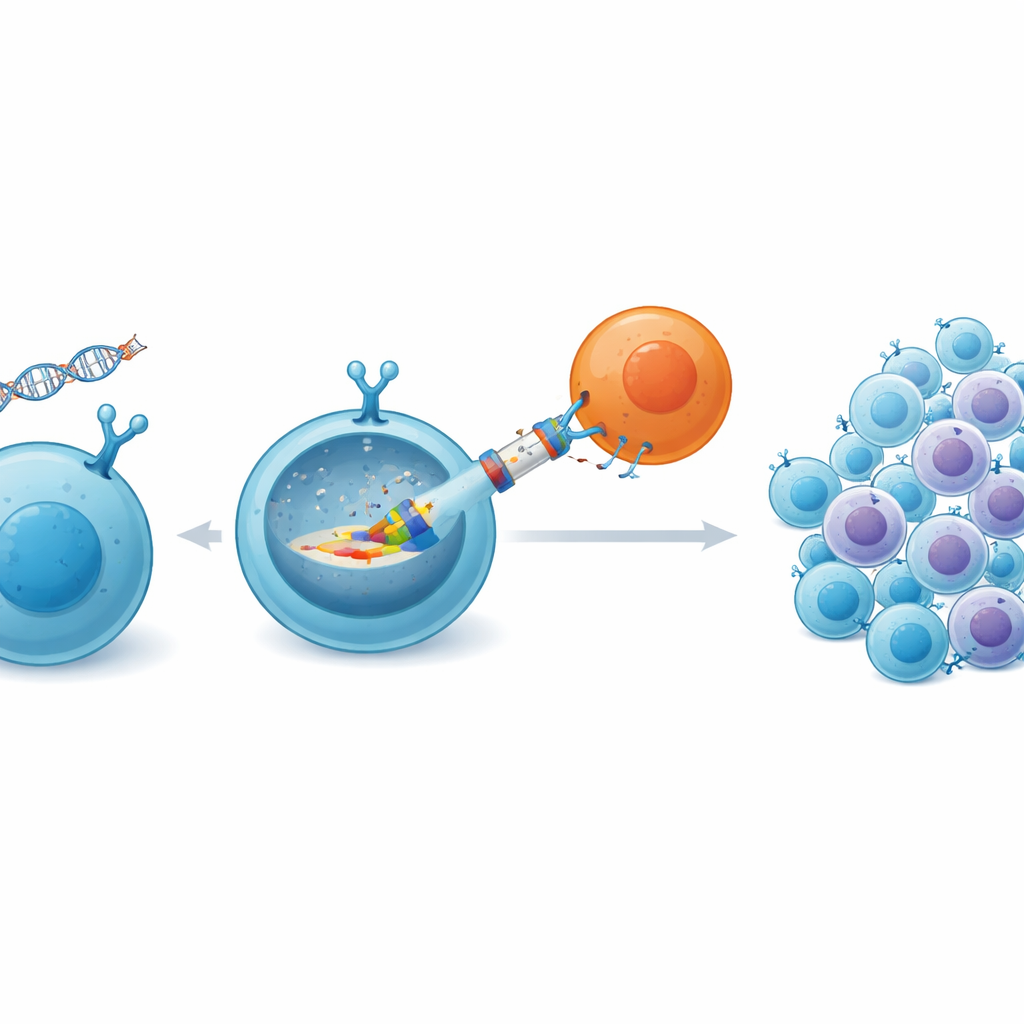
A Two‑Signal Engine That Never Shuts Off
The authors propose that lymphoma arises when two internal “go” signals run together for too long. First, certain B cells recognize ever‑present self‑molecules like histones and nucleosomes, giving them a constant low‑level trigger. Second, because of their uniquely mutated antibody tips, these same B cells present a small piece of their own antibody on their surface, which is seen by the special helper T cells. This second signal delivers strong, repeated help. The result is chronic back‑and‑forth stimulation in germinal centers, with B and T cells pushing each other to divide, mutate, and survive. Over months, this relentless cycle increases the odds that some B or T cells will acquire cancer‑promoting genetic changes and transform into lymphomas. Experiments where the team transferred only the specialized helper T cells into mice carrying the special B cells still led to autoantibodies and B cell lymphomas, underscoring how powerful this two‑signal engine can be.
What This Means for Human Disease
To a lay reader, the key message is that the same misdirected immune dialogue that drives autoimmune disease can also fertilize the ground for cancer. In these mice, B cells that mistakenly target self‑molecules are not acting alone; they are being chronically egged on by helper T cells that recognize a tiny, mutated part of the B cell’s own antibody. This closed loop turns what should be a temporary, controlled response into a long‑lasting spiral of activation and mutation, first producing harmful autoantibodies and later malignant lymphomas. The work suggests that, in humans, targeting this kind of “idiotype‑specific” T‑B collaboration—rather than just dampening broad immunity—might one day help break the link between autoimmunity and B cell cancers.
Citation: Gopalakrishnan, R.P., Ward, J.M., Greiff, V. et al. Idiotype-specific CD4+ T cells chronically stimulate autoreactive B cells to develop into B lymphomas in mice. Nat Commun 17, 3200 (2026). https://doi.org/10.1038/s41467-026-69916-w
Keywords: autoimmunity, B cell lymphoma, T cell help, germinal center, autoantibodies