Clear Sky Science · en
Analysis and control of untemplated DNA polymerase activity for guided synthesis of kilobase-scale DNA sequences
How DNA Makes New Patterns from Scratch
DNA is usually thought of as a faithful instruction book, copied letter-for-letter each time a cell divides. But the enzymes that do this copying turn out to have a playful side: under the right conditions, they can spin out entirely new DNA sequences with no template to follow. This study takes a deep look at that little-known behavior, nicknamed “doodling,” and shows how it might one day be harnessed to build long strands of DNA on demand and to record information about the environments they experience.
The Copying Machines That Also Improvise
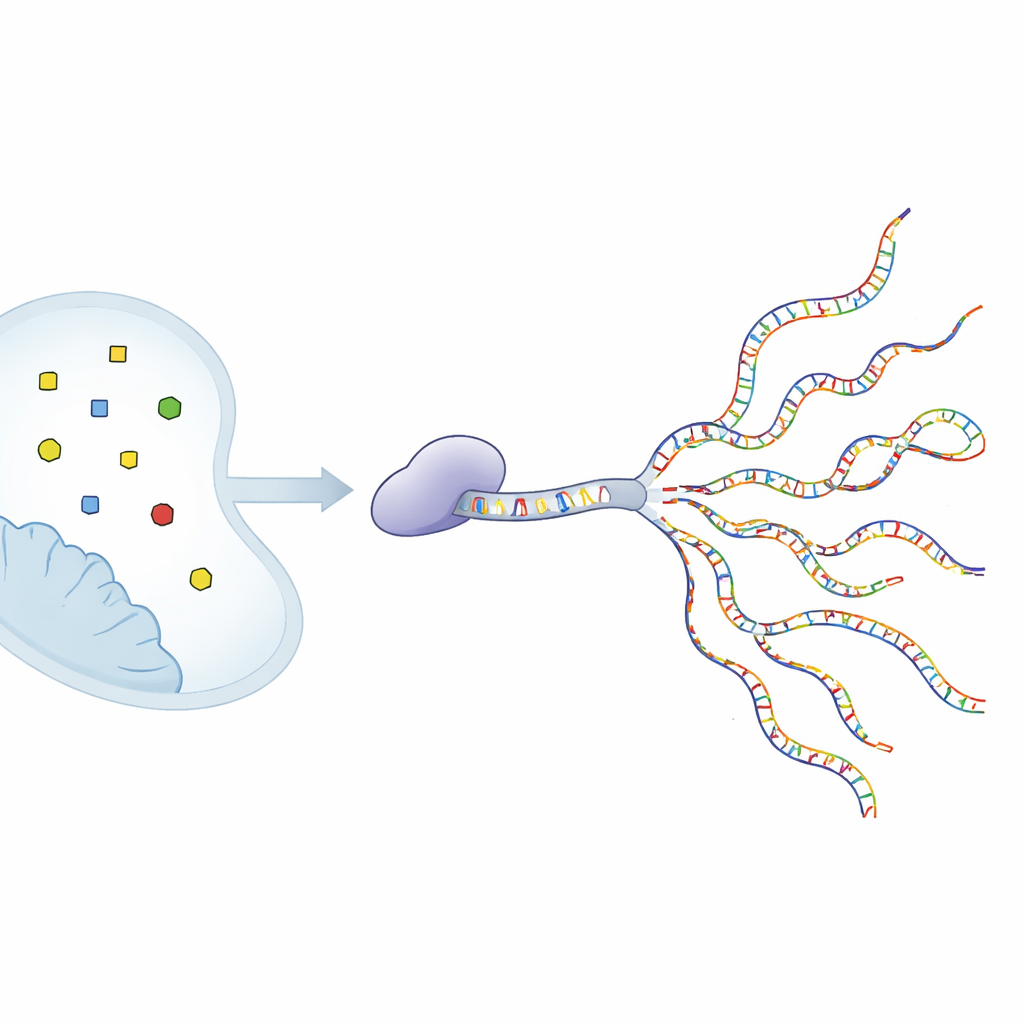
DNA polymerases are the molecular workhorses that normally copy genetic material with high accuracy. Decades ago, researchers noticed that some of these enzymes can also add DNA bases together even when no original strand is present to guide them, creating new genetic material from scratch. Until recently, it was difficult to see what those products really looked like, because older methods only captured a tiny, biased sample of the molecules formed. In this work, the authors used long-read nanopore sequencing, real-time fluorescence measurements, and ultra-detailed atomic force microscopy to watch doodling in action across several natural and engineered polymerases, and under a range of temperatures and chemical conditions.
What the Free-Form DNA Looks Like
By feeding the enzymes only the four basic DNA building blocks and no starting template, the team generated pools of brand‑new DNA fragments, many thousands of bases long. Using nanopore sequencing, they discovered that the resulting strands are far from uniform. Instead, they often contain strong patterns—short motifs of one or two bases repeated over and over, or slightly longer repeated units such as GTATATAC or CTATAG. Different polymerases favored different motifs and produced very different length distributions. For example, the widely used Taq polymerase could generate a substantial fraction of fragments longer than a thousand bases at higher temperatures, while another enzyme, Vent, tended to stall at shorter lengths and produced a different dominant repeat. The patterns suggest that once a repeat emerges by chance, it can fold back and serve as its own mini-template, helping that sequence extend more efficiently than its competitors.
Seeing the Growth and Shape in Real Time
Fluorescence assays, which light up in proportion to the amount of DNA present, revealed that doodling tends to unfold in two stages. First, there is a slow phase where short, mostly random fragments appear. After about half an hour, the reaction suddenly speeds up into a rapid growth phase, consistent with the rise of self‑replicating motifs that can extend themselves much more quickly. Atomic force microscopy added a physical view, showing that many doodled strands are not simple lines but branched structures, where one segment sprouts off another. Some branches likely arise where complementary repeats on a single strand fold into hairpins; others may reflect separate strands that have paired up at matching motifs. Overall, the physical lengths measured by microscopy closely matched the sequencing-based lengths, giving confidence that even very long, tangled products are being accurately characterized.
Tuning the Environment to Steer the Patterns
The researchers then asked how much control they could gain over this free‑form synthesis. By changing temperature, salt levels, and buffer chemistry, they found they could bias which motifs emerged and how long the strands grew. In some minimalist mixtures, the length distribution became narrow and bell‑shaped, as if all strands were growing at similar rates under tight constraints. Limiting which building blocks were present had an even stronger effect: giving Taq polymerase only adenine and thymine, for instance, drove the system to produce very long strands dominated by orderly blocks of A’s and T’s. Seeding reactions with short, specially designed “self‑amplifying” DNA pieces also proved powerful. When multiple seed types were mixed together, subtle differences in their sequences led to very different degrees of amplification at different temperatures, creating a kind of chemical fingerprint of the conditions encoded in the final pool of DNA.
Why Template-Free DNA Matters
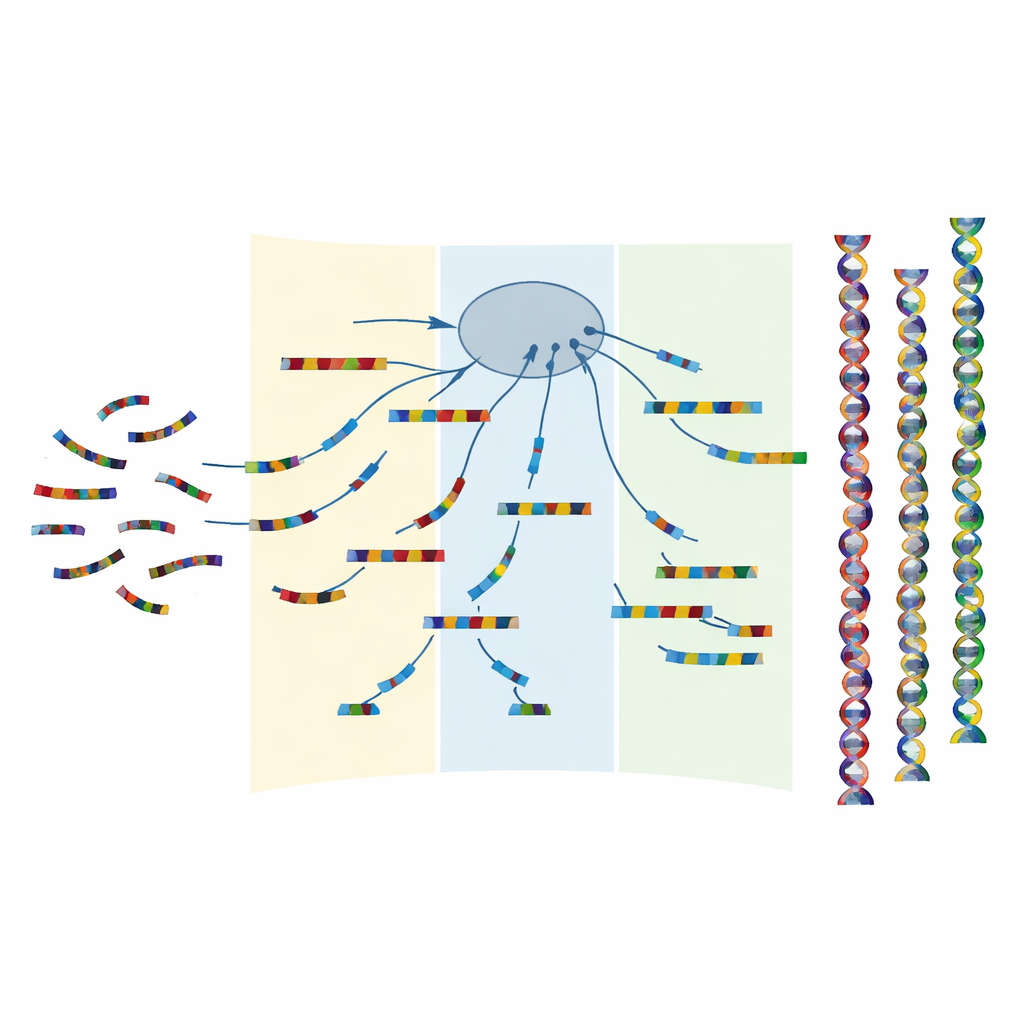
Together, these findings show that DNA polymerases are not just copiers but generators of new sequence diversity, shaped by their own intrinsic preferences and by the environment around them. In practical terms, this opens the door to using doodling as a tool: for rapidly producing long, single‑stranded DNA of controlled overall composition, for building difficult repetitive sequences that current synthesis methods struggle with, or even for encoding time‑varying signals into DNA as a durable molecular record. Although we are still far from writing precise kilobase‑length messages this way, understanding and controlling this improvisational side of DNA chemistry could eventually give biologists a new, cleaner, and potentially very scalable route to building and probing genomes.
Citation: Castle, S.D., Irvine, T.C.T., Woolfson, A. et al. Analysis and control of untemplated DNA polymerase activity for guided synthesis of kilobase-scale DNA sequences. Nat Commun 17, 3251 (2026). https://doi.org/10.1038/s41467-026-69915-x
Keywords: DNA polymerase, template-free DNA synthesis, nanopore sequencing, self-replicating DNA motifs, synthetic genomics