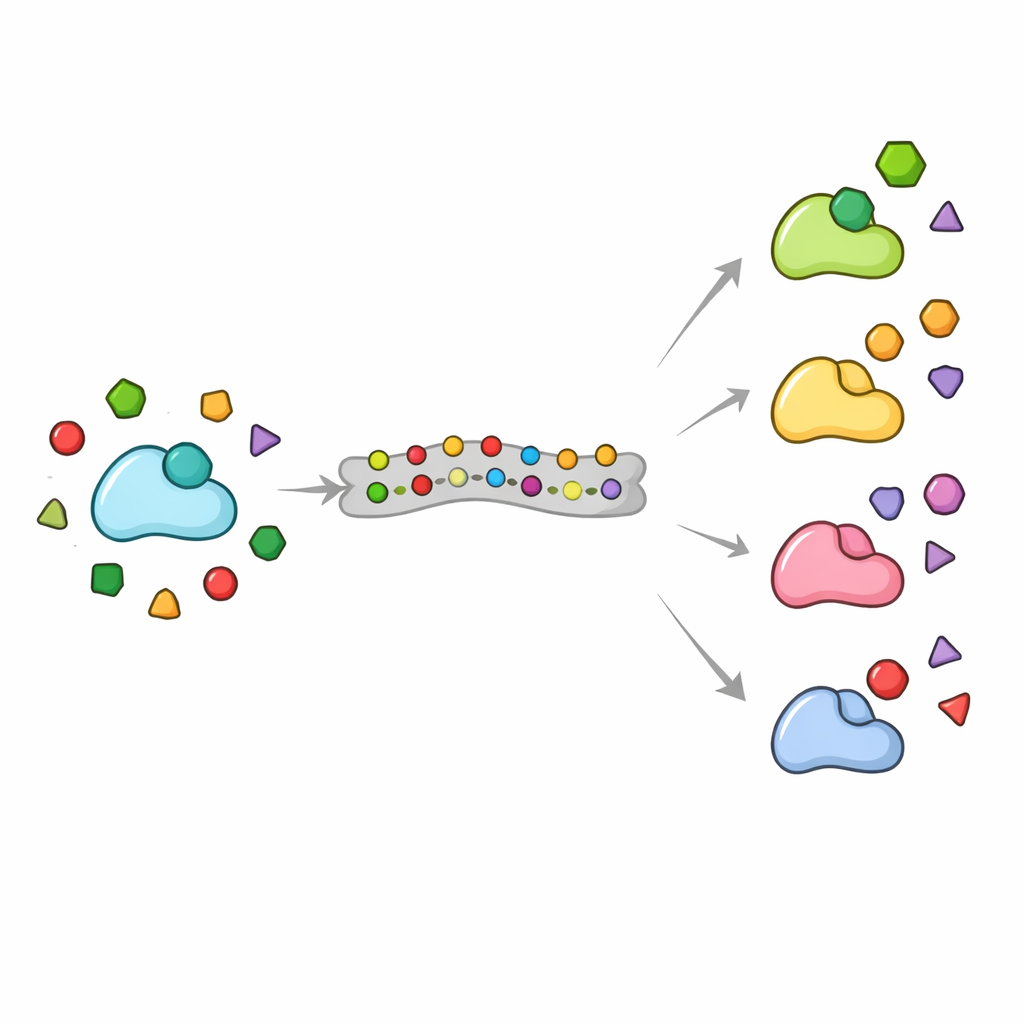
From brewing beer to cleaning up pollutants and powering new medicines, enzymes are the tiny molecular machines that make modern biotechnology possible. Yet many enzymes are picky: they work well on one chemical but barely touch close relatives. Others are more flexible, processing a whole family of similar molecules. This study asks a deceptively simple question with big implications: how do small genetic changes turn a “generalist” enzyme that accepts many inputs into a “specialist” that prefers just one—and how can we deliberately steer that transformation?
Exploring a shape-shifting enzyme
The researchers focused on a naturally promiscuous enzyme called D-amino acid oxidase (DAOx), which helps break down building blocks of proteins. This enzyme already acts on several related D-amino acids that differ subtly in size and water-loving or water-fearing character. Such versatility makes DAOx attractive for industrial chemistry and potential cancer therapies, but it also raises a mystery: what, exactly, in the enzyme’s structure decides which of these look-alike molecules it favors? Traditional structural biology offers static snapshots, but they do not easily reveal how thousands of possible mutations scattered across the enzyme alter its preferences.
A high-throughput enzyme test bed Figure 1.
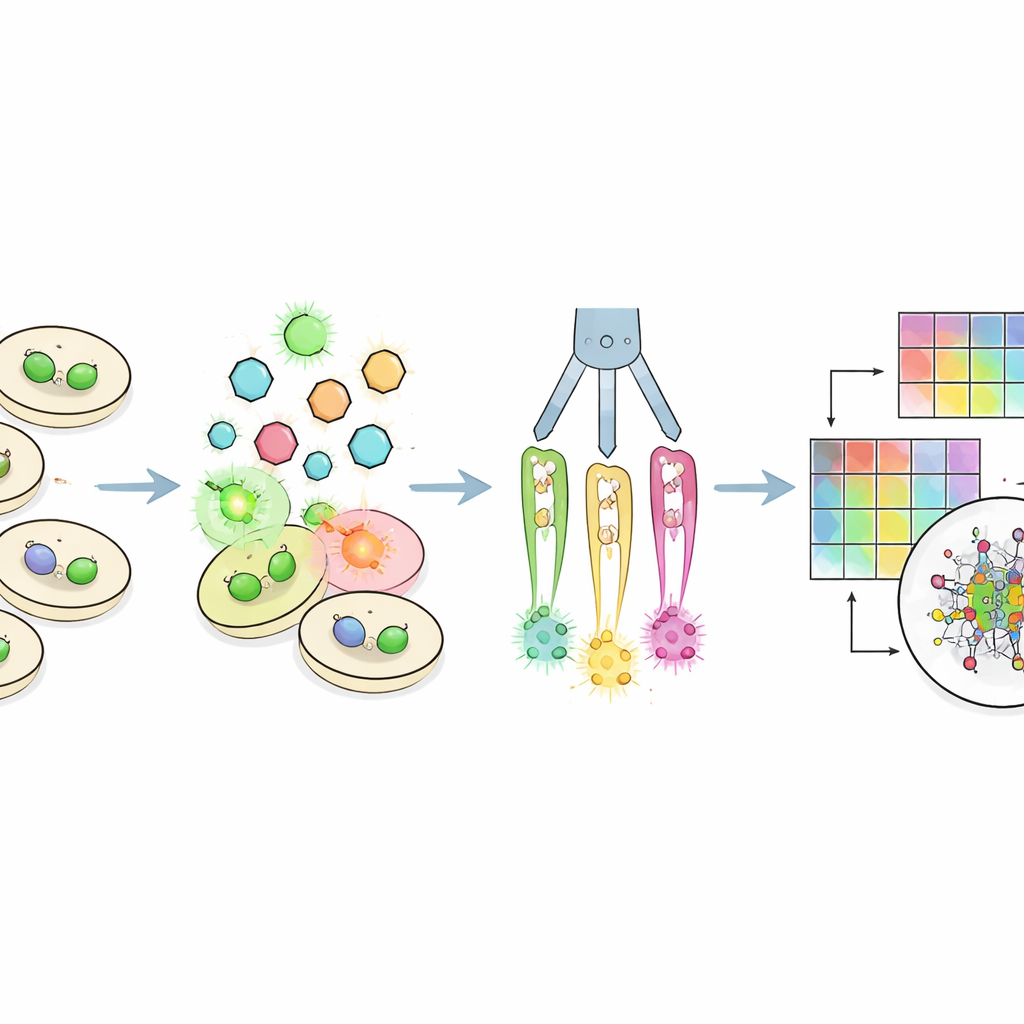
To tackle this challenge, the team used a platform they previously developed called enzyme proximity sequencing (EP-Seq). In this system, each variant of DAOx is displayed on the surface of a yeast cell. When the enzyme processes its substrate, it generates hydrogen peroxide, which triggers a chemical reaction that fastens fluorescent tags onto the same cell’s surface. Brighter cells contain more active enzyme. Using a cell-sorting machine, the scientists separated millions of cells into bins based on brightness for each of five different D-amino acid substrates. They then sequenced DNA barcodes to learn which mutations were present in each bin, translating fluorescence into a quantitative “fitness” score for how well each mutant enzyme handled each substrate.
Mapping the landscape of specificity
This approach produced around 40,000 measurements covering about 6,500 unique DAOx variants, each tested on five substrates. By comparing performance across substrates, the researchers defined a “specificity score” that captures how strongly a mutation tilts the enzyme toward one substrate and away from another. Surprisingly, mutations that alter substrate choice were not confined to the active site where chemistry occurs; instead, they were spread across nearly half of the enzyme’s positions. Changes right next to the active site caused dramatic shifts in preference but often slowed the overall reaction, while more distant changes gently tweaked preferences with only modest effects on activity. This reveals two distinct paths to specificity: bold reshaping of the catalytic pocket at a cost, or subtle long-range tuning that preserves function.
How size and charge shape choices Figure 2.
Diving deeper, the team measured traditional kinetic parameters for hand-picked mutants and compared them to their high-throughput scores. They found strong agreement, confirming that their specificity metric truly reflects how efficiently each enzyme variant processes different substrates. Many of the most selective mutants work by excluding the “wrong” molecules rather than gripping the “right” one more tightly. For example, adding bulk at the entrance to the substrate tunnel favored the smallest substrate, D-alanine, by blocking larger ones. Other mutations changed local electrical charges to better welcome water-loving substrates like D-asparagine and D-glutamine while discouraging hydrophobic ones. Remarkably, some mutations far from the active site acted like hidden dials, subtly reshaping internal contacts to bias substrate choice without major damage to activity.
Building better catalysts from modular changes
Because many mutations affected specificity in complementary ways, the researchers next asked whether combining them could create highly tuned enzymes. In several cases, pairing two mutations that each nudged the enzyme toward a particular substrate produced an even sharper specialist, sometimes boosting preference more than 200-fold compared with the original enzyme. One variant became essentially exclusive for D-glutamine, a substrate that the wild-type enzyme barely touches. Other combinations steered DAOx to favor bulky hydrophobic substrates or small ones, depending on how steric crowding and charge were jointly adjusted. These results show that specificity can be engineered in a modular fashion by stacking mutations whose effects add up or reinforce one another.
What this means for future enzyme design
In simple terms, this work turns a messy problem—predicting how countless possible mutations change what an enzyme likes to eat—into a measurable landscape. By systematically linking enzyme activity to DNA sequence, the EP-Seq platform reveals which protein sites act as major switches of substrate choice and which serve as fine-tuning knobs. The study demonstrates that it is often easier, both in evolution and in the lab, to make enzymes more selective by blocking unwanted reactions than by dramatically boosting desired ones. This insight, together with the large, publicly available dataset, provides a roadmap for designing bespoke biocatalysts and for training artificial intelligence models to predict and engineer enzyme specificity with far greater confidence.
Citation: Vanella, R., Boult, S., Küng, C. et al. Decoding the substrate specificity landscape of a promiscuous enzyme through multi-substrate mutational scanning.
Nat Commun17, 3245 (2026). https://doi.org/10.1038/s41467-026-69913-z