Clear Sky Science · en
Ground-truth encoding of self-motion in the primate cerebellar nodulus and uvula
How the Brain Knows When You Move
Every time you turn your head, stand up, or ride in a car, your brain must figure out exactly how you are moving and how your body is tilted relative to gravity. That internal sense of motion keeps your eyes steady, your balance intact, and your blood pressure regulated when you change posture. This study asks a surprisingly basic question: is there a part of the brain that simply reports how you are really moving, regardless of whether you moved on purpose or were pushed by the outside world?
A Small Brain Region with a Big Job
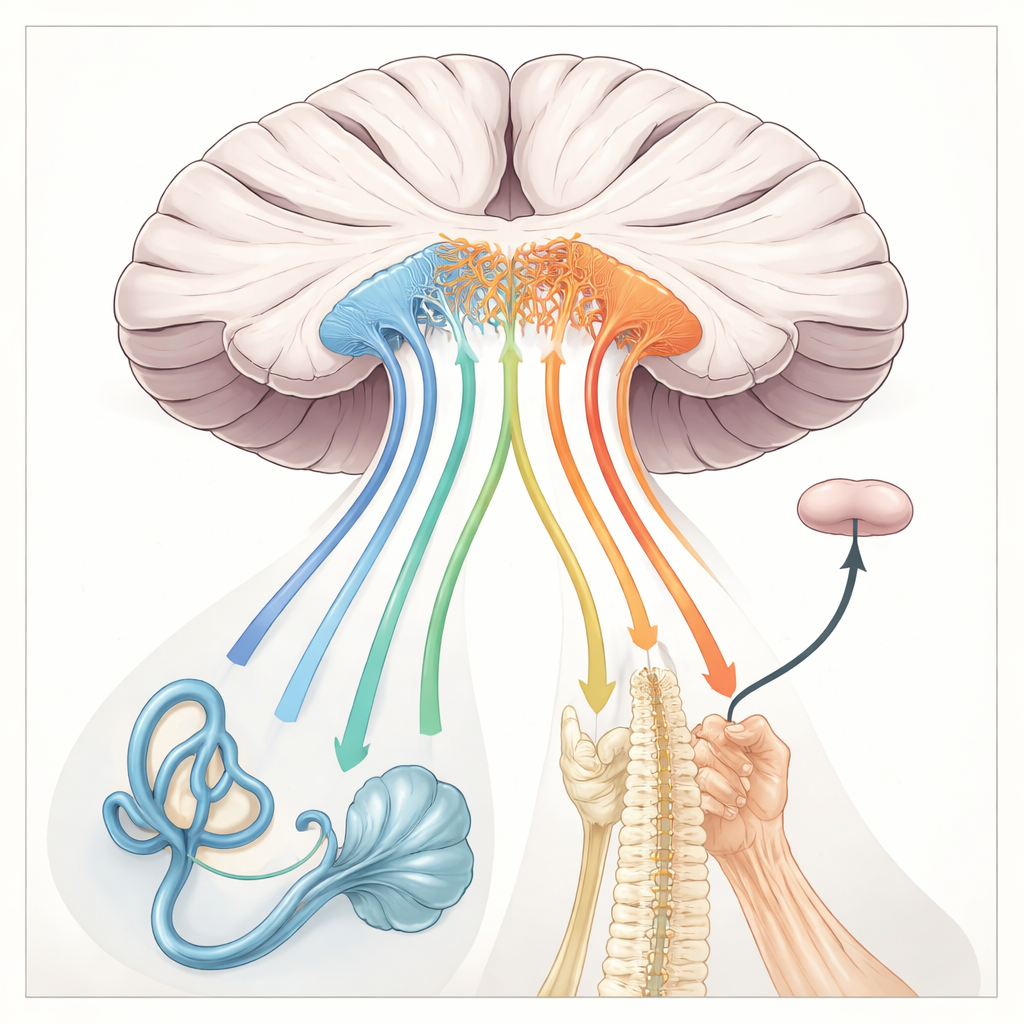
Deep in the back of the brain lies a tiny strip of tissue called the nodulus and uvula, part of the cerebellum. It receives signals from the inner ear balance organs and from sensors in the neck and body. Traditional theories have suggested that this region uses an internal prediction system to cancel out the expected sensory signals produced by our own voluntary movements, highlighting only unexpected disturbances. But everyday life also demands a steady picture of how the body is moving and how it is oriented with respect to gravity. The authors set out to test whether the nodulus and uvula really behave like a prediction-based filter, or whether instead they act as a “ground-truth” meter of self-motion.
Watching Individual Brain Cells During Motion
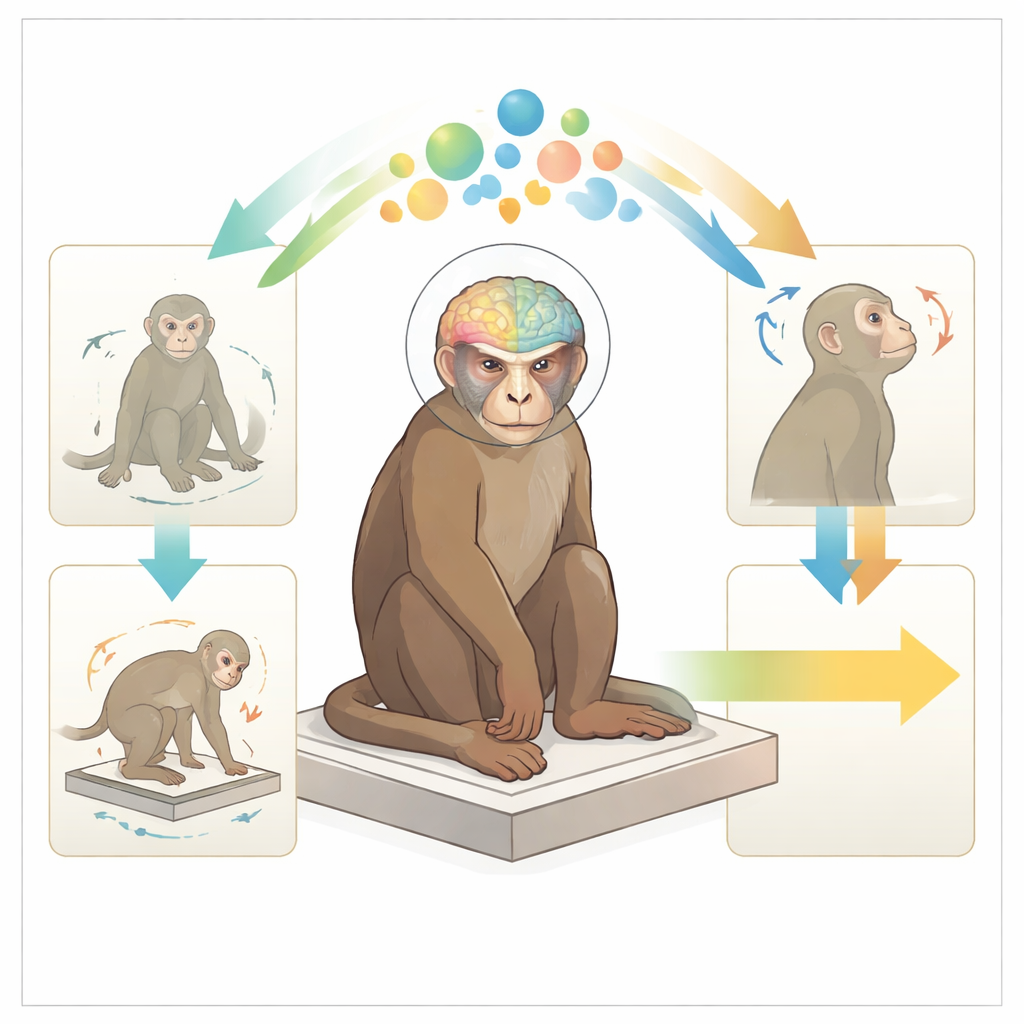
The researchers recorded the electrical activity of single Purkinje cells, the main output neurons of this cerebellar region, in two rhesus monkeys. They compared responses when the animals were moved passively by a motion platform with responses when the monkeys actively moved their own heads for a reward. The team examined straight-line translations, such as sliding forward and backward, as well as head tilts that change orientation relative to gravity. By carefully matching the speed and timing of active and passive movements, they could ask whether these neurons changed their behavior depending on who “caused” the motion—the monkey or the machine.
Same Signal Whether You Move or Are Moved
Across many cells, Purkinje activity during self-generated movements closely matched activity during equivalent passive movements. Neurons that responded strongly to being slid forward or backward fired just as strongly when the monkey made the same motion voluntarily. When active and passive movements were combined, the cells encoded the total motion of the head in space, adding the two components together rather than preferring one over the other. Crucially, when the monkeys tried to move their heads but the researchers quietly locked the apparatus so the head could not move, the cells did not change their firing, even though motor commands were clearly being sent to the neck muscles. This shows that these neurons are driven by actual sensory motion, not by copies of outgoing motor commands.
Keeping Track of Gravity All the Time
The inner ear’s gravity sensors respond in the same way to being tilted and to being accelerated in a straight line, so the brain must combine several signals to work out which is which. The nodulus and uvula are known to receive information from both the semicircular canals (which detect rotation) and the gravity‑sensitive organs. In this study, Purkinje cells encoded both the swinging motion of head tilts and the final static head position relative to gravity. Strikingly, their responses were almost identical whether a tilt was imposed passively or produced by the monkey’s own effort. Even when the head was held motionless at an up‑or‑down angle, firing rates were the same regardless of how that posture had been reached. This stable behavior contrasts with nearby cerebellar regions that do suppress signals during active movement.
Why a Ground-Truth Motion Meter Matters
Taken together, the results show that the nodulus and uvula do not primarily cancel out expected self‑generated motion. Instead, they provide a steady, context‑independent description of how the head and body are really moving in space and how they are oriented relative to gravity. This ground‑truth estimate can feed into systems that control eye movements, posture, alertness, and automatic adjustments of heart and breathing during posture changes. Other cerebellar areas may still specialize in filtering out predictable signals to fine‑tune reflexes, but this small region appears dedicated to telling the rest of the brain, as reliably as possible, “this is how you are actually moving right now.”
Citation: Mildren, R.L., Cullen, K.E. Ground-truth encoding of self-motion in the primate cerebellar nodulus and uvula. Nat Commun 17, 3166 (2026). https://doi.org/10.1038/s41467-026-69909-9
Keywords: self-motion, cerebellum, vestibular system, balance, gravity