Clear Sky Science · en
Drift-free ferroelectric photodetection with fast temporal response via thermal diffusion engineering
Why faster, cooler light sensors matter
From smartphone cameras to self-driving cars and wearable health monitors, modern life depends on devices that turn light into electrical signals. Many of these photodetectors need an external power supply and can struggle with speed and stability when operated continuously. This study explores a class of self-powered light sensors made from ferroelectric materials—crystals that naturally separate electric charges—and shows how simply reshaping the way heat flows through the device can make them dramatically faster, more stable, and better suited for future imaging and neuromorphic vision systems.
A special kind of light-sensitive material
Conventional photodetectors rely on semiconductor junctions and applied voltages to generate current, which adds complexity and power consumption. Ferroelectric thin films offer an appealing alternative. When illuminated, their built-in electric fields can pull apart charges and create a voltage even without an external bias. The material at the heart of this work, bismuth ferrite (BiFeO3), absorbs visible light and maintains its ferroelectric behavior at room temperature, making it attractive for flexible imaging, optical communication, and brain-inspired electronics. Yet in practice, devices based on these films often respond slowly and show “drift,” where the output current keeps creeping upward under constant light instead of settling to a stable value.
The hidden problem of trapped heat
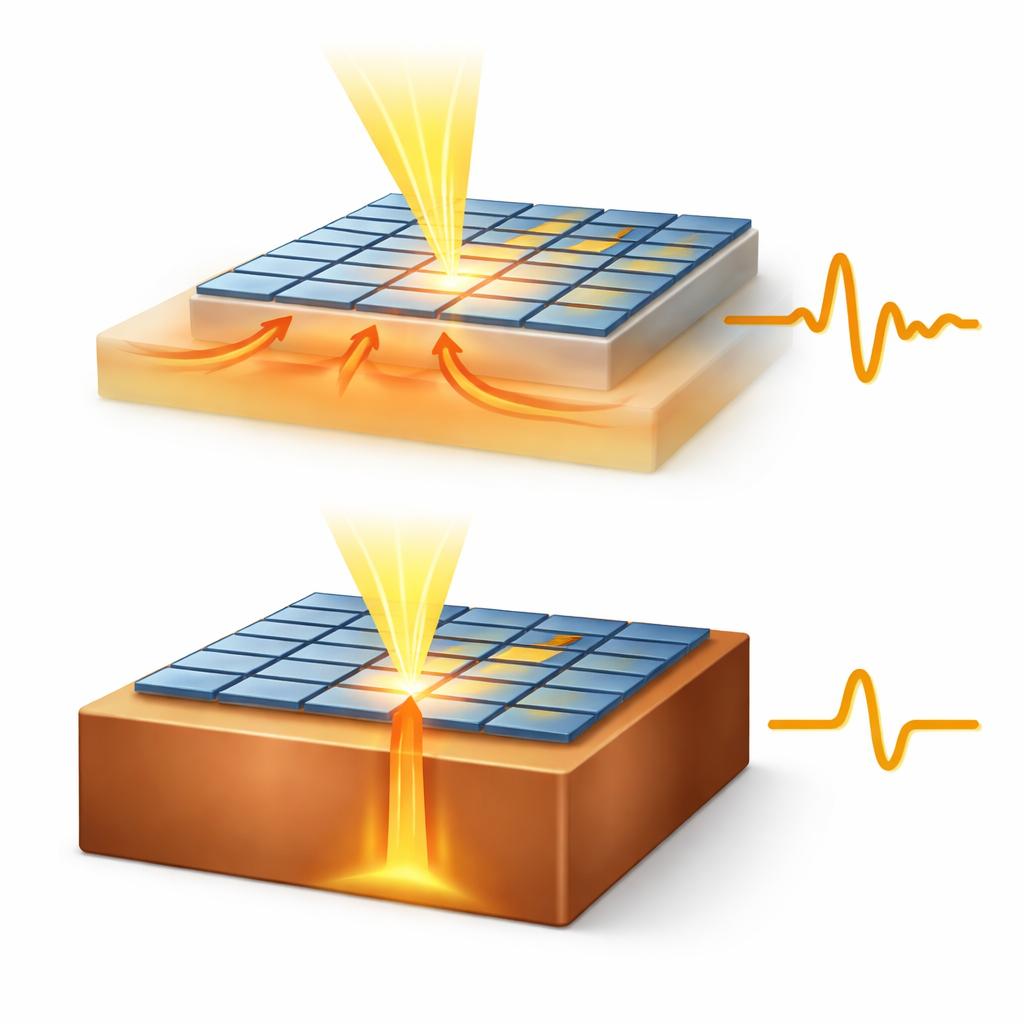
The authors trace these performance issues to an overlooked culprit: heat. Most ferroelectric devices are built on glassy or mica substrates that are excellent electrical insulators but poor thermal conductors. When light shines on the device, some of its energy turns into heat that cannot easily escape. This heat spreads sideways within the thin film, raising its temperature over time. As the device warms, more charge carriers are activated thermally, leading to artificial gain and a slow, drifting photocurrent. Time-resolved measurements on a conventional BiFeO3 device show that under pulsed illumination the current can more than triple during a single “on” period and takes well over a second to rise, far slower than the intrinsic electronic timescale of the material.
Redesigning the thermal pathway
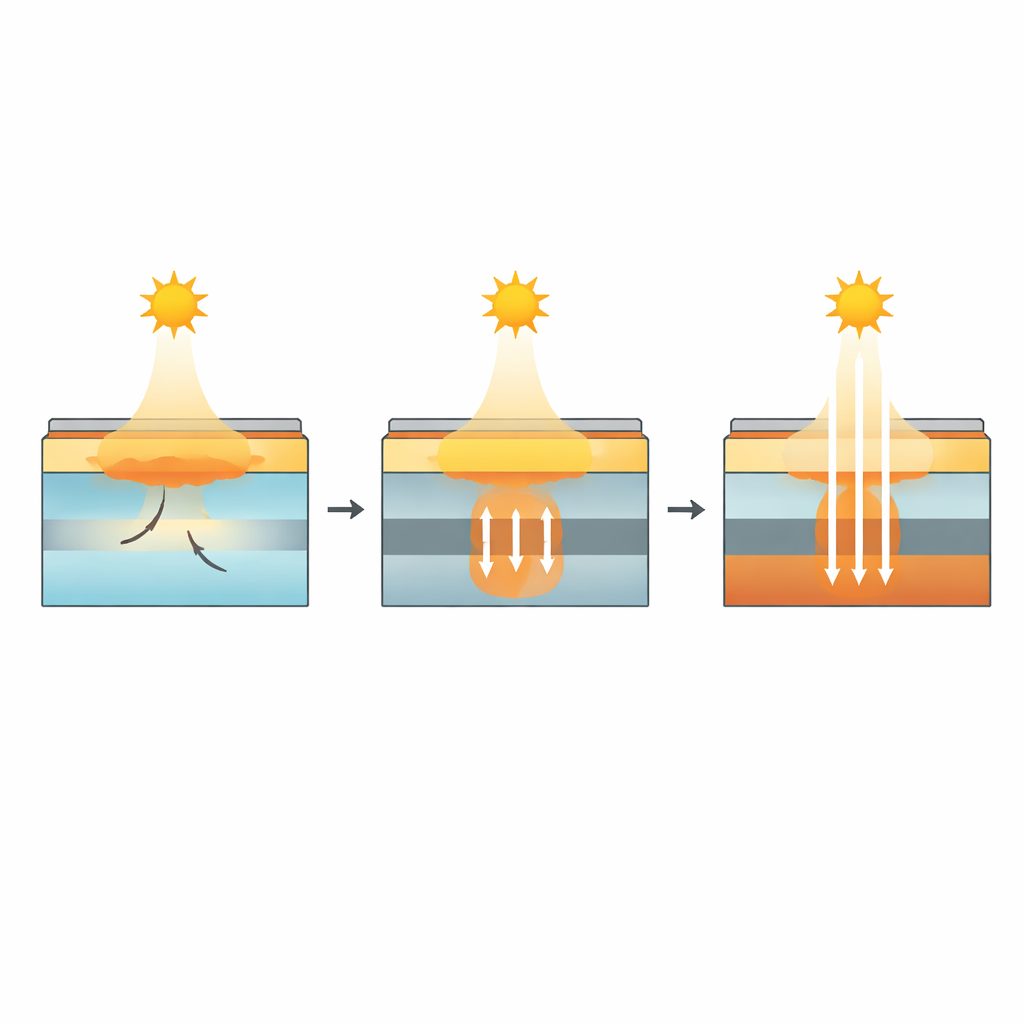
To solve this, the researchers did not change the light-absorbing film or the electrodes. Instead, they re-engineered the thermal environment by placing the same ferroelectric stack onto a plate of copper, a metal that conducts heat extremely well. This simple change encourages heat to flow vertically down into the metal rather than laterally across the device. In the copper-backed architecture, the response time improves by more than three orders of magnitude, dropping to the millisecond and even sub-millisecond range, while the photocurrent drift is almost completely eliminated. Frequency-domain tests confirm that the detector can operate cleanly up to several kilohertz, and long-term cycling over tens of hours shows that the signal amplitude stays within a few percent of its initial value.
Seeing heat flow and proving it is general
To confirm that heat management is indeed the key, the team combined infrared thermal imaging, direct temperature measurements, and computer simulations. Devices on low-conductivity supports reached temperatures more than 30 degrees above room temperature and displayed broad, circular hot spots, evidence of lateral heat spreading. In contrast, copper-backed devices stayed much cooler and showed tightly confined hot regions directly under the illuminated spot. Simulations using a heat-transfer model reproduced this behavior, revealing strong vertical heat extraction in the metal-supported design. When the researchers repeated the same thermal-diffusion strategy with a range of other ferroelectric materials—such as lead titanate and barium titanate—they saw similar reductions in drift and faster responses, underscoring that the approach is broadly applicable rather than tied to a single compound.
Sharper images with less signal spillover
Thermal control also improves how clearly these devices can “see” patterns of light. In arrays of ferroelectric pixels, unwanted lateral heat flow can generate false signals in neighboring, shaded regions, blurring the image. The authors demonstrated this by projecting simple X- and Z-shaped light patterns through masks onto both conventional and copper-backed arrays. In the standard configuration, masked pixels still produced noticeable signals, indicating strong thermal crosstalk. The drift-free architecture, however, confined the response almost entirely to the illuminated pixels, yielding much sharper patterns. A quantitative analysis of how far the signal spreads from a bright line showed roughly a seven-fold improvement in spatial confinement for the thermally engineered design.
What this means for future devices
This work shows that for advanced light sensors, controlling heat can be just as important as tailoring electronic or optical properties. By giving heat an efficient vertical escape route through a metal substrate, the researchers turned a slow, drifting ferroelectric photodetector into a fast, stable, and self-powered device. Because the method does not depend on a particular material recipe, it offers a practical path toward scalable, low-power photodetector arrays suitable for wearable imaging, neuromorphic vision, and other applications where both speed and long-term signal fidelity are essential.
Citation: Minhas, J.Z., Qian, W., Xu, L. et al. Drift-free ferroelectric photodetection with fast temporal response via thermal diffusion engineering. Nat Commun 17, 3287 (2026). https://doi.org/10.1038/s41467-026-69908-w
Keywords: ferroelectric photodetector, thermal management, BiFeO3, self-powered imaging, neuromorphic vision