Clear Sky Science · en
Extreme longitudinal thermal conductivity and non-diffusive heat transport in isotopic hBN
Why moving heat in flat crystals matters
As our phones, computers, and future quantum gadgets get smaller and more powerful, getting heat out of tiny circuits becomes a central engineering challenge. This study explores an unusual, ultrathin crystal called hexagonal boron nitride (hBN) that can carry heat along its surface extremely well while remaining an excellent electrical insulator. By watching how heat actually flows through suspended strips of nearly perfectly purified hBN, the authors uncover both record‑high heat conduction and surprising behavior that breaks the usual rules taught in textbooks.
A flat heat highway made of clean atoms
Every solid carries heat using vibrations of its atoms, known as phonons. In most cases, these vibrations behave like a crowd of people bumping into each other at random, leading to a smooth, predictable temperature gradient from hot to cold. The team focused on a special version of hBN made almost entirely of one boron isotope (10B), which reduces random mass disorder in the crystal. This cleaner atomic structure lets phonons travel farther before scattering, turning the material into a kind of heat superhighway. Because hBN is also a strong electrical insulator, it is an attractive candidate for safely pulling heat away from delicate electronic and optical devices without conducting electricity.
Building a tiny heat bridge and taking its temperature
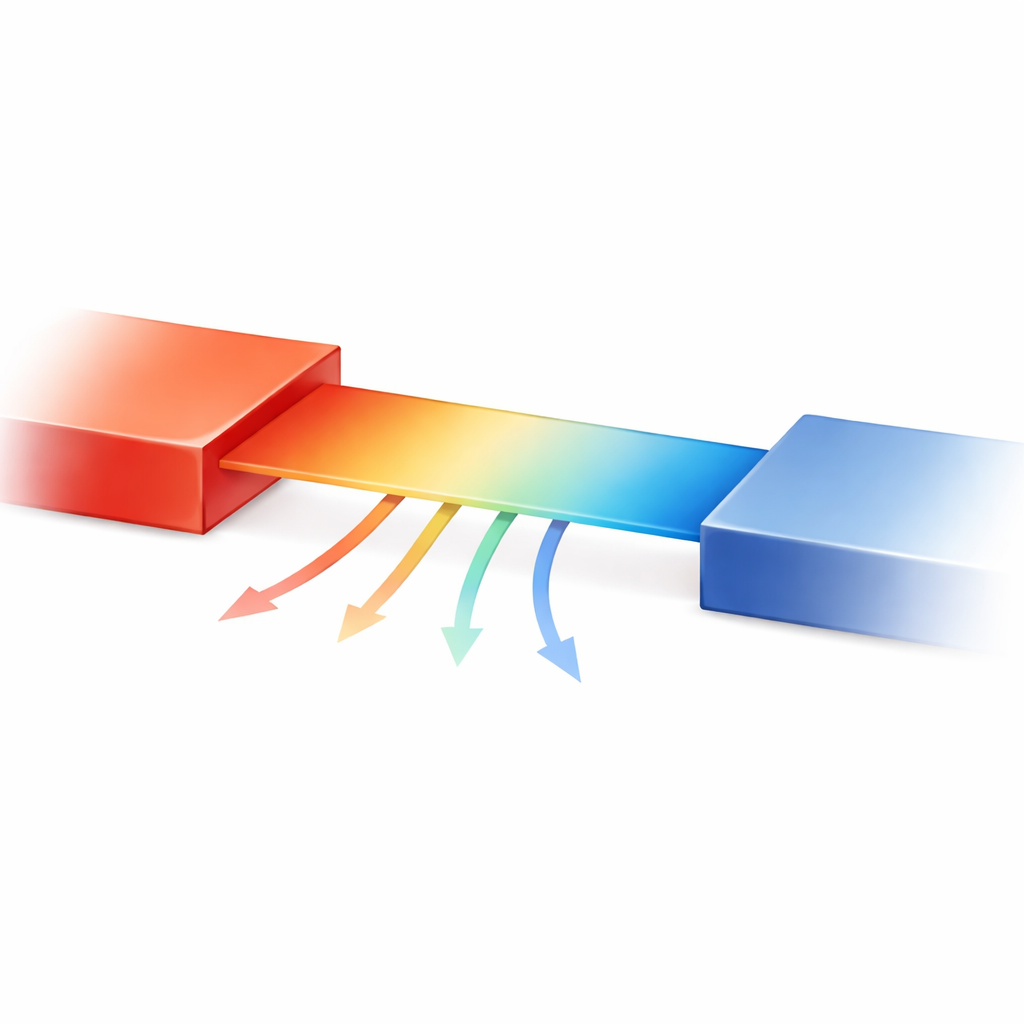
To probe how well this material moves heat, the researchers built microscopic bridges: two silicon "arms" face each other across a small gap, and a thin heterostructure of hBN with a single‑layer semiconductor (WSe2) is suspended between them. One silicon arm is electrically heated, creating a hot side, while the opposite arm stays cooler and acts as a heat sink. The team then scans a focused laser across the device and reads tiny shifts in the color of the scattered light (Raman spectroscopy), which depend sensitively on temperature. Clever calibration shows that the WSe2 layer serves as an accurate thermometer for the much thicker hBN beneath it, allowing them to reconstruct detailed temperature maps along and across the suspended strip.
How many temperature points you really need
Heat‑flow measurements in nanostructures are notoriously easy to misinterpret, especially when only a couple of temperatures are recorded. The authors first validate their method on thin graphite and then on their hBN‑based devices, comparing experimental temperature profiles to detailed computer simulations. They demonstrate that using only two measurement points can miss important effects, particularly at the contacts and interfaces. A six‑point strategy, combined with finite‑element modeling, is enough to capture the full temperature landscape and reliably extract the in‑plane thermal conductivity. With this refined approach, they report an exceptionally high thermal conductivity of about 1650 W·m⁻¹·K⁻¹ at room temperature for suspended monoisotopic hBN—higher than most earlier values and comparable to some of the best heat‑carrying materials known.
When heat stops behaving like simple diffusion
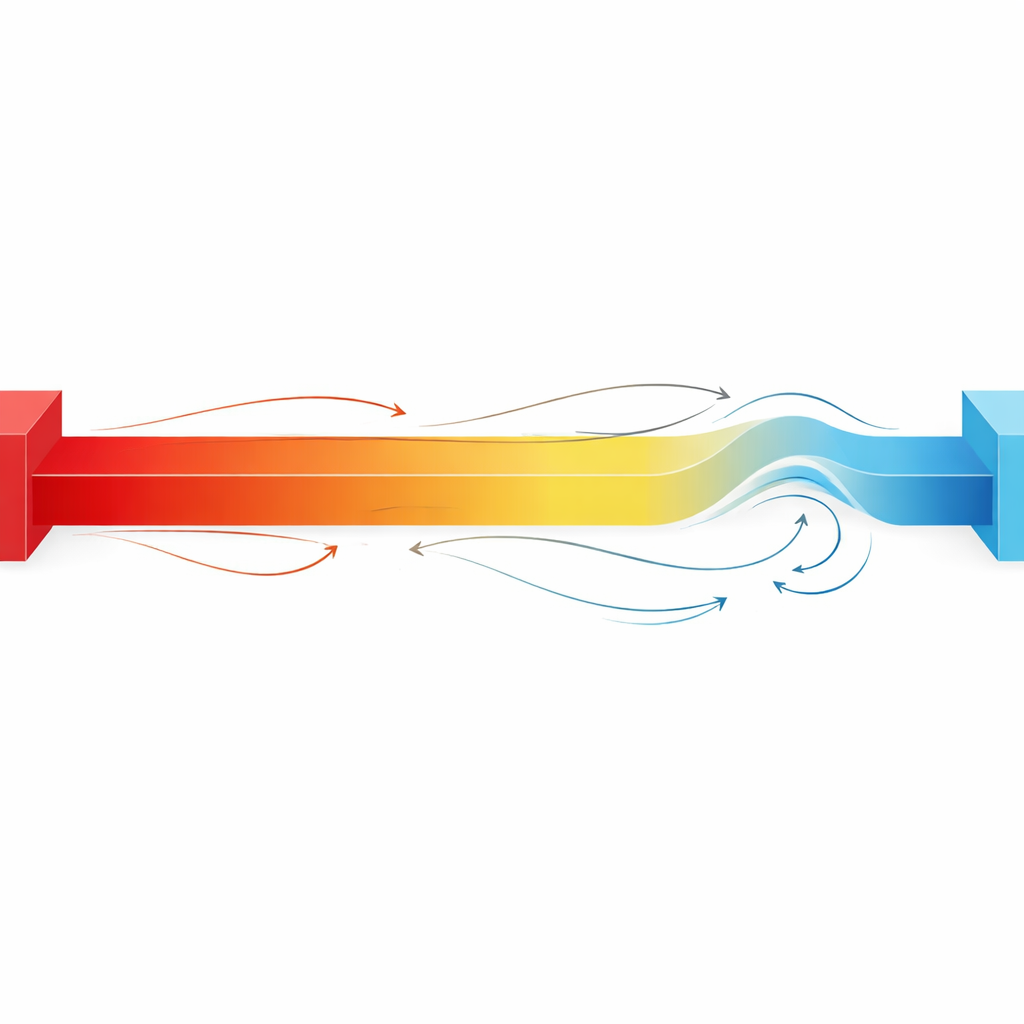
Once the technique was established, the authors pushed it into more extreme conditions by using thinner hBN flakes and larger temperature differences along the bridge. At higher overall temperatures, the temperature profile along the suspended region is almost a straight line, just as ordinary diffusion theory (Fourier’s law) predicts. But as they lower the hot‑spot temperature into a certain range, the profile warps: large sections of the strip sit at nearly constant temperature and then drop sharply over very short distances, sometimes even becoming cooler than the nearby contact. Similar anomalies appear across the width of the flake, where temperature peaks near the edges instead of in the center. These shapes cannot be explained if heat simply diffuses like ink in water; instead, they suggest that phonons begin to move collectively, in a hydrodynamic‑like fashion, where local heat flow and effective conductivity depend on position and geometry.
What this means for future cool electronics
By directly mapping temperature with high spatial resolution, this work shows that suspended, isotopically pure hBN can carry heat extremely efficiently while simultaneously supporting non‑classical, non‑diffusive heat transport. For everyday device designers, the main takeaway is that the usual single‑number thermal conductivity can fail in carefully engineered two‑dimensional materials—heat may not spread in straight, predictable lines. For the broader community, these findings argue that new theories are needed to describe how heat flows when phonons act more like an organized fluid than a random gas. Such behavior could eventually be harnessed to make "thermal logic" elements—diodes, valves, and switches that steer heat on demand—offering a new way to control temperature in next‑generation nanoelectronics.
Citation: Brochard-Richard, C., Di Berardino, G., Herth, E. et al. Extreme longitudinal thermal conductivity and non-diffusive heat transport in isotopic hBN. Nat Commun 17, 3352 (2026). https://doi.org/10.1038/s41467-026-69907-x
Keywords: hexagonal boron nitride, thermal conductivity, phonon hydrodynamics, Raman thermometry, 2D materials