Clear Sky Science · en
Giant photostriction rate for remote opto-ultrasonic structural health monitoring
Light That Listens for Cracks
Imagine checking the health of a bridge, airplane wing, or pipeline without touching it—simply by shining a modest beam of light and listening for the ultrasound it creates. This study presents a new ceramic material that turns light into vibrations with unusual strength and speed, opening the door to compact, low-power devices that can remotely monitor the safety of large structures.
Why Turning Light into Sound Is Hard
Engineers often use ultrasound—high-frequency sound waves—to probe hidden flaws inside metal or composite parts. Today, that usually means attaching wired sensors or using powerful lasers that heat surfaces to generate sound. Both approaches can be bulky, power-hungry, or hard to deploy on moving or inaccessible structures. A more elegant route is to use materials that change shape directly when illuminated, a phenomenon called photostriction. In many ferroelectric crystals, light nudges electrical charges, which in turn deform the crystal. But in bulk, real-world materials this effect is usually weak and slow, limiting the strength of ultrasound they can produce.
Building a Better Light-Driven Material
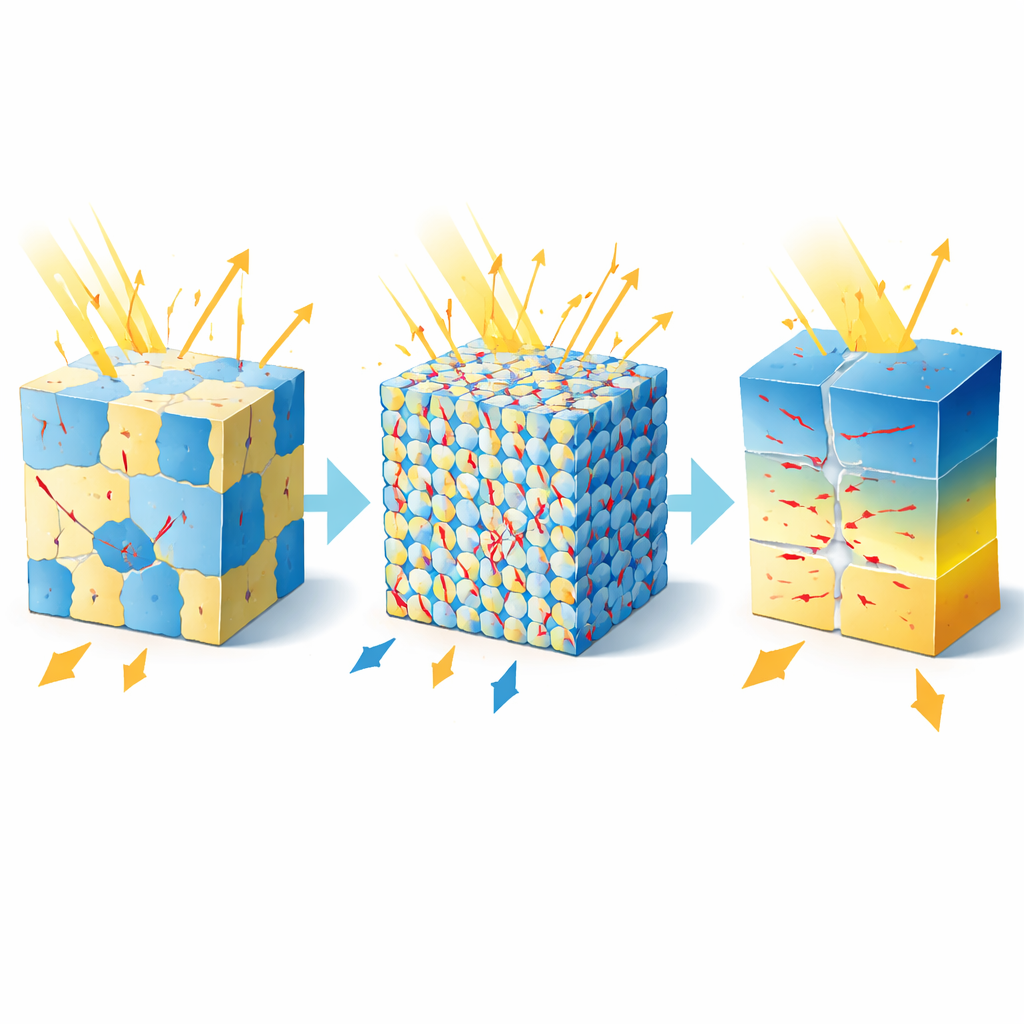
The researchers tackled this challenge using a lead-free ceramic known as (K,Na)NbO3, gently tweaked by adding small amounts of the rare-earth element terbium. They did not rely on delicate electrical pre-conditioning (poling), which often makes devices fragile. Instead, they re-engineered the material’s structure on several length scales at once. First, they shrank the ceramic grains to sizes smaller than the wavelength of violet light, so light passes through with less scattering and interacts with more of the material. Second, they encouraged the formation of dense, nanosized internal domains—tiny regions with slightly different electric orientations—where light can more effectively drive local strain. Third, terbium atoms act as traps for photo-excited electrons, extending their lifetime so they can drift to domain walls and enhance the internal electric changes that cause the material to stretch or bend.
From Atomic Shifts to Powerful Bending
To understand why this design works so well, the team combined computer simulations with high-resolution electron microscopy and local electrical measurements. Simulations showed that domains tens of nanometers across offer the best balance: they are small enough to boost local electric fields when charges pile up at their boundaries, but not so small that random internal fields scramble the effect. Imaging revealed that terbium doping indeed shrinks both grains and domains into this ideal window, while atomic-scale mapping linked subtle shifts in metal–oxygen bond lengths to changes in how the tiny domains tilt and distort. These structural tweaks adjust both the strength and direction spread of local polarization—the built-in electrical alignment—so that light-driven charges can move efficiently and create strong local strains that add up rather than cancel.
Record-Breaking Motion Under Light
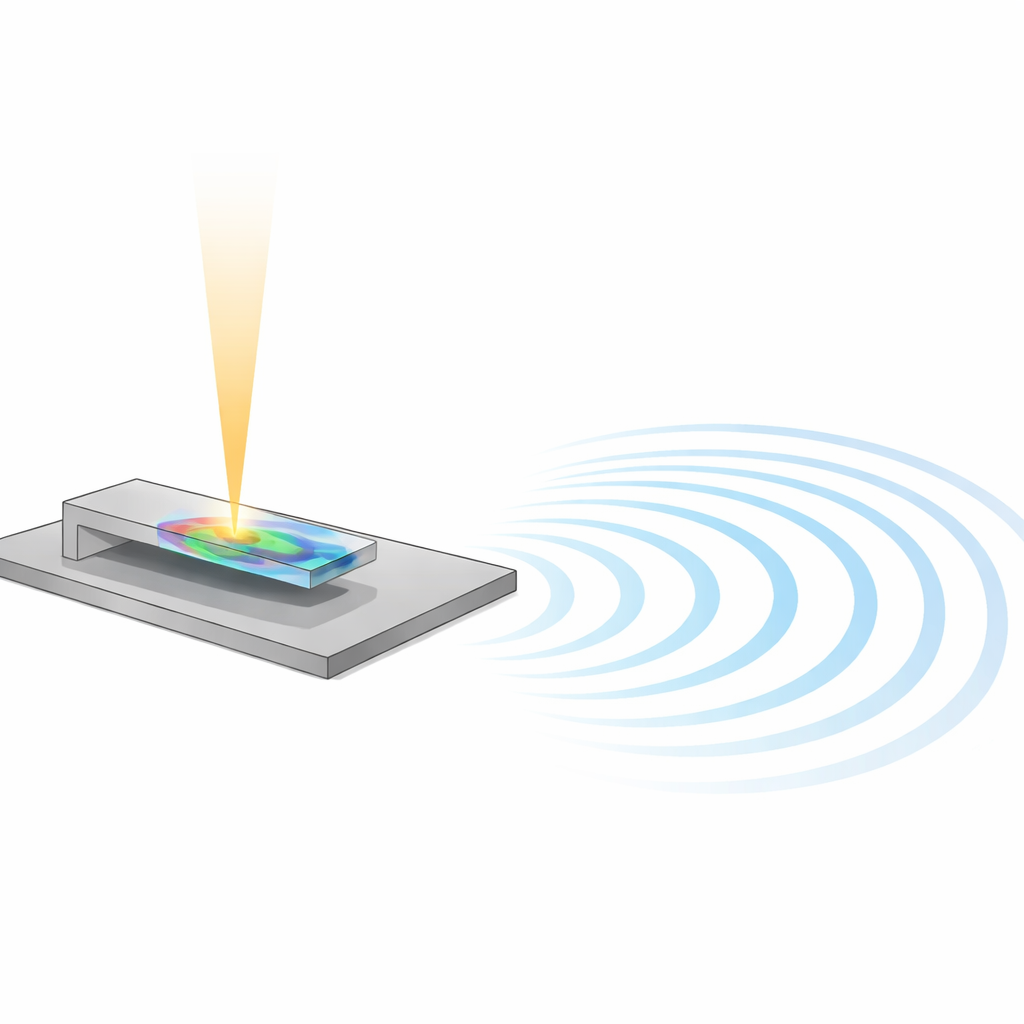
When the team shaped their ceramic into a small cantilever and shone modulated violet light on it, the strip bent vigorously at its mechanical resonance. The resulting photostriction rate—a measure that combines how much the material strains and how fast—reached 6.41 × 10⁻¹ per second, about one hundred times higher than in widely used ferroelectric crystals. Importantly, this performance came from non-poled ceramics, which are easier to manufacture and more stable during long-term use. The material also remained effective after weeks in water, indicating good robustness against harsh environments.
Remote Ultrasound for Safer Structures
To demonstrate a practical use, the researchers bonded their light-driven cantilever to an aluminum plate and illuminated it with a gently flickering beam at the resonant frequency. The bending ceramic launched ultrasonic waves that propagated along the plate and were measured by a scanning laser sensor some distance away. By analyzing how the waves changed when they encountered artificial notches of different depths, the team could detect and gauge hidden defects. Unlike conventional laser ultrasound systems, which often rely on heating or tiny surface explosions, this approach uses a non-thermal, solid-state mechanism that needs only modest optical power and no electrical wiring at the sensing site.
What This Means for Everyday Safety
In simple terms, the authors have created a ceramic that acts like a light-driven loudspeaker for ultrasound, powerful enough to probe the health of real engineering structures. By carefully arranging its grains, internal domains, and atomic makeup, they unlocked much faster and stronger shape changes than seen before in similar bulk materials. This design strategy offers a pathway to affordable, durable devices that can sit quietly on bridges, aircraft, or industrial plants, waiting to be activated by light to reveal early signs of damage—helping keep critical infrastructure safer with less complexity and lower energy use.
Citation: Yin, J., Yang, Y., Shi, X. et al. Giant photostriction rate for remote opto-ultrasonic structural health monitoring. Nat Commun 17, 3132 (2026). https://doi.org/10.1038/s41467-026-69906-y
Keywords: photostriction, opto-ultrasonic sensing, ferroelectric ceramics, structural health monitoring, light-induced ultrasound