Clear Sky Science · en
Switching speed limits in electrically driven VO2 structural Mott–Peierls transition
Fast switches for future electronics
Many next-generation technologies, from brain-inspired computers to ultra-fast wireless links, will rely on electronic parts that can flip between “off” and “on” states at incredible speeds using very little energy. This study focuses on vanadium dioxide, a material that abruptly switches from an electrical insulator to a metal near room temperature. The authors reveal how fast this material can be driven back and forth using electrical signals and what ultimately sets the speed limit, providing design rules for future devices built from such “switchable” materials.
A material that can change its mind
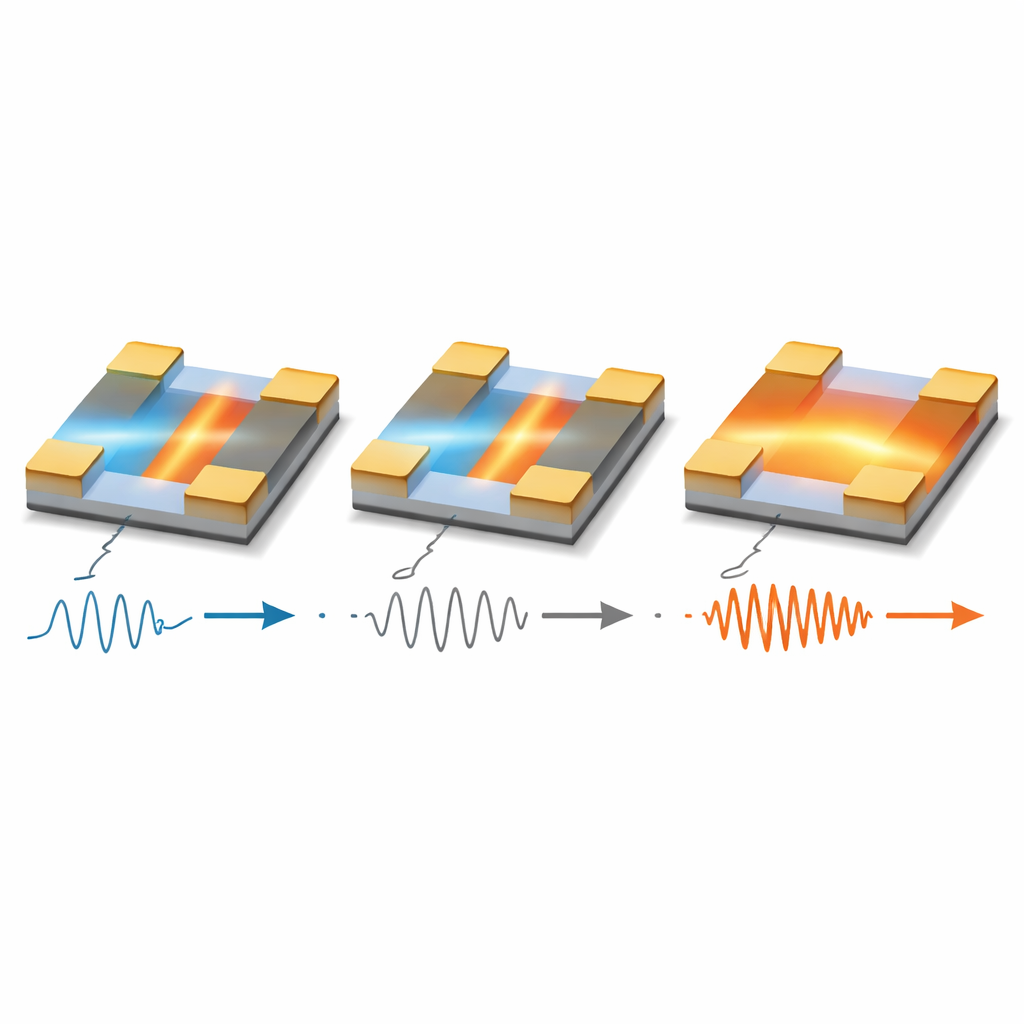
Vanadium dioxide (VO₂) belongs to a family of quantum materials whose electrons can cooperate in unusual ways, producing a dramatic jump from insulating to metallic behavior. When VO₂ switches, its atoms also shift slightly, so the electrical and structural changes are tightly linked. Earlier research mainly used laser light to trigger these transitions and found that they can occur in trillionths of a second. But practical devices—such as neuromorphic circuits that mimic neurons, or compact radio-frequency switches—will be driven by electrical signals, not lasers. Until now, the structural side of this electrically driven transition, especially at very high frequencies, has been hard to see in action.
Watching atoms move with fast electrons
To bridge this gap, the researchers built a microwave-driven ultrafast transmission electron microscope that uses only electrical signals to both excite the VO₂ and probe its atomic structure. In their setup, a thin VO₂ film sits between two tiny electrodes on a sapphire base, forming a working device. A special electron gun produces extremely short electron pulses that pass through the device while it is being driven by electrical signals ranging from megahertz (millions of cycles per second) to gigahertz (billions of cycles per second). By carefully synchronizing the probing electrons with the electrical “pump,” the team can reconstruct how the crystal structure and metallic regions evolve on nanometer length scales and picosecond–nanosecond time scales, over millions of repeat cycles.
Where speed runs into a wall
Electron diffraction measurements reveal a clear dependence of the structural switching on the driving frequency. At megahertz frequencies, the VO₂ rhythmically toggles between its insulating and metallic structures, though with a noticeable delay: the switch to the metallic state takes on the order of tens of nanoseconds, and the return to the insulating state is slower still. At gigahertz frequencies, however, the structural fingerprints of the insulating phase vanish and do not reappear as the signal oscillates. The material becomes locked in the metallic state, unable to cool and revert between cycles. This shows that, above a certain frequency, the atoms cannot keep up with the electrical driving, even though the voltage continues to swing.
How the metallic pathway forms and fades
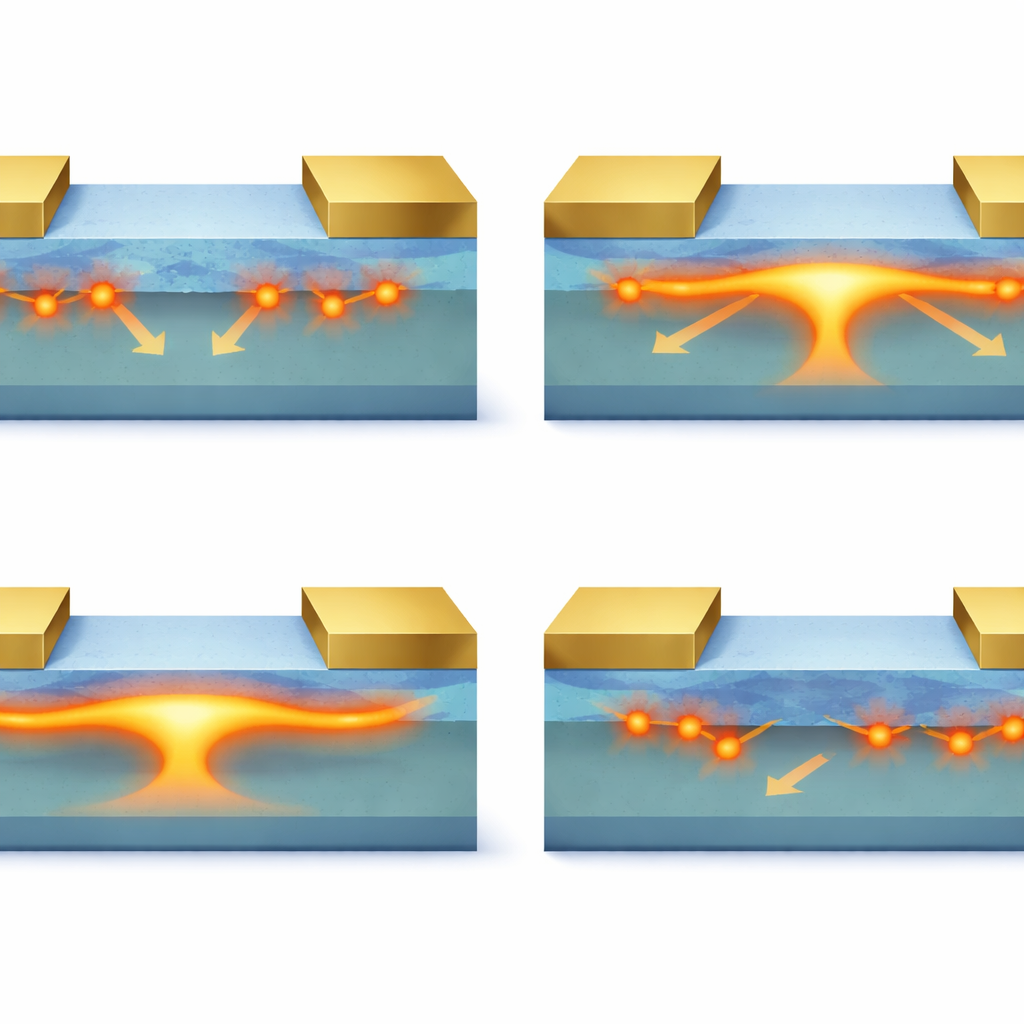
Real-space imaging at megahertz frequencies reveals how metallic regions actually appear and disappear inside the device. The metallic state first nucleates as tiny domains just beneath the electrodes, then expands laterally and downward toward the substrate, eventually forming a continuous metallic filament that bridges the two contacts. By tracking changes in image contrast through time and depth, the authors measure a structural “wave front” that advances at roughly 4.5 nanometers per nanosecond—much slower than the speed of electrons or sound waves in the solid. This slow front, and the way it lags behind the electrical pulse, points to heat flow and local heating as the main drivers of the structural change, with the electric field helping to trigger and guide the growth. When the voltage drops, the metallic filament dissolves as heat is shed into the surroundings, and this cooling step turns out to be the bottleneck.
Why pulse shape and heating matter
The team then explores how changing the electrical pulse shape alters the behavior. Keeping the repetition rate fixed but lengthening the “on” time of each pulse allows more current to flow and more heat to build up. Imaging and diffraction show that wider pulses create a thicker metallic filament that penetrates further toward the substrate and takes longer to disappear. Above a certain duty cycle, the material no longer fully returns to its insulating structure between pulses; instead it remains partly or fully metallic, effectively mimicking the behavior seen at gigahertz frequencies. Computer simulations based on a network of tiny resistive elements confirm this picture: at low frequencies or short pulses, the device structure and resistance switch cleanly; at moderate conditions, only parts of the filament cycle; and at high effective heating, the metallic state persists.
What this means for future devices
By combining high-speed electron imaging, diffraction, and modeling, the study identifies a fundamental speed limit for devices that rely on VO₂’s coupled electronic and structural transition. The key lesson is that the time it takes for the material to cool and structurally reset—governed by heat flow through the film, electrodes, and substrate—sets a hard ceiling on how fast the device can switch reversibly. Carefully choosing the operating frequency, pulse width, device geometry, and surrounding materials can tune a broad window between kilohertz and gigahertz where reliable operation is possible. For designers of neuromorphic circuits, RF switches, and other advanced hardware, these results provide a roadmap for harnessing VO₂ and similar materials without outrunning the atoms that make their unique behavior possible.
Citation: Pofelski, A., Liu, C., Reisbick, S.A. et al. Switching speed limits in electrically driven VO2 structural Mott–Peierls transition. Nat Commun 17, 3139 (2026). https://doi.org/10.1038/s41467-026-69904-0
Keywords: vanadium dioxide, metal insulator transition, ultrafast electron microscopy, neuromorphic devices, high frequency switching