Clear Sky Science · en
A countercurrent microflow strategy for simultaneous high selectivity and conversion in aromatic nitration
Why safer chemistry matters
Aromatic nitration is a workhorse reaction of the chemical industry, used to make ingredients for medicines, dyes, pesticides and explosives. Yet it is also notoriously dangerous: the process is highly exothermic, uses corrosive acids and can generate unstable byproducts that are difficult to store and transport safely. For nearly two centuries, chemists have had to accept a trade-off between making these reactions fast and keeping them clean and safe. This paper reports a micro-scale flow strategy that largely breaks that trade-off, offering both high productivity and high selectivity while reducing hazards.
The long-standing bottleneck
In conventional plants, aromatic nitration is carried out in large stirred tanks using a mixture of nitric and sulfuric acids. To avoid runaway heat buildup and dangerous byproducts, operators typically run the reaction cold and dilute, which slows production. Moving to microreactors and continuous flow since the 1990s improved heat removal and reduced the amount of hazardous material present at any moment. However, these microreactors still suffered from a core problem: when the reaction was pushed harder to increase output, unwanted ">over-nitration" steps followed, adding extra nitro groups, lowering the yield of the desired product and generating thermally unstable compounds.
A new way to move liquids
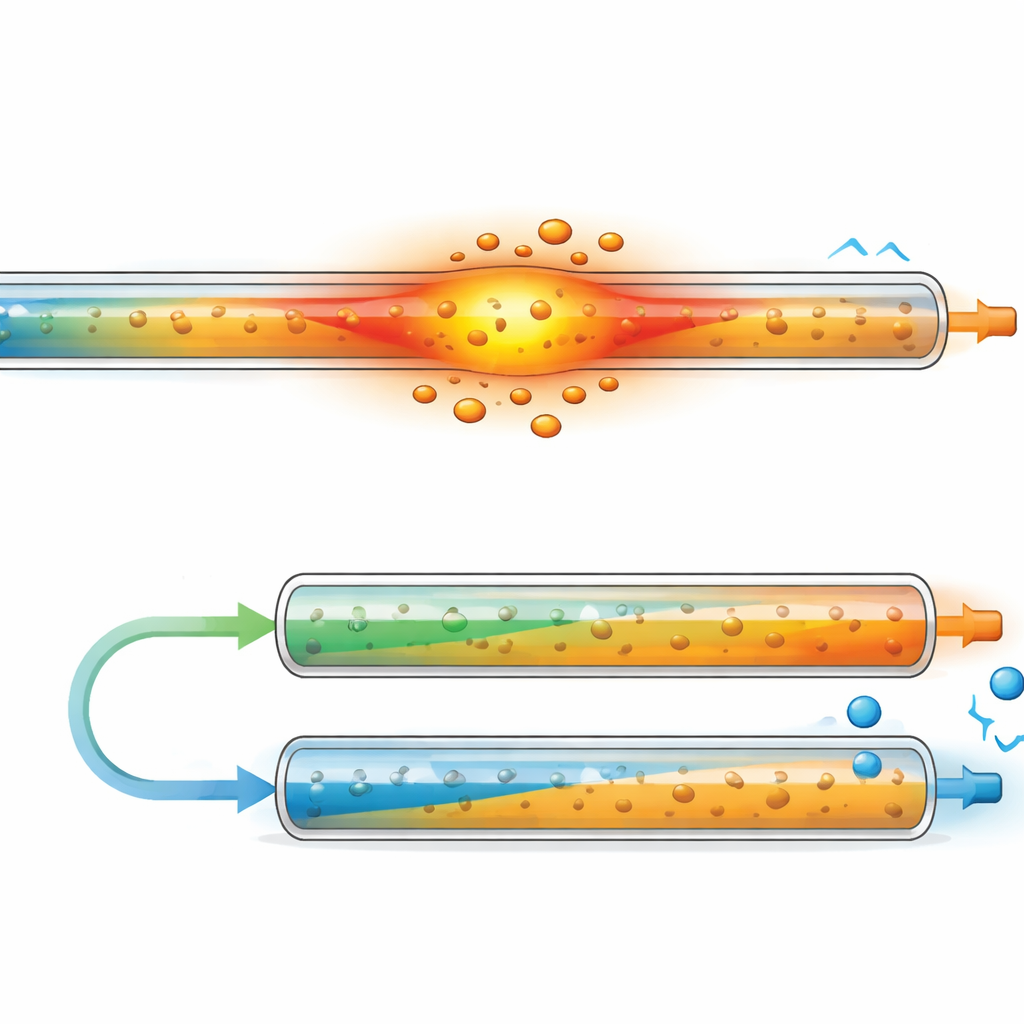
The authors tackle this by rethinking how the two liquid phases meet and react. Instead of a single microreactor in which organic molecules and mixed acid travel in the same direction, they divide the process into two small stages linked in a countercurrent loop. Within each stage, droplets of organic liquid and acid move together (co-current), but between stages the acid and organic streams flow in opposite overall directions. Fresh organic feed enters the first stage, where it reacts with partially spent acid arriving from the second stage. The partially nitrated organic product, combined with fresh acid, then enters the second stage for completion, and the acid looped back to the first stage closes the cycle. This clever arrangement reshapes the concentration gradients along the flow path without changing the basic chemistry.
Faster reactions with cooler operation
By analyzing the reaction kinetics, the team shows that the two-stage countercurrent design dramatically improves how efficiently reactants are used over time. In a traditional single-stage microreactor, more than 90 percent of the conversion happens in the first tenth of the residence time, after which the reaction slows sharply. Trying to squeeze out the last few percent of conversion requires much longer residence times, which favors over-nitration. In the new layout, each stage operates in a more favorable concentration window, so the overall time needed to reach almost complete conversion drops by more than a factor of five. At the same time, peak heat release rates and interfacial temperature spikes are roughly halved, making thermal control easier and further reducing the risk of runaway behavior.
Letting water police the reaction
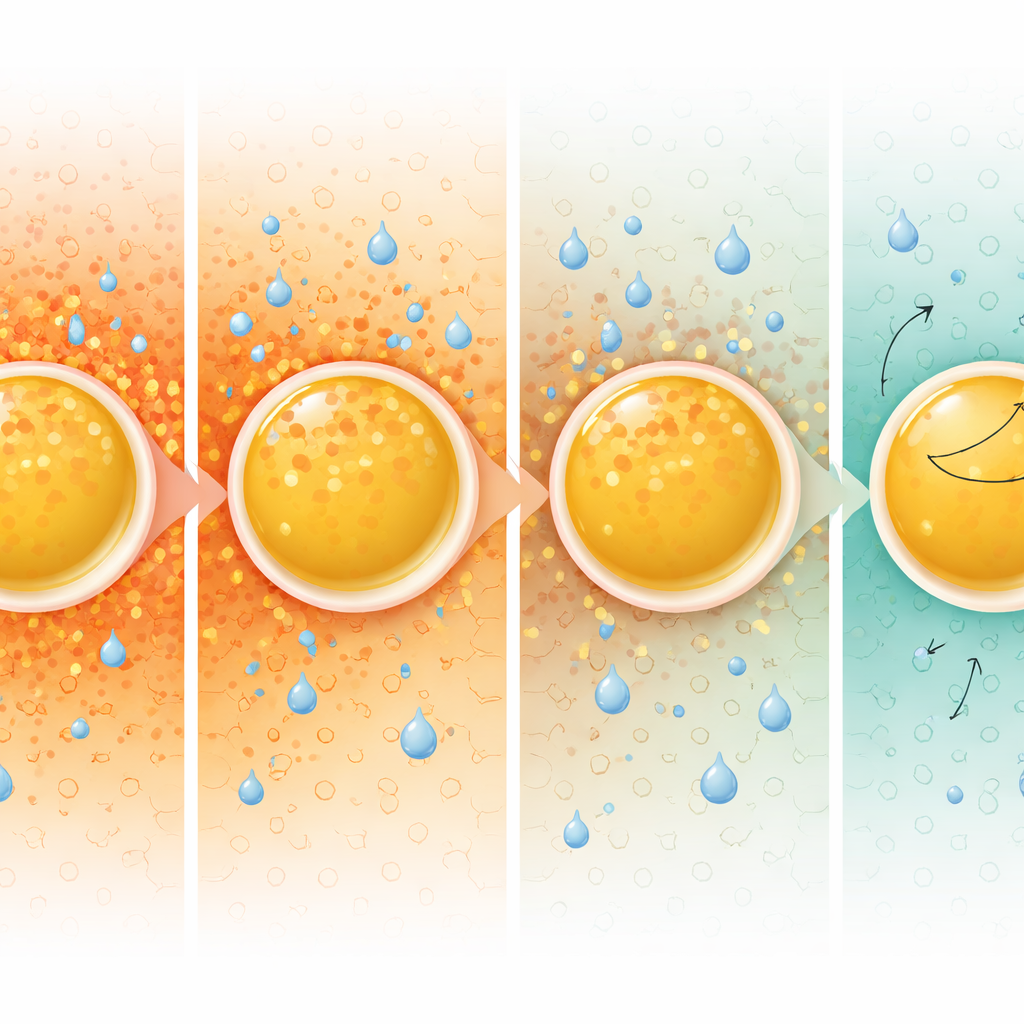
High productivity alone would not be enough if over-nitration remained a problem. The authors therefore probe how to tune the acid composition to steer the reaction pathway. They discover that running with a relatively low amount of sulfuric acid creates an unexpected ally: the water produced as the main nitration proceeds. In this environment, the accumulating water dilutes the sulfuric acid around the droplets. This dilution makes the desired mononitrated product much less soluble in the acid phase, so it tends to stay in the organic droplets instead of migrating into the acid where further nitration occurs. Molecular simulations indicate that weakening of the hydrogen-bonding structure in the acid phase and a drop in the concentration of the powerful nitrating species both contribute to this "product inhibition" effect, which selectively hampers the unwanted over-nitration steps.
Breaking the usual trade-off
Combining the countercurrent flow design with this water-driven inhibition gives a microreaction system that is both fast and highly selective. Using toluene as a test case, the authors achieve about 99.9 percent conversion with 99.8 percent of the product in the desired mononitrated form, while the over-nitrated byproduct drops to just 0.2 percent—one to two orders of magnitude lower than typical reports. The overall production rate per unit reactor volume outperforms standard batch reactors by roughly two orders of magnitude. Applying the same strategy to benzene and chlorobenzene shows similar benefits, suggesting the approach could be broadly useful wherever aromatic nitration is needed. In practical terms, this means chemical manufacturers may be able to design plants that are smaller, safer and more energy-efficient, while delivering cleaner products and minimizing hazardous byproducts.
Citation: Song, J., Pan, Y., Xin, R. et al. A countercurrent microflow strategy for simultaneous high selectivity and conversion in aromatic nitration. Nat Commun 17, 2990 (2026). https://doi.org/10.1038/s41467-026-69902-2
Keywords: aromatic nitration, microreactor, flow chemistry, process safety, reaction selectivity