Clear Sky Science · en
Multi-ancestry GWAS of age-related hearing loss identifies 140 loci and key cellular mechanisms
Why hearing loss in aging matters to everyone
Many people find that conversations, especially in noisy places, become harder to follow as they get older. This age-related hearing loss does not just make sounds quieter; it can affect social life, mood, and overall health. The study described here looks deep into our DNA to understand why some people are more likely to develop hearing loss with age, and which tiny parts of the inner ear are most involved.
Looking at genes across the globe
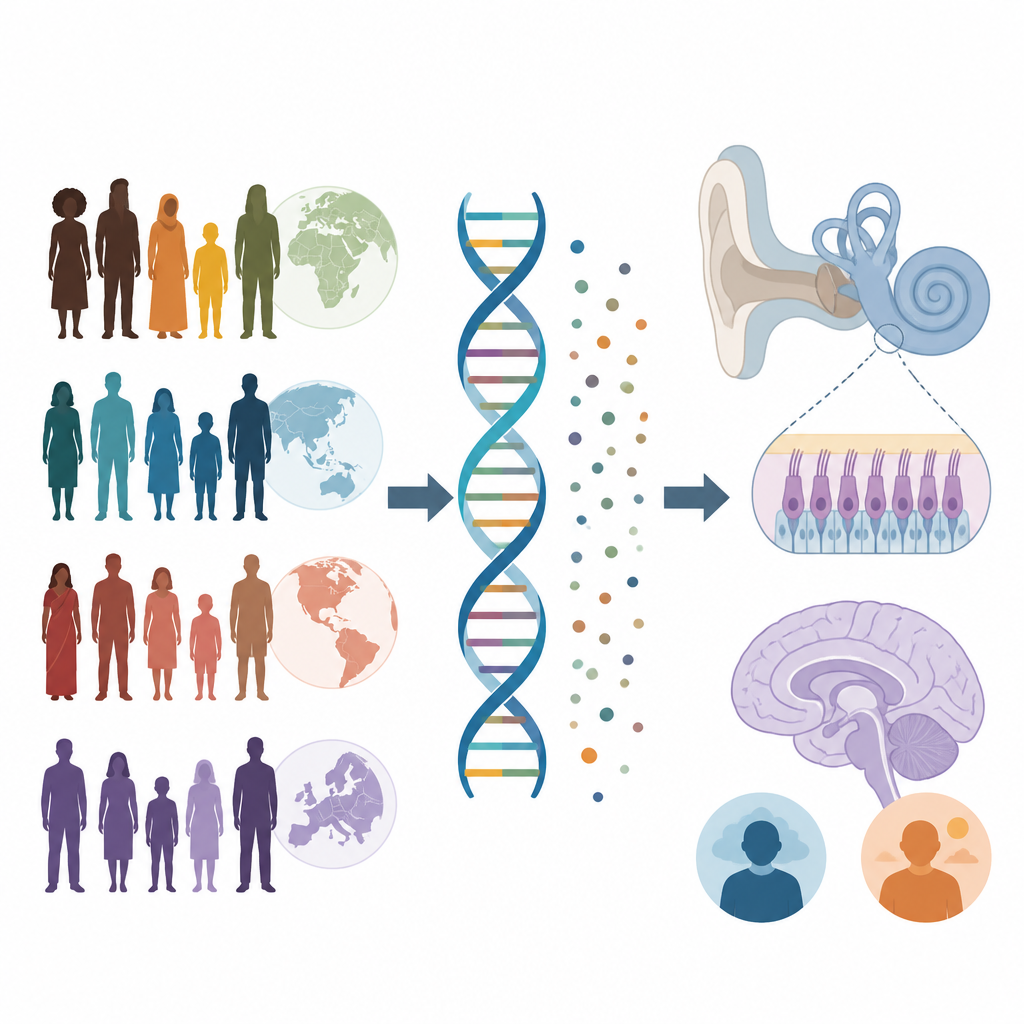
The researchers combined genetic data from more than 1.5 million adults drawn from European, East Asian, African, and American backgrounds. They compared the DNA of over 450,000 people with age-related hearing loss to more than one million people with normal hearing. By scanning the entire genome, they found 140 spots, or loci, where genetic differences were linked to hearing loss, including 44 that had not been seen before. Many of these signals appeared in all ancestry groups, showing that much of the genetic risk is shared across populations.
Many small genetic hits, shaped by evolution
Instead of a few powerful “hearing genes,” the study shows that age-related hearing loss is highly polygenic, meaning it arises from the combined effect of many small DNA changes. Rare variants tended to have larger effects, and the pattern suggested that harmful changes have been held down in frequency by natural, or purifying, selection. This implies that as future studies sequence more people in detail, especially from diverse groups, additional rare variants with strong impact on hearing are likely to be uncovered.
Links to mood, pain, and daily habits
Using genetic tools, the team also asked how hearing loss relates to other traits recorded in the UK Biobank. They found shared genetic influences between age-related hearing loss and more than one hundred traits. These included other hearing problems, but also long-standing illness, chest pain, insomnia, smoking history, and measures of mood such as neuroticism, irritability, loneliness, and depressed feelings. Some of these links looked consistent with a possible causal contribution to hearing loss, hinting that the biology behind mood, pain, and lifestyle may partly overlap with the biology of how we hear.
From DNA code to inner ear cells
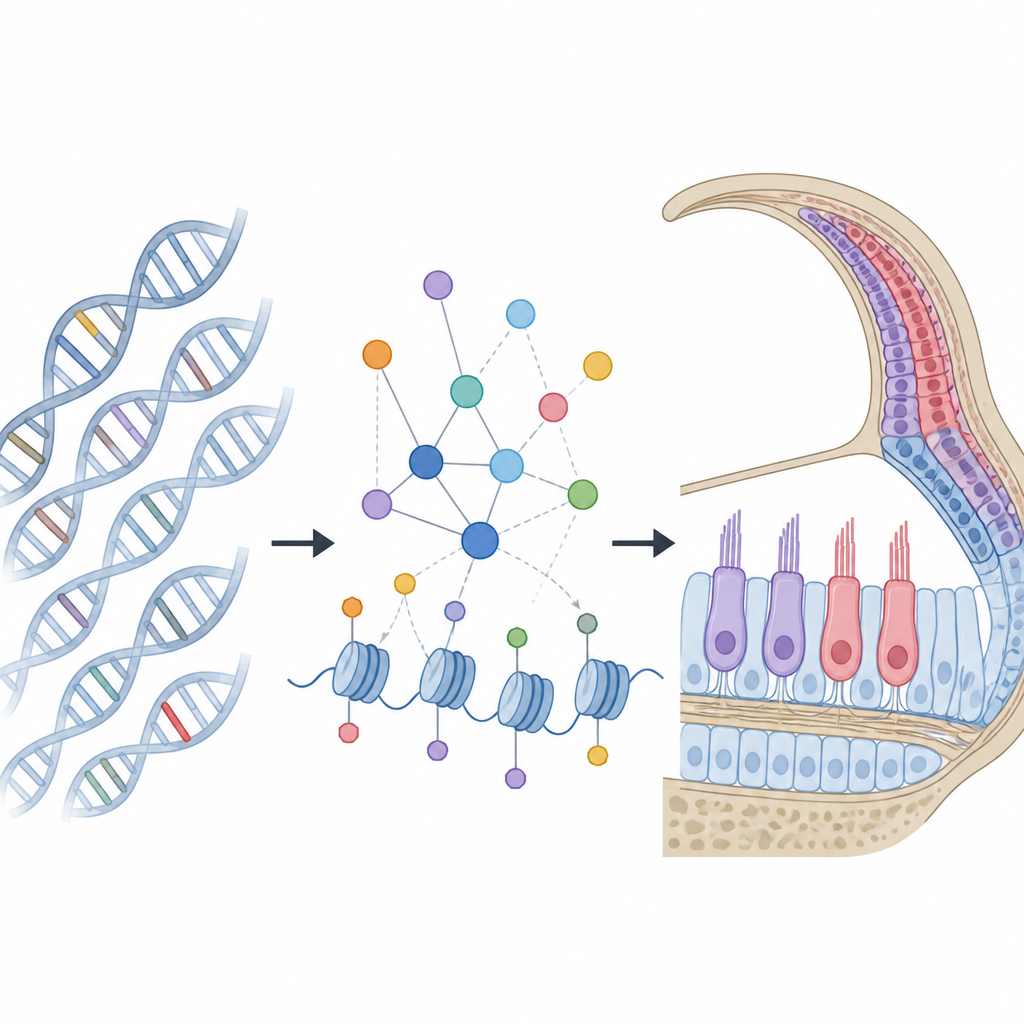
Finding a DNA signal is only the first step; figuring out what it does is harder. The researchers used several layers of biological data to connect genetic variants to specific genes and chemical marks on DNA called methylation. They highlighted 22 genes whose activity in blood appears tied to hearing loss risk, and 85 methylation sites that likely help control those genes. For nine DNA changes, they could pinpoint “missense” variants that alter the building blocks of proteins, several in genes already known to cause inherited forms of deafness. Next, they mapped where in the body the risk variants have their strongest effects by combining the genetic data with detailed maps of gene activity in mouse embryos and single cells from the cochlea.
Pinpointing the key cells of hearing
The spatial maps showed that genetic risk for age-related hearing loss is most enriched in the inner ear region. When the team zoomed in to individual cell types, they found that hair cells that sense sound, the supporting cells that surround them, and the basal and root cells of a tissue called the stria vascularis all carry a heavy share of the genetic burden. These results help reconcile earlier studies that gave differing answers about which cells matter most, by showing that several cochlear cell types together contribute to age-related hearing loss.
What this means for the future
In simple terms, this work shows that age-related hearing loss is the product of many inherited genetic nudges spread across the genome, acting mainly through specific cells deep inside the inner ear. It also suggests that the same genetic landscape that shapes our hearing is intertwined with aspects of physical health, sleep, and mood. While the study does not yet translate into a simple test or treatment, it provides a detailed map for future research that could guide the design of targeted drugs, gene-based approaches, or protective strategies aimed at preserving hearing as people grow older.
Citation: Shi, L., He, H., Li, J. et al. Multi-ancestry GWAS of age-related hearing loss identifies 140 loci and key cellular mechanisms. Nat Commun 17, 4325 (2026). https://doi.org/10.1038/s41467-026-69894-z
Keywords: age-related hearing loss, genetics, inner ear cells, multi-ancestry GWAS, hearing and mental health