Clear Sky Science · en
Enhancement of signal-to-noise ratio at a high-order exceptional point of coherent perfect absorption
Listening for tiny signals in a noisy world
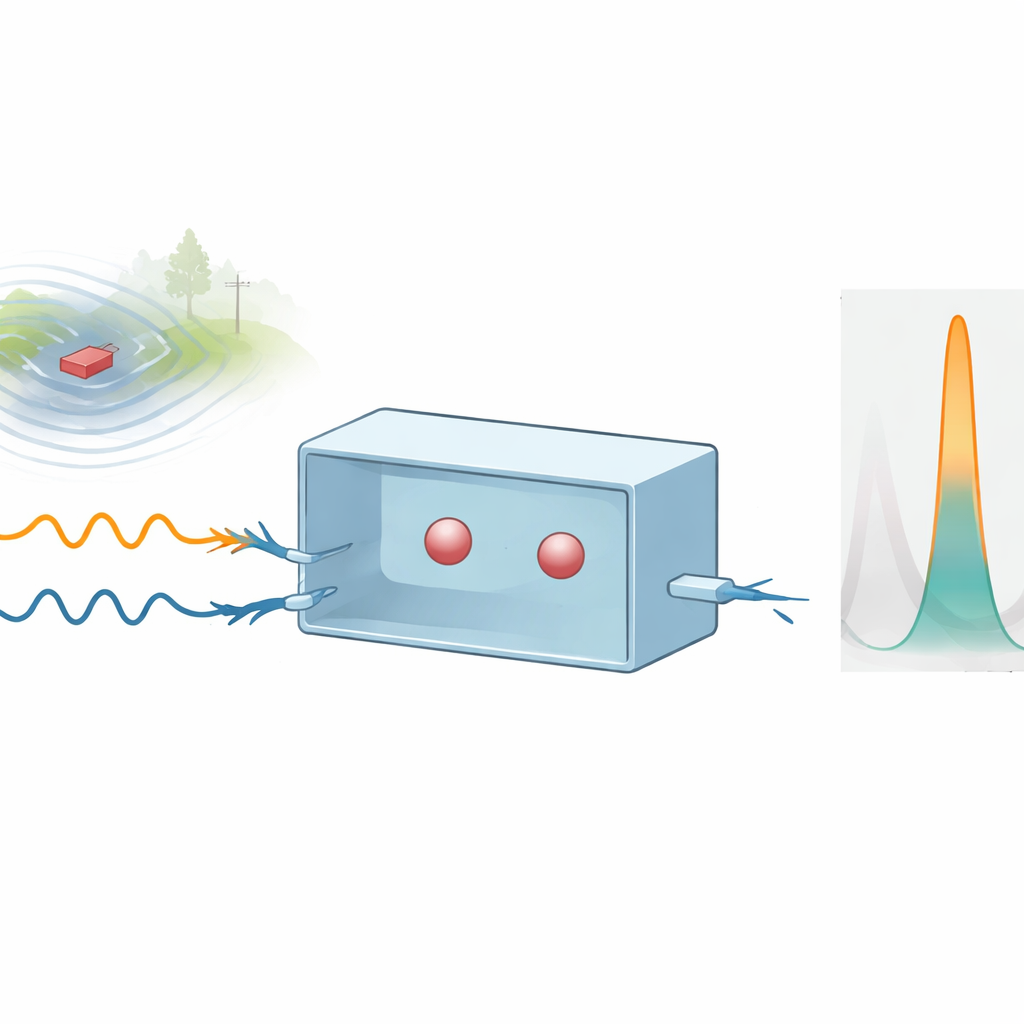
Our world is full of faint signals: small changes in magnetic fields from electronics, the human body, or distant astrophysical sources. Detecting these tiny shifts is like trying to hear a whisper in a crowded room. This paper presents a new way to build ultra-sensitive magnetic field sensors that not only boost the strength of the desired signal, but also keep the noise under control. By carefully shaping how energy is absorbed in a microwave cavity containing two tiny magnetic crystals, the researchers achieve sharper, cleaner measurements than were thought possible with earlier approaches.
Why unusual singular points matter
Many next-generation sensors rely on a class of systems called “non-Hermitian,” where energy can leak in or out. In such systems, special operating points known as exceptional points act like mathematical tipping points: several vibrational modes of the system merge into one. Near these points, even a very small disturbance can cause a disproportionately large change in the system’s response, which in principle makes them attractive for sensing weak signals. However, previous work has shown a major drawback: while the response becomes stronger, the noise can also blow up, cancelling any real gain in measurement quality. This has led to a long-standing debate about whether exceptional-point sensors can truly outperform conventional designs.
Perfect absorption as a clever workaround
The authors propose and demonstrate a way around this limitation by shifting attention from where the system naturally resonates to where it perfectly absorbs energy. They construct a microwave cavity holding two identical spheres of yttrium iron garnet (YIG), a well-known magnetic material. When two carefully tuned microwave signals enter from opposite sides, the waves inside the cavity interfere in just the right way so that almost all of the incoming energy is swallowed—this state is called coherent perfect absorption. At a special third-order exceptional point of this absorption process, three different absorption pathways collapse into one. Here, even a slight change in magnetic field, which slightly retunes the YIG spheres, produces a large, easily measurable shift in the frequency or depth of the tiny remaining output signal.
Building a quiet but highly responsive sensor
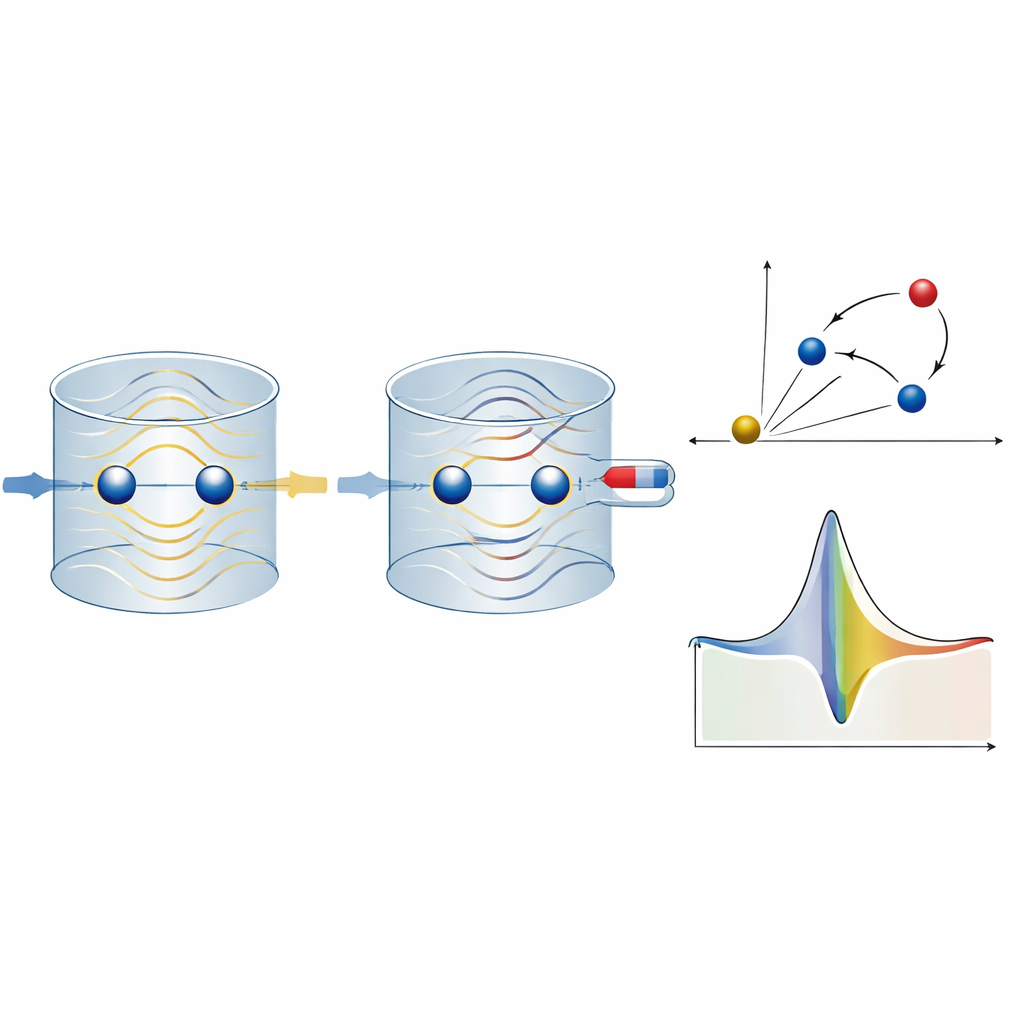
Crucially, the team engineers the system so that the exceptional behavior appears only in the “absorption landscape,” not in the underlying resonant modes that carry most of the noise. This separation means that the usual problem—overlapping modes amplifying noise—does not occur, even though the sensor still benefits from the sharp, nonlinear response characteristic of a high-order exceptional point. In experiments, they adjust the positions and orientations of the YIG spheres and the coupling of the cavity to external ports until the system reaches the desired operating point. There, a small change in magnetic field yields a frequency shift that grows with the cube root of the disturbance, instead of changing linearly as in normal sensors, and the depth of the absorption dip changes even more dramatically.
How much improvement do they actually get?
To test real-world performance, the researchers repeatedly measure how the output frequency and minimum intensity change under many tiny variations of the magnetic field, building up statistics over one hundred runs. They find that, at their coherent perfect absorption exceptional point, the frequency response to a small magnetic shift is about fifteen times larger than in a comparable setup without this special tuning. When they look at how the minimum output intensity changes, the effect is even stronger: a 400-fold increase in responsivity. Importantly, the noise in the measured frequency does not blow up; instead, it stays essentially flat, and the noise in the minimum intensity actually drops near perfect absorption because it is dominated by fundamental shot noise that scales with the signal level itself.
What this means for future sensing technologies
Putting response and noise together, the authors demonstrate a twelve-fold boost in the signal-to-noise ratio for frequency-based magnetic field sensing and a seventy-fold boost when using changes in the minimum output intensity as the sensing signal. In everyday terms, their device can distinguish much smaller magnetic changes than a standard setup operating under similar conditions, without paying the usual penalty of extra noise. Beyond this specific microwave and magnon platform, the same design principle—separating the exceptional point that enhances sensitivity from the modes that carry most of the noise—can be applied to optical microcavities, electronic resonators, and other wave-based systems. This work suggests a practical route toward ultra-sensitive, noise-resilient sensors that could benefit fields ranging from quantum metrology to biomedical diagnostics.
Citation: Wang, ZQ., Sun, YM., Hu, YD. et al. Enhancement of signal-to-noise ratio at a high-order exceptional point of coherent perfect absorption. Nat Commun 17, 3343 (2026). https://doi.org/10.1038/s41467-026-69889-w
Keywords: magnetic field sensing, exceptional points, coherent perfect absorption, cavity magnonics, signal-to-noise ratio