Clear Sky Science · en
Photonic non-Abelian topological insulators with six bands
Light on the Edge
Electronics and photonics are steadily moving toward devices that can guide signals without loss, even in the presence of imperfections. A powerful approach uses "topological" structures that protect how waves move through a material. This paper reports a new kind of optical topological insulator that works with many interacting light channels at once, opening the door to richer and more controllable signal pathways on a chip than previous designs allowed.
Why Ordinary Rules Fall Short
Conventional topological insulators are usually described one energy band at a time. In simple systems, a quantity called the Zak phase can predict whether special edge states will appear at the boundaries of a material. These edge states behave like protected highways for waves or electrons. But when many bands interact at once, as in more complex crystals or photonic structures, that simple picture breaks down: the Zak phase may claim edge states should exist where experiments show none, or miss others that do appear. To handle these multi-band situations, theorists have developed a "non-Abelian" description, where band properties no longer add like ordinary numbers but instead behave more like matrix operations that do not commute.
A New Six-Band Playground for Light
The authors design a minimal model that captures this non-Abelian behavior using six coupled channels of light. Conceptually, the structure looks like three parallel chains, each with two sites per repeating unit, all linked together. By carefully choosing how strongly neighboring sites couple and by enforcing certain symmetries, the team ensures that the six energy bands remain separated by gaps yet are tied together in a way that demands a multi-band description. In this framework, the overall twisting of all six band eigenstates across momentum space can be viewed as a rotation in a six-dimensional space. Instead of being labeled by simple integers, the possible phases of the system are classified by generalized quaternions—a mathematical set where the order of multiplication matters. Each such "charge" encodes how the entire frame of six states rotates, not just whether a single band picks up a phase of zero or pi.
Hidden Patterns of Edge and Interface States
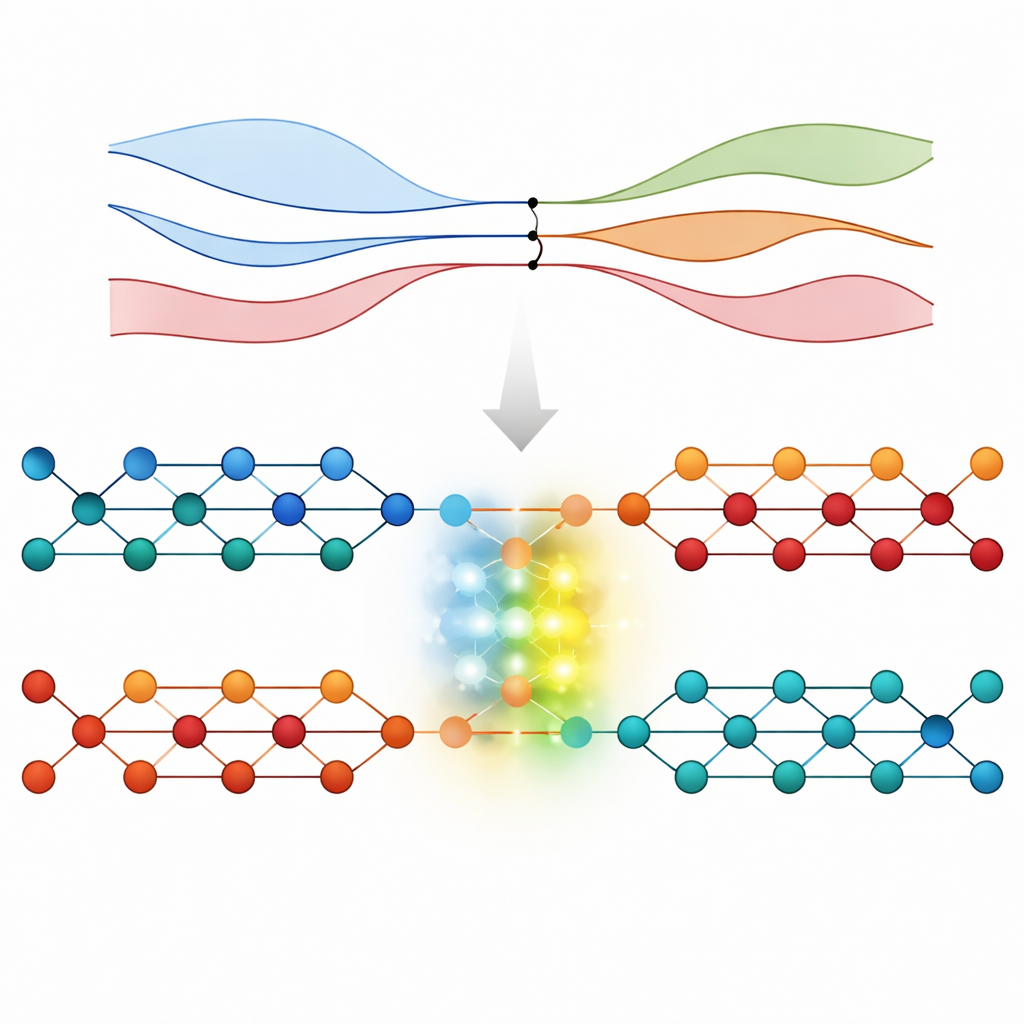
Armed with this classification, the researchers show that their six-band system can realize several distinct non-Abelian phases, each associated with a different generalized quaternion charge. They calculate how the spectrum of allowed energies and the presence of edge states change as they tune a control parameter that adjusts the coupling strengths. In some phases, edge states appear in every gap; in others, they are confined to particular gaps in patterns that the Zak phase cannot explain. Even more striking are the domain-wall states that form where two regions with different non-Abelian charges meet. Here, the rule is not simply based on a difference of charges but on a quotient: effectively comparing how one multi-band rotation must morph into another. This quotient determines in which gaps localized states will emerge at the interface, revealing an unexpectedly rich bulk–boundary relationship.
Bringing the Theory onto a Photonic Chip
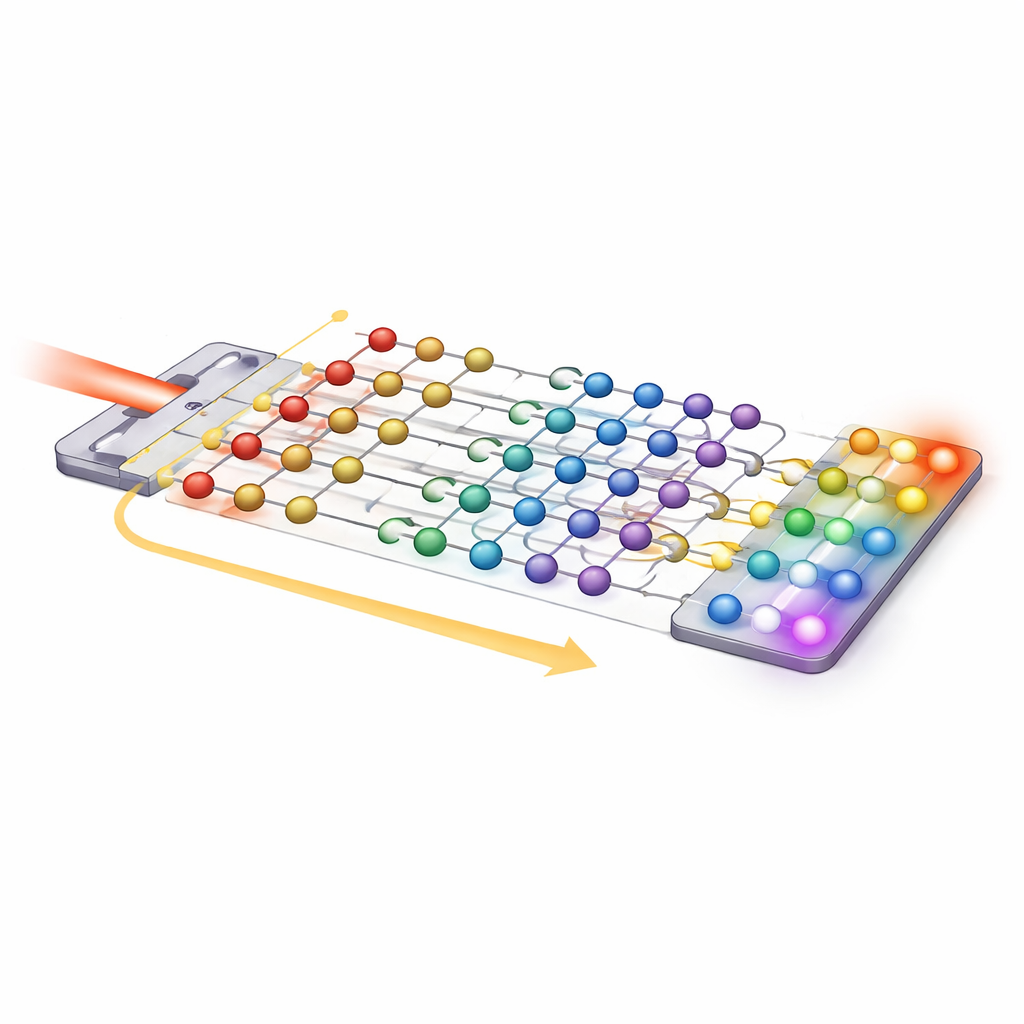
To prove that these ideas are more than abstract mathematics, the team fabricates three-layer photonic waveguide arrays inside glass using femtosecond-laser writing. Each unit cell contains six waveguides arranged to mimic the designed couplings. By gradually varying the spacing between layers along the propagation direction, they make light experience a sequence of different non-Abelian phases as it travels. By launching carefully shaped input beams that match calculated edge modes and imaging the output, they observe when light remains tightly confined to the boundary and when it leaks into the bulk, signaling topological phase changes. They also build structures in which two different non-Abelian photonic insulators join at an interface and directly visualize localized domain-wall modes whose positions in the spectrum match the predictions of the quotient rule.
What This Means for Future Photonics
The study shows that non-Abelian topological behavior with six interacting bands can be realized in a practical optical platform and that its unusual edge and interface states can be both predicted and observed. Rather than relying on single-band measures, designers can now use the richer language of multi-band rotations to engineer where light will localize and how many protected channels will exist. This opens a route to photonic devices that can host multiple robust pathways and controllable junctions on the same chip, with potential impacts on optical computing, signal routing, and even topological quantum information processing.
Citation: Jiang, T., Tian, ZN., Tao, R. et al. Photonic non-Abelian topological insulators with six bands. Nat Commun 17, 3020 (2026). https://doi.org/10.1038/s41467-026-69887-y
Keywords: photonic topological insulators, non-Abelian band topology, waveguide arrays, edge states, domain-wall modes