Clear Sky Science · en
Evaluating spatially targeted HIV interventions and harm reduction services among people who inject drugs in a high-burden setting
Why this study matters
For people who inject drugs, the risk of getting HIV can be many times higher than for other vulnerable groups, especially in places where health services are hard to reach or carry heavy stigma. This study asks a practical question with real-world impact: if outreach teams bring clean needles, treatment, and testing directly to the spots where people actually inject together, how much could that cut new HIV infections? Focusing on New Delhi, India, the researchers use detailed maps of gathering places and social ties to test how smart placement of services might save the most lives with limited resources. 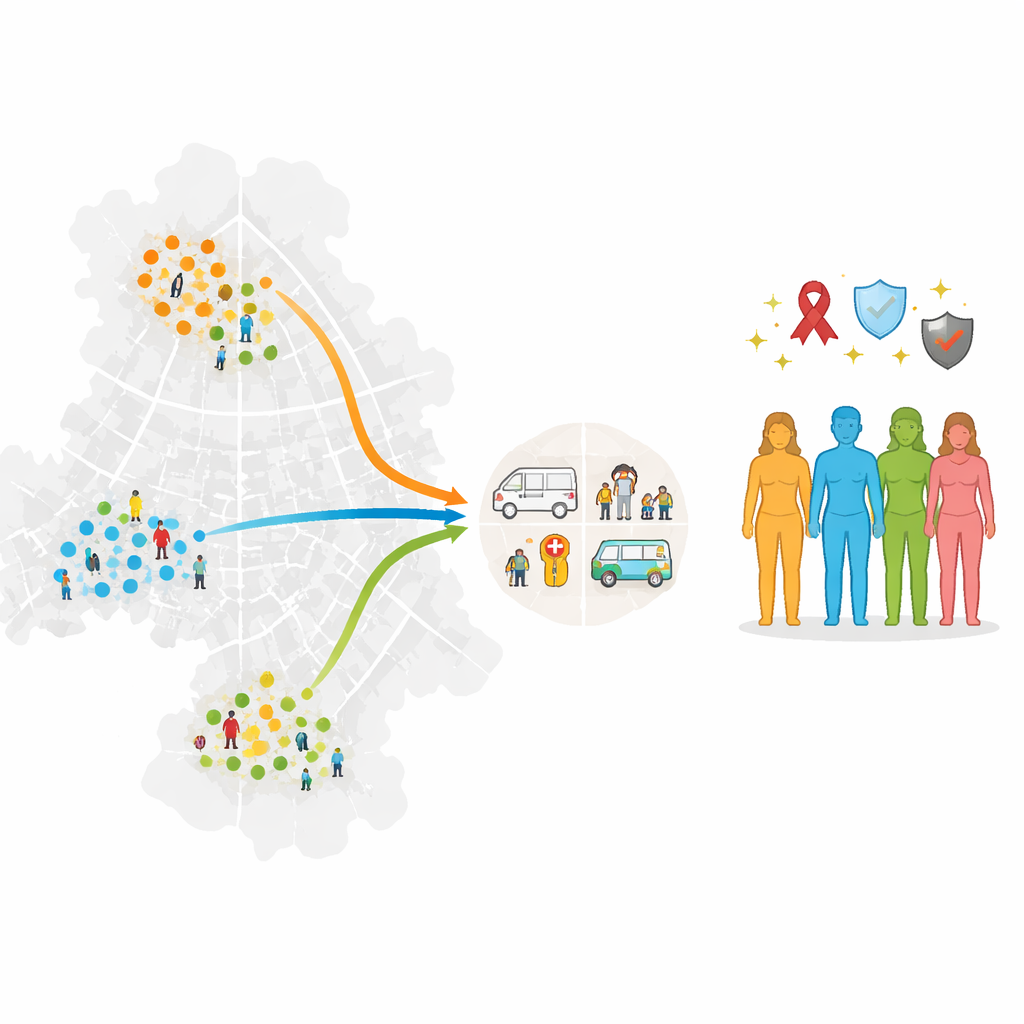
Hidden gathering places in the city
The team worked with 2,512 people who inject drugs in New Delhi and carefully mapped where they lived, where they injected, and with whom they shared equipment. They identified 110 common injection spots across the city, but found that just a handful of these venues drew most of the crowd. About two thirds of the participants reported visiting only the five busiest locations. People at these popular spots tended to be younger, injected more often, had more injection partners, and were more likely to be living with HIV. At the same time, they were less likely to have been tested for HIV or to receive medication for opioid dependence, highlighting a mismatch between where risk was highest and where services were reaching people.
Risk is clustered, not evenly spread
When researchers overlaid the injection venues on a map of New Delhi, a clear pattern emerged: these locations were not scattered randomly but formed three distinct clusters in different parts of the city. Most people tended to inject near where they lived, and many rarely crossed between clusters. One cluster in particular contained a single area whose venues were used almost only by residents of that same neighborhood, suggesting a self-contained local risk pocket. This geographic clustering means that a relatively small number of strategically chosen venues could reach a large share of the population at highest risk, while other venues serve fewer, more isolated groups. 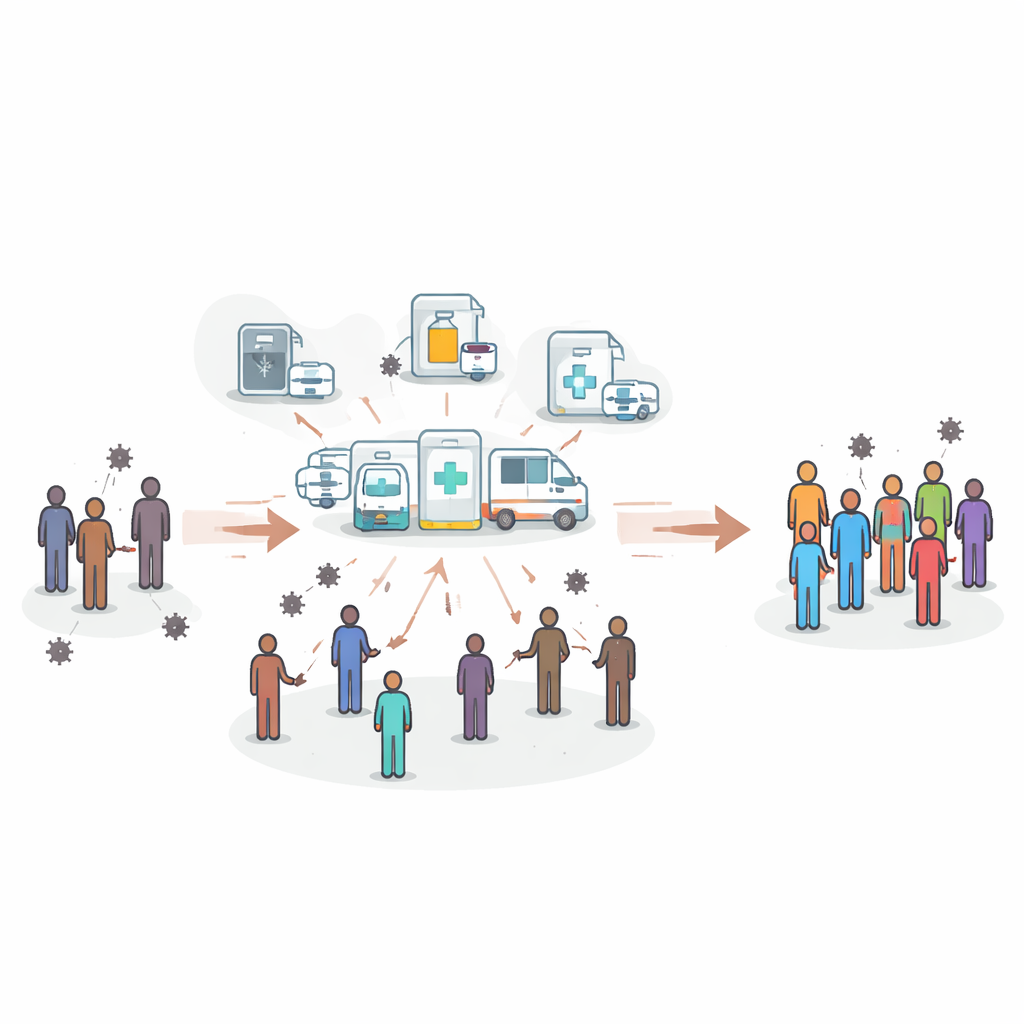
Testing smarter ways to place services
To see how best to expand help, the team built a computer model that mimicked the real network of people, their injection partners, the venues they visited, and their current access to services like clean needles, opioid treatment, HIV testing, and HIV medication. They then simulated what would happen over two years under different plans for scaling up these services at injection venues. Two strategies were compared. In the first, venues were ranked simply by how many people used them, with services rolled out to the busiest spots first. In the second, venues were grouped by geographic cluster, and services were spread across clusters so that early expansions covered different parts of the city at once, not just one hotspot.
How much HIV could be prevented
Without any new expansion, the model estimated that the population would experience about 6.8 new HIV cases per 100 people each year. When full coverage targets were met at just the single most popular venue, that rate dropped to 2.7 new cases per 100 people per year. Extending the same level of services to the 12 most visited venues reduced incidence even further, to 1.3 new cases per 100 people. Scaling up clean needle programs produced the largest drop for each step of expansion, with additional gains from greater access to opioid treatment, HIV testing, and timely antiretroviral therapy. When comparing the two targeting strategies, spreading services across different geographic clusters tended to reach more unique individuals with the first few venues, though both approaches produced similar reductions in HIV incidence once several venues were covered.
What this means for real-world action
In plain terms, the study shows that bringing a package of harm reduction and HIV services directly to the places where people inject together—especially the busiest gathering spots—can dramatically reduce new HIV infections in a relatively short time. While the exact best order of venue expansion may depend on local patterns of movement and risk, the findings suggest that health planners should treat injection venues themselves as key touchpoints, alongside clinics and hospitals. Targeting services to a small number of well-chosen sites can reach many high-risk individuals quickly, turning urban hotspots of infection into powerful hubs for prevention and care.
Citation: Wang, J., Clipman, S.J., Mehta, S.H. et al. Evaluating spatially targeted HIV interventions and harm reduction services among people who inject drugs in a high-burden setting. Nat Commun 17, 3102 (2026). https://doi.org/10.1038/s41467-026-69874-3
Keywords: HIV prevention, harm reduction, injection drug use, spatial targeting, India public health