Clear Sky Science · en
Machine learning guided resolution of mechanical trade-off in polymer composites via stress adaptive interface
Why this matters for everyday materials
From car bumpers to helmets and aircraft parts, we rely on plastic-based materials that must be both strong and tough. Yet engineers usually face a painful trade-off: making a plastic stiffer and stronger often makes it more brittle and easier to crack. This study shows a way to break that compromise by borrowing ideas from bone and combining them with modern machine learning, opening a path toward lighter, safer, and more durable composites for real-world use.
Learning from bone’s inner scaffolding
Natural bone is remarkably good at resisting everyday bumps and even hard hits because of its internal, sponge-like architecture called trabecular bone. Instead of being a solid block, it is a porous 3D scaffold that can spread and dissipate forces. The researchers translated this idea into a "trabecular interlocked composite" where stiff fibers run through a continuous porous skeleton, much like the beams in a building. Within this structure, a softer plastic phase threads around and between the stiff regions, forming a physical interlock that keeps the whole material connected even as it bends and stretches. 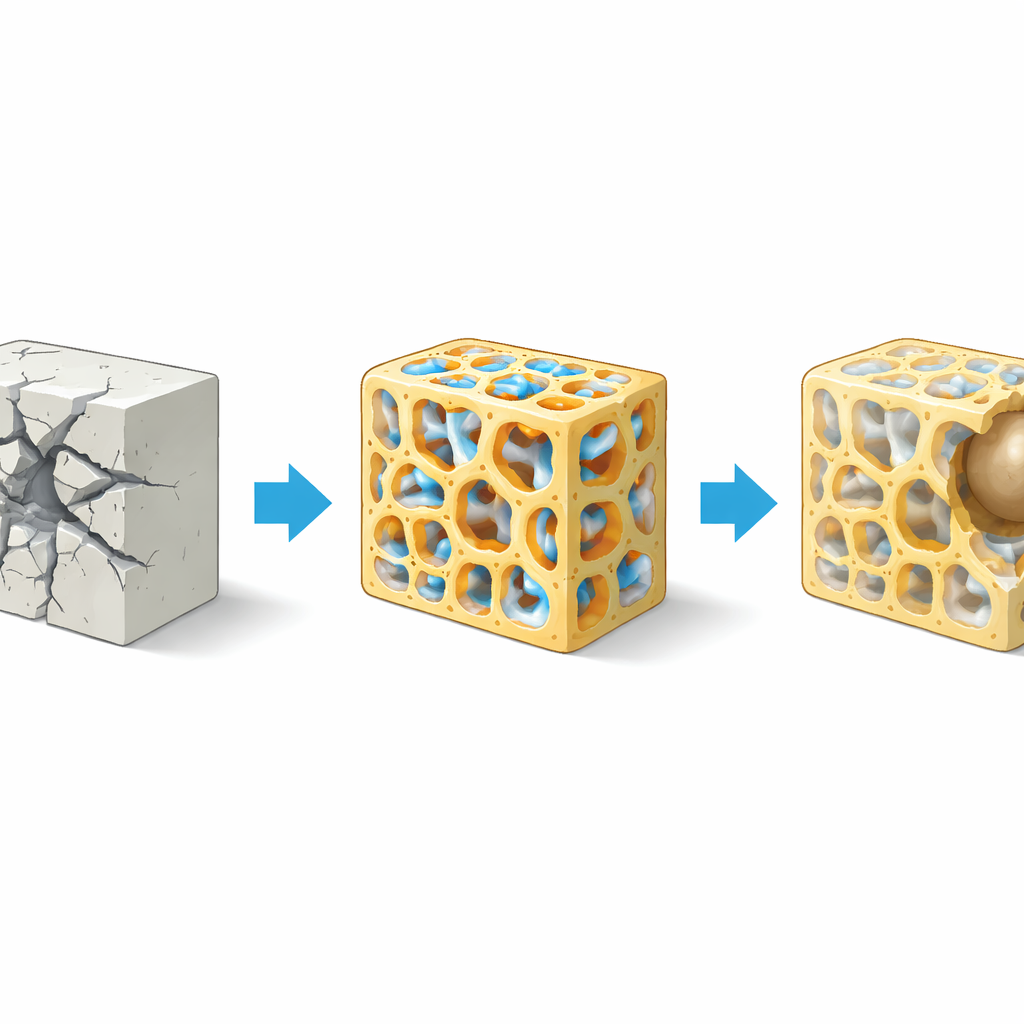
A smart interface that adapts under stress
The key innovation is not only the architecture but also a "stress-adaptive" interface between the different components. Instead of relying on fixed chemical bonds that can snap abruptly, the team uses a flexible plastic that can flow slightly when heated during processing and weave into the rigid matrix and fibers. This creates a dense tangle of chains at the boundaries, more like Velcro than glue. When the material is stretched or hit, these tangled chains can slide, rearrange, and re-engage, continually redistributing stress rather than letting it concentrate at a sharp crack. High-speed impact tests, electron microscopy, and laser-based spectroscopy show cracks being deflected, fibers bridging gaps, and wide zones of plastic deformation that soak up energy instead of failing suddenly.
Letting algorithms search the design space
Designing such composites is not as simple as picking one recipe. Changing the amounts of the stiff matrix, soft phase, and fibers can raise one property while lowering another. Rather than tweaking one ingredient at a time, the authors use a machine learning framework that treats the problem as a multi-goal search: maximize strength, fracture toughness, and impact resistance simultaneously. They first build computer models that learn from a set of carefully chosen test formulations. Then, using an approach called Pareto Set Learning, the system maps out combinations that give the best possible trade-offs. An "active learning" loop selects the most informative next experiments, quickly honing in on a narrow region of compositions where all three properties are high, reducing the number of costly lab trials. 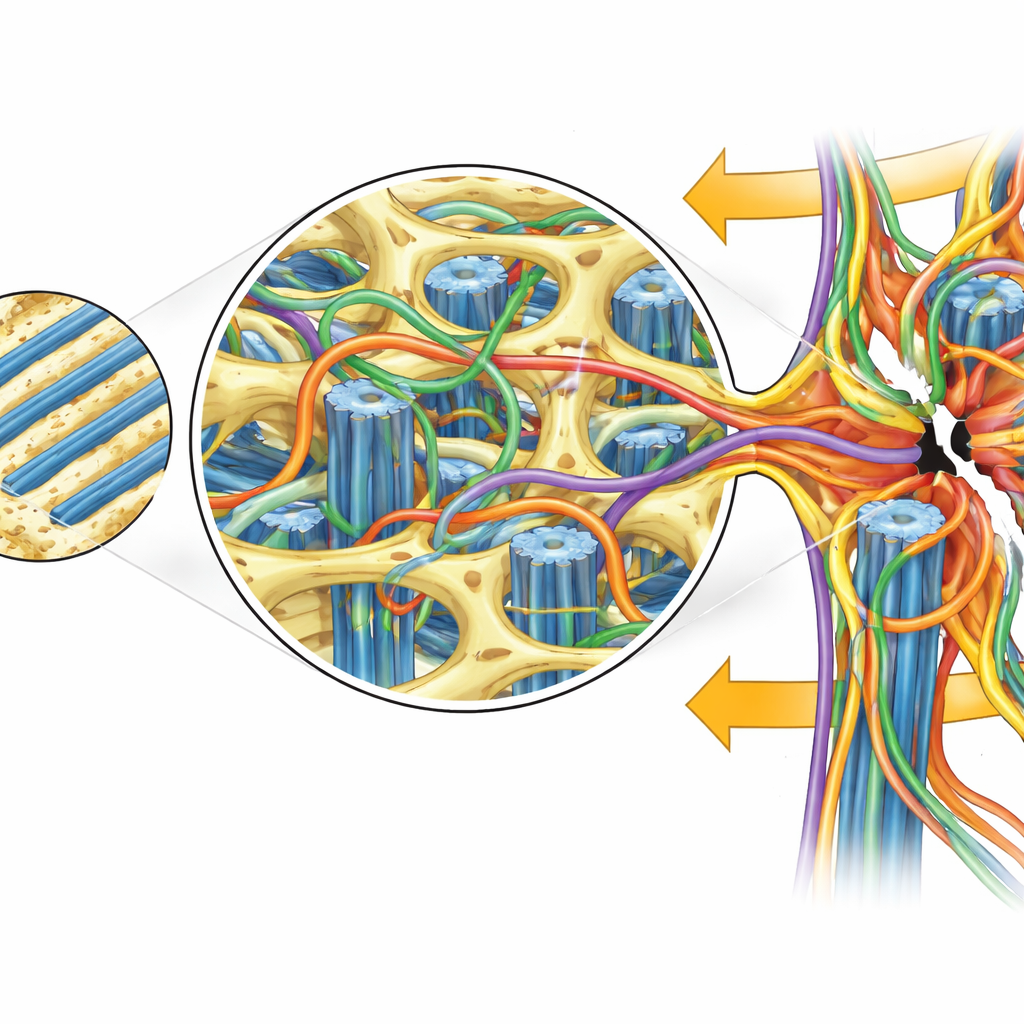
Record performance in a lightweight package
The resulting composites reach strengths around 250 megapascals (similar to some structural metals), fracture toughness above 14 MPa·m1/2, and impact energies near 4.8 joules, all while remaining relatively light. When plotted against existing natural and man-made materials, these new materials sit in a rare region that combines low density with high resistance to cracking and impact. Importantly, the same design principles work across different industrial plastics and reinforcements: the team shows success with several common thermoplastics, various fibers, and even flat graphene sheets. The approach does not depend on a particular chemical recipe, but on the idea of a porous, bone-like scaffold and a mobile, entangled interface.
What this means going forward
In plain terms, this work shows how to make plastics that are both hard to break and able to shrug off heavy blows, without becoming heavy or brittle. By fusing a bone-inspired internal structure, a self-adjusting boundary between components, and a machine learning "co-pilot" for formulation, the authors outline a general recipe rather than a single material. That recipe could guide the design of next-generation composites for safer cars, lighter aircraft, better sports gear, and protective equipment that absorbs impacts instead of failing when it is needed most.
Citation: Wang, H., Cheng, J., Wu, Z. et al. Machine learning guided resolution of mechanical trade-off in polymer composites via stress adaptive interface. Nat Commun 17, 3105 (2026). https://doi.org/10.1038/s41467-026-69872-5
Keywords: polymer composites, bioinspired materials, impact-resistant plastics, machine learning design, lightweight structures