Clear Sky Science · en
Electrolyte diluent with large electrostatic potential difference for fast charging and slow discharging lithium metal batteries
Why Faster, Longer-Lasting Batteries Matter
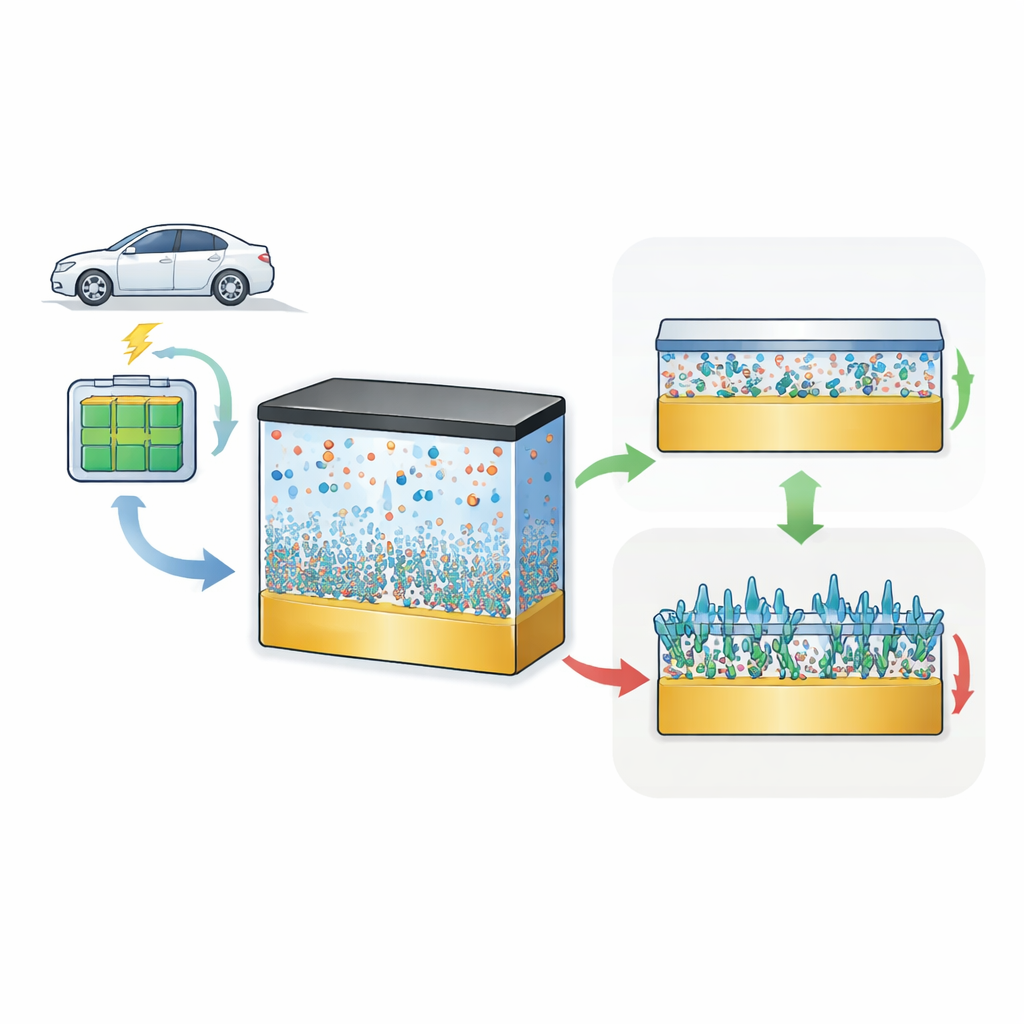
Modern devices and electric cars increasingly demand batteries that can be charged in just a few minutes and then deliver power steadily for hours. Today’s lithium-ion batteries struggle to combine ultra-fast charging with long life. This study explores a new way to fine-tune the liquid inside next-generation lithium metal batteries so they can charge quickly without forming dangerous needle-like growths and can discharge smoothly over long periods.
What Makes Lithium Metal So Appealing
Lithium metal batteries replace the standard graphite negative electrode with pure lithium metal, which can store far more energy in the same weight and volume. That could mean longer driving range and more room for power-hungry car features. The catch is that when lithium is repeatedly deposited and removed during charging and discharging, it tends to grow into tree-like structures called dendrites and to leave behind isolated “dead” lithium. Both problems waste active material and can eventually cause short circuits. These issues become more severe when we operate batteries in the most attractive real-world mode: very fast charging followed by slow, gentle power draw.
Looking Inside the Hidden Boundary Layer
At the heart of the problem is a thin, fragile boundary layer that naturally forms on lithium metal, known as the solid–electrolyte interphase, or SEI. Rather than being a rigid barrier, the SEI behaves like a swollen, sponge-like film penetrated by the liquid electrolyte. Lithium ions must squeeze through this layer on their way to and from the metal surface. The study shows that under fast charging, dendrites arise mainly because lithium ions move too slowly through the SEI, causing local depletion near the surface. Under slow discharging, the opposite issue emerges: only a few spots on the surface do most of the work, creating deep pits and isolated lithium. The authors argue that to solve both problems, you must both speed up ion transport through the SEI and encourage more uniform reaction sites across the surface.
A Smart Additive That Shrinks Ion Clumps
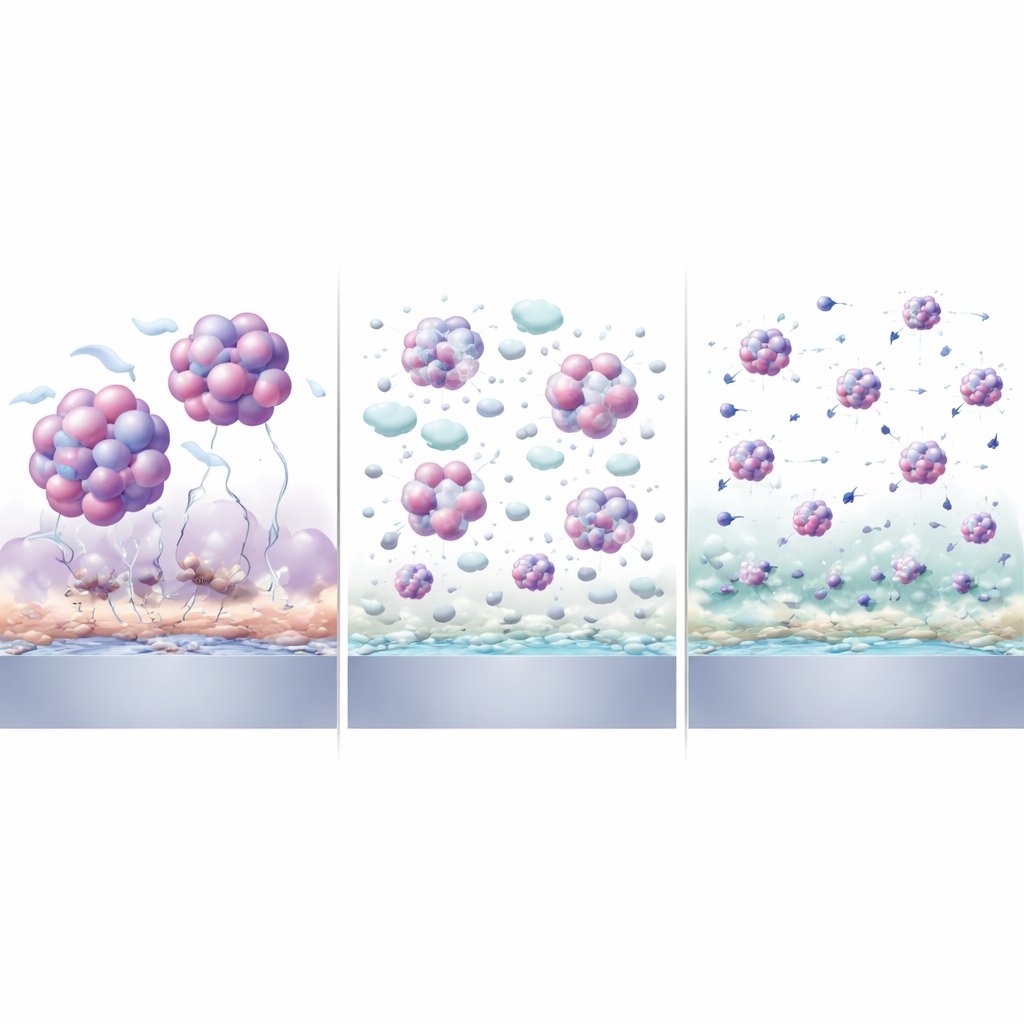
The researchers focus on a special type of electrolyte called a localized high-concentration electrolyte, where ions are packed closely together in clusters. These formulations are known to build a more robust, inorganic-rich SEI but usually work best only at modest charging speeds. The team proposes a new design principle based on a molecular property called electrostatic potential difference. They introduce a small additive molecule, (difluoromethyl)trimethylsilane, into a standard ether-based electrolyte. This additive is engineered so that different parts of the molecule carry strongly contrasting electrical character. Even though it does not strongly grab lithium ions itself, it changes the electric environment around them and breaks up large ion clusters into smaller ones. Experiments and simulations confirm that, compared to a closely related additive, this molecule creates many more small ion pairs and fewer bulky aggregates.
How Smaller Clusters Tame Fast Charging
Once clusters are smaller, lithium ions can weave through the swollen SEI more easily. The study uses several electrochemical tests to separate the effects of bulk ion movement, charge transfer at the surface, and transport through the SEI. The authors find that the new electrolyte does not dramatically change the basic reaction rate or the chemical makeup of the SEI compared to the control, but it does speed the relaxation of the electrode potential after current is switched off—a signature of easier ion diffusion through the SEI. Microscopy images show that, at very high current, conventional and control electrolytes produce thin, needle-like lithium deposits, while the new formula maintains smooth, flat layers even when charged at 12 milliamps per square centimeter. This leads to highly stable cycling efficiencies that remain above 98 percent under these extreme conditions.
Keeping Discharge Smooth and Even
Slow discharging presents a different challenge: reactions tend to become concentrated at a few structurally weak surface sites, which dig deep pits and leave behind dead lithium. The new electrolyte turns out to help here as well. It slightly increases the voltage penalty, or overpotential, required for lithium to move, which sounds harmful but actually spreads the reaction over many more locations on the surface. Imaging of lithium after slow discharge reveals shallow, widely distributed pits instead of a handful of deep ones. In full battery cells paired with a high-energy cathode, this translates into impressive practical performance: the cells can reach roughly three-quarters of full charge in about six minutes at a 10 C rate and still keep more than 80 percent of their original capacity after 200 cycles, even when discharge is relatively gentle.
What This Means for Future Batteries
By carefully tailoring the shape and charge distribution of an apparently simple additive molecule, the authors demonstrate a powerful lever for controlling how lithium ions move through the critical boundary layer in lithium metal batteries. Their work shows that shrinking ion clusters and slightly raising the electrode’s polarization can simultaneously support extremely fast charging and stable, slow discharging. For non-specialists, the key takeaway is that smarter electrolyte design—not just new electrode materials—may unlock safer, longer-lasting batteries that charge in minutes rather than hours.
Citation: Kim, M., Kim, J., Baek, M. et al. Electrolyte diluent with large electrostatic potential difference for fast charging and slow discharging lithium metal batteries. Nat Commun 17, 3183 (2026). https://doi.org/10.1038/s41467-026-69870-7
Keywords: lithium metal batteries, fast charging, electrolyte design, solid electrolyte interphase, (difluoromethyl)trimethylsilane