Clear Sky Science · en
Self-driven recycling of spent Li-ion battery materials with electricity generation
Why old batteries still matter
Lithium-ion batteries power our phones, laptops and electric cars, but once they wear out they are usually shredded and treated with heat or strong acids. That recovers valuable metals, yet it burns energy, uses lots of chemicals and leaves polluted wastewater. This paper describes a different approach: using the leftover energy still stored in spent battery materials to drive their own recycling while also capturing carbon dioxide. For a general reader, it shows how clever chemistry and engineering can turn a growing waste problem into a source of both raw materials and clean power.
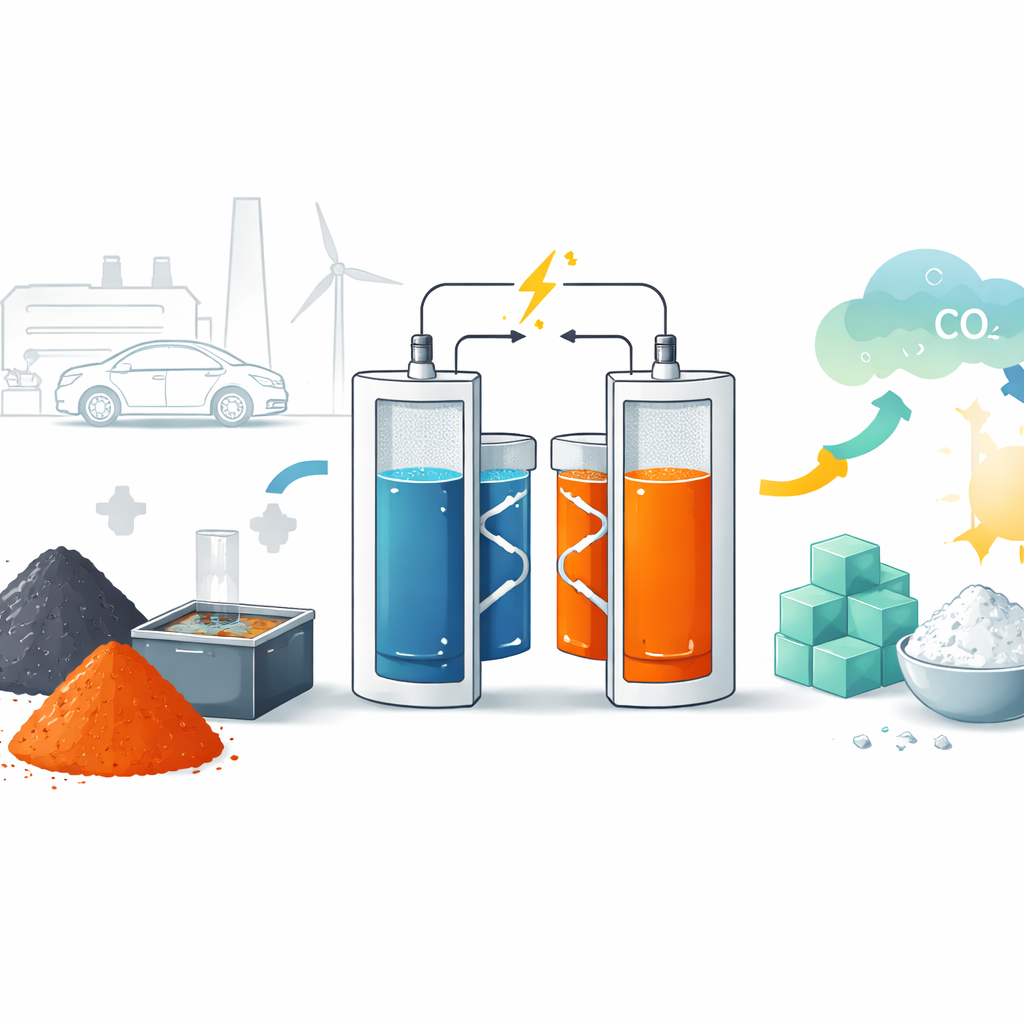
From dead cells to hidden power
Conventional recycling of lithium-ion batteries relies on two main routes. Pyrometallurgy melts the shredded cells at temperatures above those in a blast furnace, producing metal-rich alloys but consuming huge amounts of energy and releasing harmful gases. Hydrometallurgy uses acids and oxidants at modest temperatures to dissolve out metals such as lithium, nickel, cobalt and manganese, but it requires large volumes of chemicals and generates salty wastewater. Both routes are usually tuned to a single type of cathode material, so recycling plants struggle with the messy mixture of chemistries coming from real-world electric vehicles and storage batteries. At the same time, the cathode powders still contain electrochemical energy that current processes simply waste as heat.
A flow system that recycles itself
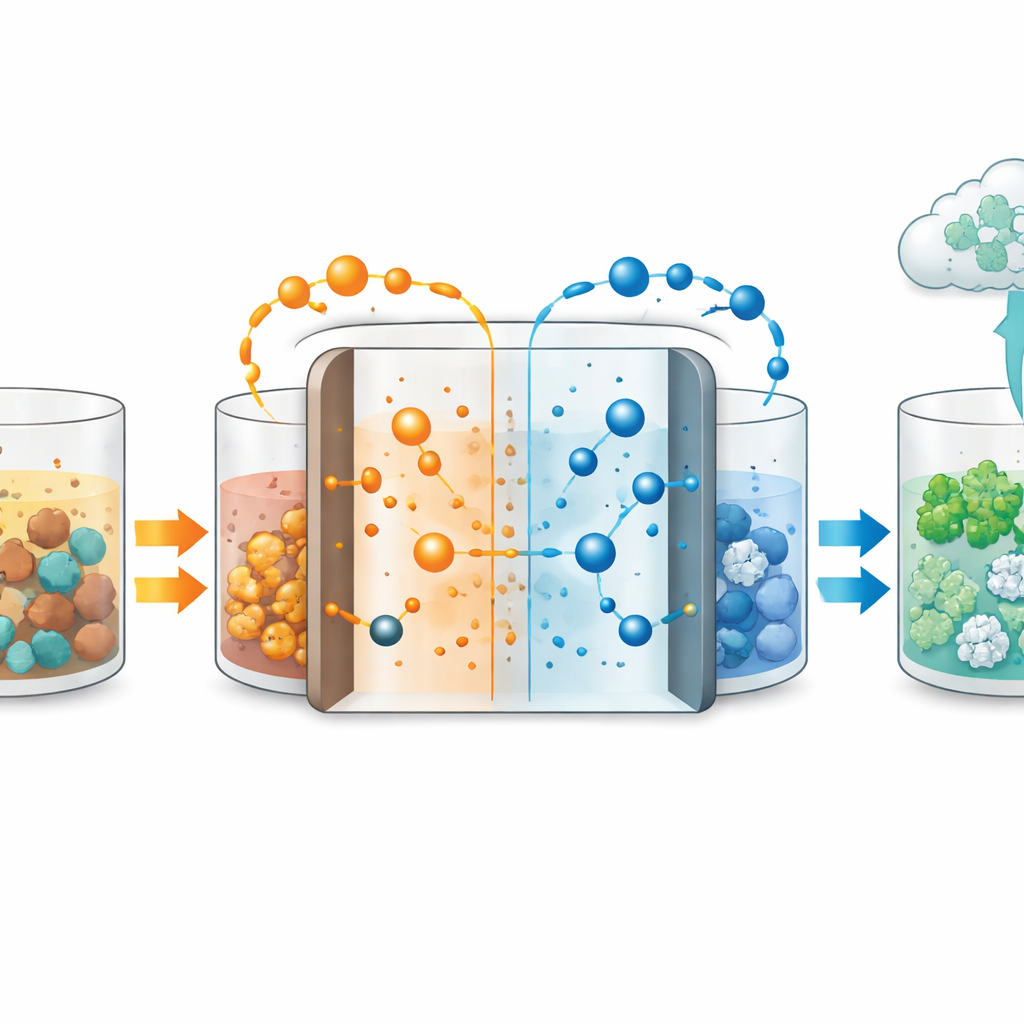
The authors propose a "self-driven" recycling strategy built around a redox flow cell, a kind of battery where energy is stored in liquids that circulate through an electrochemical stack. They place two common spent cathode materials into separate external tanks: lithium iron phosphate (LFP) on one side and nickel–manganese–cobalt or lithium cobalt oxide (grouped here as layered oxides) on the other. Special dissolved molecules, called mediators, shuttle between the tanks and the flow cell. On the LFP side, one mediator pulls electrons from the solid, oxidizing it and releasing lithium ions into solution. On the layered-oxide side, another mediator donates electrons into the solid, reducing it and dissolving lithium and transition metals into the liquid. Because the two solids have different inherent voltages, the overall reaction runs spontaneously like a galvanic cell and produces usable electrical power while it leaches metals from the waste.
Closing the loop on metals, lithium and chemicals
Once the discharge step has moved lithium and metal ions into the catholyte, the solution is further processed. Adjusting the alkalinity causes nickel, cobalt and manganese to come out as mixed metal hydroxide particles, which can later be turned back into fresh cathode powders. The remaining lithium-rich liquid is then bubbled with carbon dioxide, forming lithium carbonate crystals—a standard industrial lithium product—while also locking away the gas. The solid iron phosphate left from the LFP side can be purified and relithiated to regenerate LFP. To avoid constant purchases of acid and base, the team adds a "hydrogen looping" subsystem: two additional flow cells that use water splitting and hydrogen oxidation to regenerate hydrogen ions and hydroxide ions inside the same solution. In this way the process steadily reuses its key chemicals, consuming mainly water and electricity instead of bulk reagents.
Performance, efficiency and real-world impact
Laboratory tests show that more than 95% of lithium and transition metals can be recovered from mixed LFP and layered-oxide feedstocks. The mediators remain stable through cycling, and the main bottleneck is how fast the acid can supply protons in the layered-oxide tank, which controls the leaching rate. The system can be adapted to different commercial cathodes, including cobalt-rich ones. A techno-economic analysis compares this redox-mediated route to a standard hydrometallurgical plant for a realistic blend of battery scrap. Although the new process spends more on electricity—mainly to run the hydrogen loop—it saves heavily on acids, bases and neutralizing salts. Overall, the model predicts lower recycling cost per kilogram of waste, higher profit margins, and the added benefit of electricity production and carbon dioxide capture.
What this means for future batteries
In simple terms, this work turns old battery materials into both their own fuel and their own solvent. By exploiting the natural voltage gap between different cathodes, the system recovers metals, generates power and converts waste carbon dioxide into useful lithium carbonate—all within a largely closed cycle of reusable chemicals. If scaled up and coupled to cheaper membranes and more durable mediators, such self-driven recycling plants could process mixed battery scrap from many sources with lower environmental impact. For the public, the key message is that the batteries powering the clean-energy transition do not have to become a new pollution problem; with smart electrochemistry, they can feed back into the supply chain and even help power their own rebirth.
Citation: Huang, S., Huang, S., Li, M. et al. Self-driven recycling of spent Li-ion battery materials with electricity generation. Nat Commun 17, 2996 (2026). https://doi.org/10.1038/s41467-026-69868-1
Keywords: lithium-ion battery recycling, redox flow cell, critical metal recovery, carbon dioxide capture, sustainable energy storage