Clear Sky Science · en
Direct synthesis of bicyclo[1.1.1]pentane (BCP) boronates from carboxylic acids
Why this tiny scaffold matters
Many modern medicines are held back by a simple problem: their molecules are too floppy, greasy, or easily broken down in the body. Chemists have discovered that swapping flat benzene rings for tiny three‑dimensional carbon cages, called bicyclo[1.1.1]pentanes, can give drugs better stability and behavior in the bloodstream. The challenge has been making these unusual cages quickly and reliably. This paper describes a straightforward way to forge key bicyclo[1.1.1]pentane building blocks directly from common carboxylic acids, opening a faster route to next‑generation medicines.
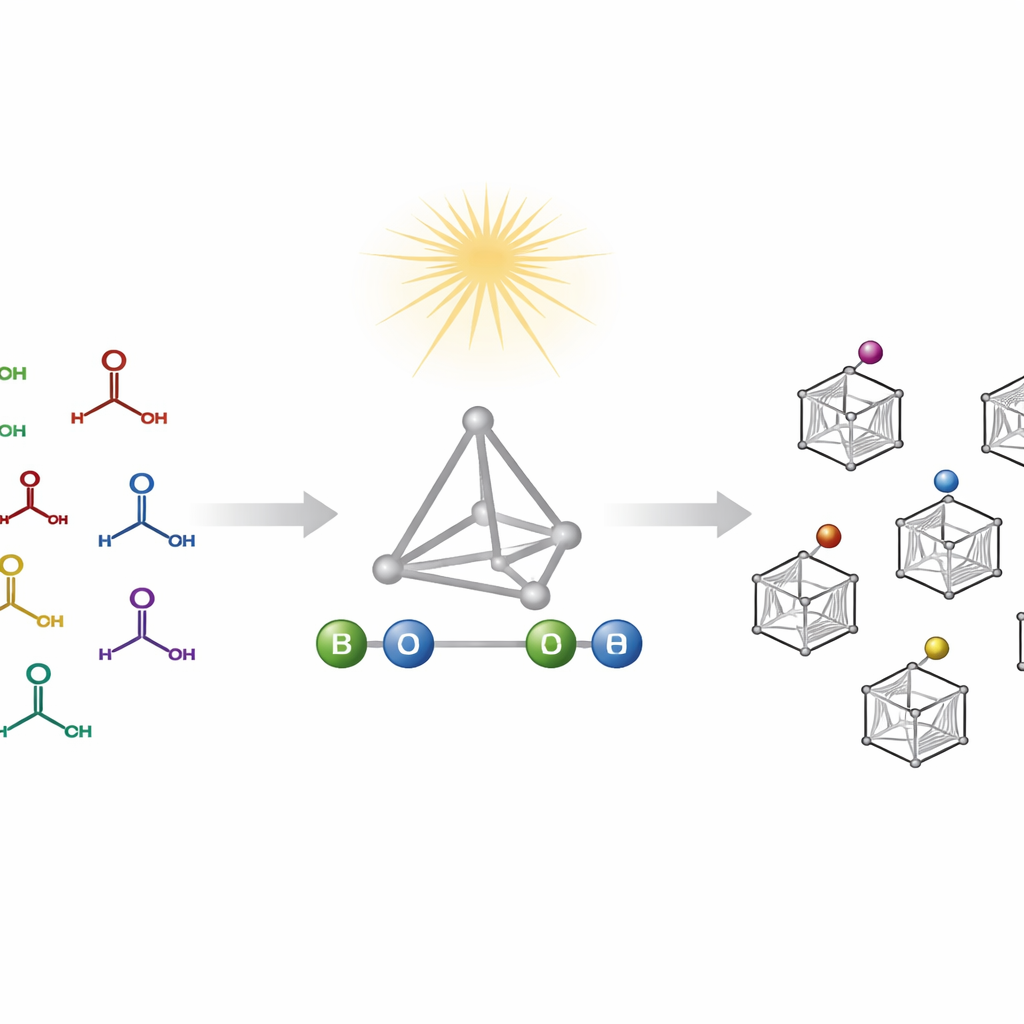
A shortcut from simple acids to useful cages
Carboxylic acids are among the cheapest and most abundant raw materials in chemistry, found in everything from fatty acids to many existing drugs. Until now, turning these acids into bicyclo[1.1.1]pentane boronates—highly adaptable connectors used to build drug molecules—required first converting the acids into special “redox‑active esters” in separate steps. Those extra manipulations wasted atoms, took time, and created by‑products. The authors show that acids can instead be transformed into the desired cage boronates in a single step by mixing them with a strained carbon framework called [1.1.1]propellane and a boron source, then shining violet light on the solution.
Light, solvent, and iron working together
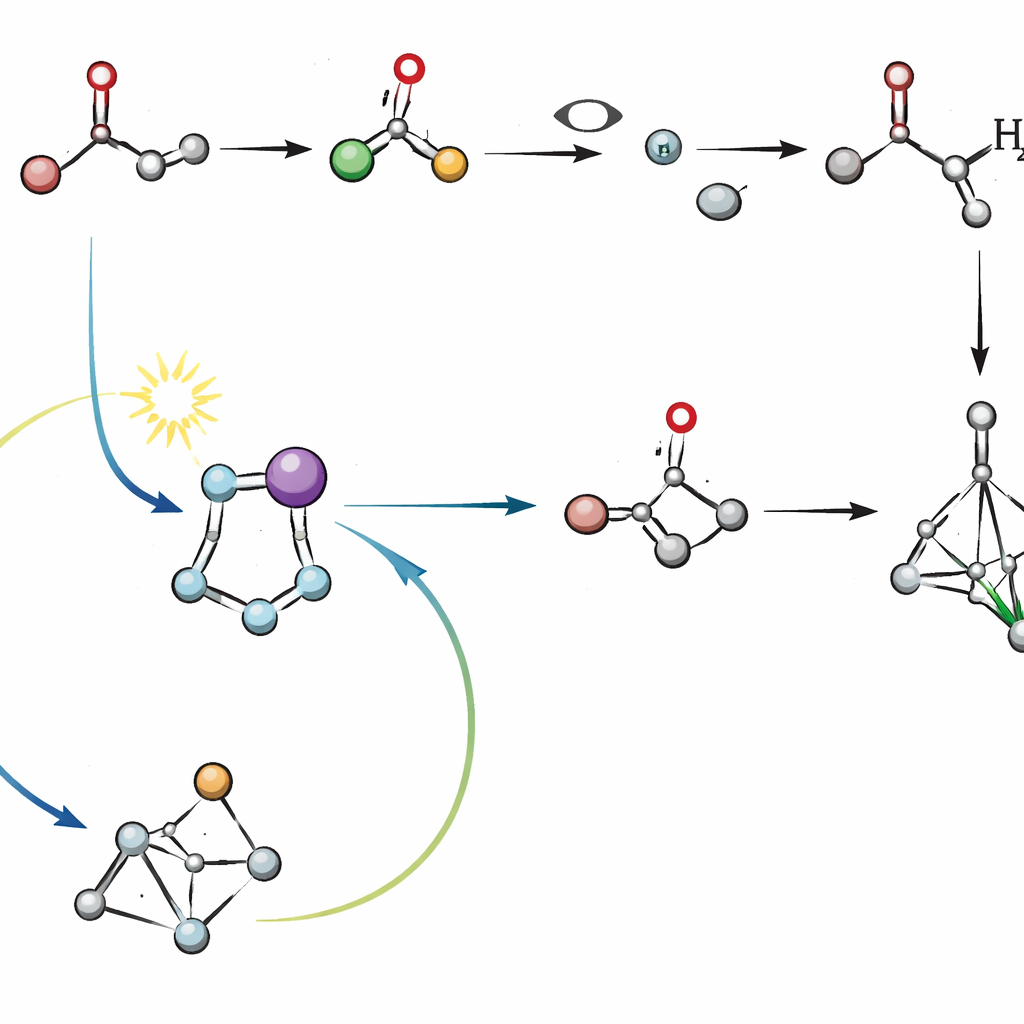
In the new reaction, the solvent dimethyl sulfoxide does more than simply dissolve the ingredients. It teams up with the boron reagent to form a light‑sensitive pair. When irradiated, this pair splits to create a reactive oxygen‑centered fragment that pulls a hydrogen atom off the carboxylic acid, triggering loss of carbon dioxide and leaving behind a short‑lived carbon radical. That radical snaps open the [1.1.1]propellane cage and, with the help of extra boron reagent, is trapped as a stable bicyclo[1.1.1]pentane boronate. Adding a simple iron salt and a mild base boosts the efficiency further: iron briefly binds the acid and, upon light absorption, also ejects the same type of carbon radical through a charge‑transfer process. These two routes—one through hydrogen abstraction, one through iron—run in parallel and reinforce each other.
One recipe, many starting materials
Because radical intermediates react mainly at a single carbon and ignore many other groups, the method tolerates a striking variety of carboxylic acids. The team converted primary, secondary, tertiary, and benzylic acids, as well as acids bearing rings, ethers, halogens, and nitrogen‑containing fragments, into the corresponding bicyclo[1.1.1]pentane boronates in generally good yields. Even complex natural products and approved drugs that contain acid units—such as ibuprofen, gemfibrozil, and resin‑derived acids—underwent the transformation late in their synthesis without falling apart. This breadth suggests that chemists can now “plug in” the cage motif to many existing molecules without extensive re‑engineering of routes.
Turning fragments into drug‑like candidates
To highlight the practical impact, the researchers used their new boronate fragments to build cage‑containing versions of two marketed drugs, the antifungal agent butenafine and the motion‑sickness drug buclizine. Starting from a single bicyclo[1.1.1]pentane boronate, they carried out a short sequence of standard reactions to attach the rest of each drug skeleton. Although these demonstrations were not optimized for yield, they show that once the cage boronate is in hand, it slots smoothly into familiar medicinal chemistry workflows, enabling quick exploration of how the three‑dimensional swap affects potency, selectivity, and pharmacokinetics.
What this means going forward
In everyday terms, the study offers chemists a new power tool: a bright‑light‑driven way to snap simple acid building blocks into compact carbon cages that can upgrade drug molecules. By avoiding pre‑activation steps and making clever use of solvent, boron, and iron, the method streamlines access to bicyclo[1.1.1]pentane fragments while tolerating many sensitive features. This dual‑pathway mechanism—hydrogen abstraction working hand‑in‑hand with iron charge transfer—may also inspire other efficient reactions that turn humble feedstock acids into sophisticated structures for medicine and materials.
Citation: Wang, Y., Tang, J.C., Wu, G. et al. Direct synthesis of bicyclo[1.1.1]pentane (BCP) boronates from carboxylic acids. Nat Commun 17, 3070 (2026). https://doi.org/10.1038/s41467-026-69851-w
Keywords: bicyclo[1.1.1]pentane, decarboxylative borylation, photochemistry, medicinal chemistry, radical chemistry