Clear Sky Science · en
Liquid photonic-molecule microlasers for ultrasensitive biosensing
Light in a droplet
Imagine if tiny liquid droplets could act as ultra-sensitive alarms for the faintest traces of disease markers in blood or inside living tissue. This study shows how to turn microscopic oil droplets into powerful laser-based sensors that can detect biomolecules at concentrations far beyond the reach of most current techniques, all while using gentle light levels that are safer for delicate biological samples.
From tiny lasers to powerful sensors
Microlasers are minuscule light sources that can sit on a chip or even inside a cell. When these lasers are made from liquid droplets, they become especially attractive for biology: droplets are easy to form in large numbers, they naturally encapsulate chemicals or biomolecules, and they respond strongly to tiny changes in their surroundings. However, most droplet lasers emit many colors of light at once, which blurs the signal and limits how precisely they can sense biological events. The challenge has been to create droplet lasers that are clean (mostly one color), efficient (requiring very little energy), and extraordinarily sensitive to molecular changes, all in a single device.
Two droplets acting as one
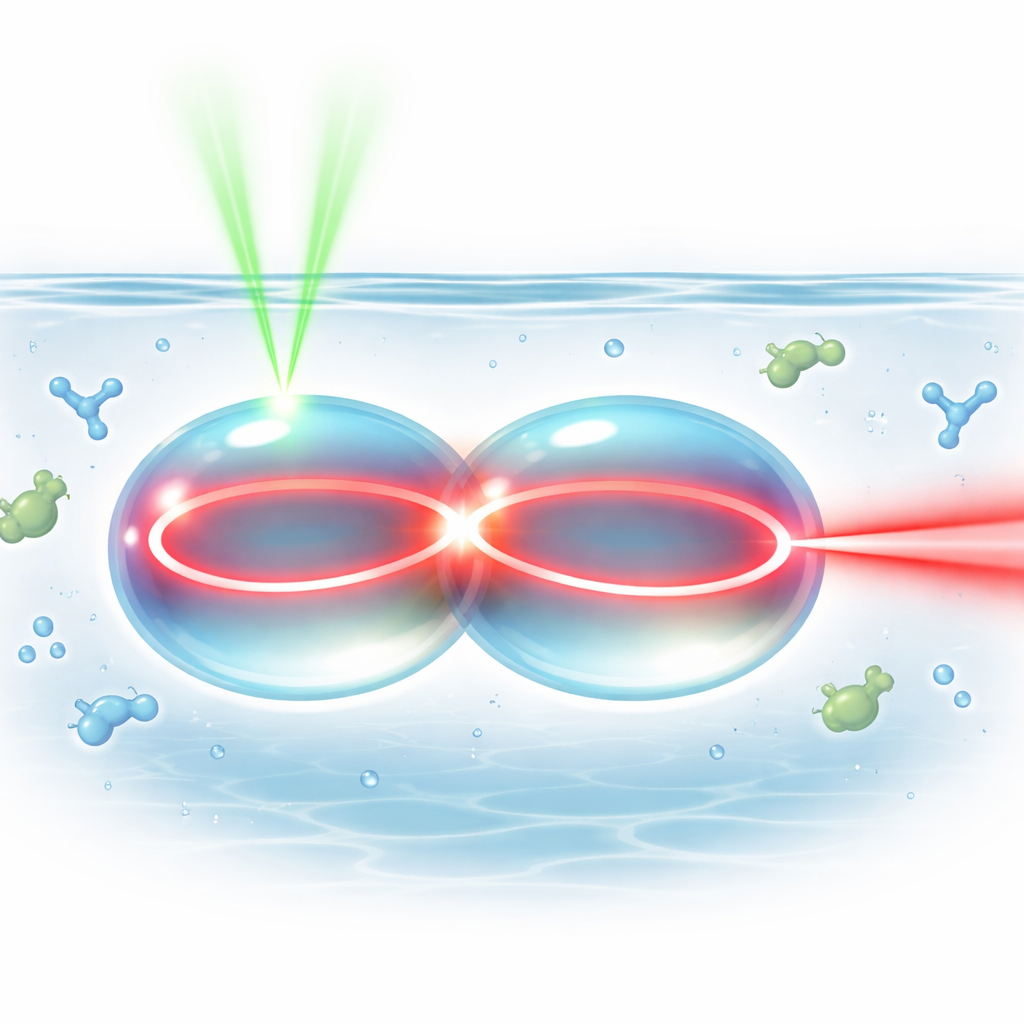
The researchers solve this by pairing two dye-filled oil droplets of slightly different sizes so that they behave like a single “photonic molecule.” When a green laser pulse shines on the pair, light circulates around the edge of each droplet, much like sound traveling along the walls of a whispering gallery. If the droplet sizes are chosen carefully, one particular light path lines up perfectly in both droplets. Under these conditions, the light no longer stays confined to either droplet alone. Instead, it forms a shared super-mode that spreads across both droplets and outcompetes all other paths. This produces a single, sharp laser color with a remarkably low energy requirement—about ten times lower than that of a comparable single droplet—making it friendlier for biological use.
Turning tiny shifts into big signals
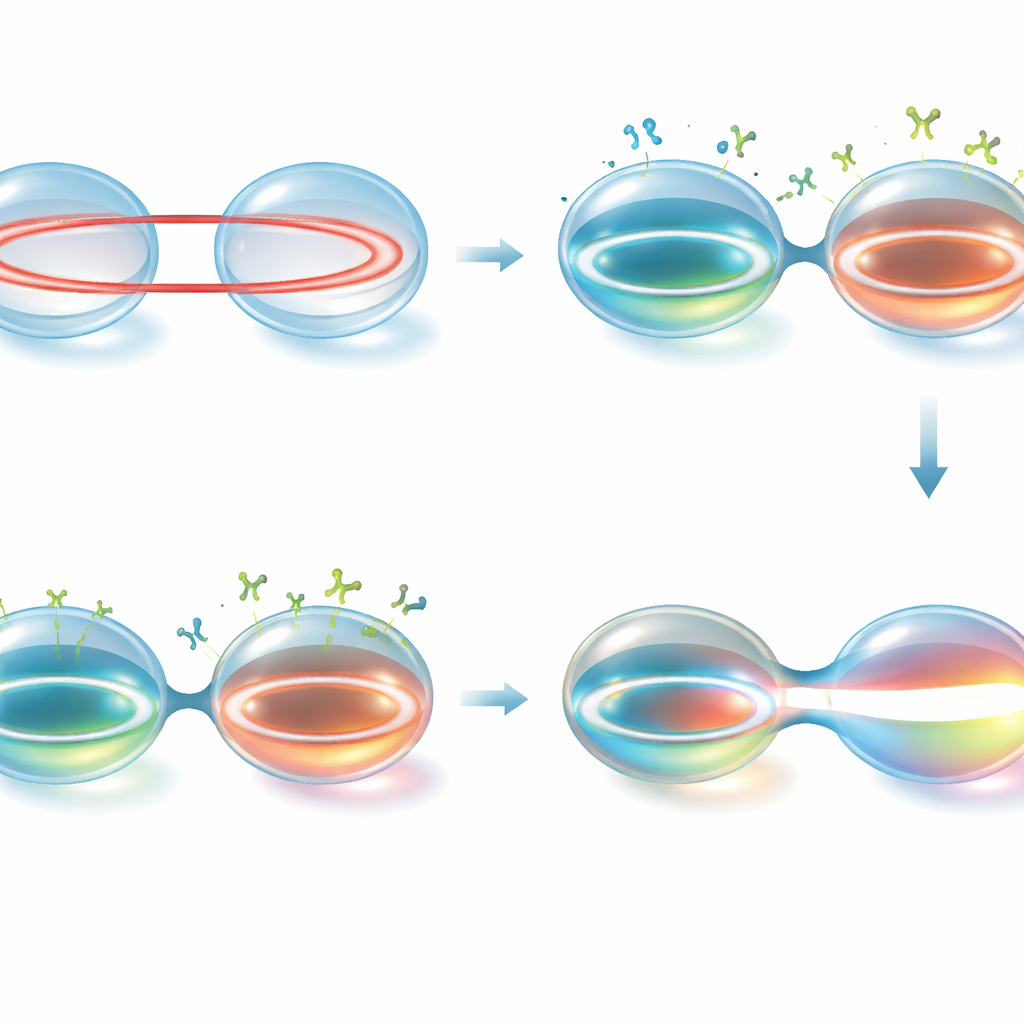
Because the two droplets are slightly mismatched, this shared light mode is highly selective. A minute change in one droplet’s optical properties can disturb the perfect alignment and force the laser to “hop” from one favored path to another, much like the tick of a Vernier scale magnifies a tiny shift. The team demonstrates this tunability by adding light-sensitive molecules to one droplet. Under ultraviolet light, these molecules rearrange their structure, subtly changing how the droplet bends light. This small refractive change causes the laser color of the coupled droplets to jump in noticeable steps rather than drift slowly, effectively amplifying the response by up to about ten times compared to a single droplet on its own.
Listening to intensity instead of color
To transform this effect into a practical biosensor, the scientists chemically decorate the surface of the smaller droplet with a molecular “Velcro” system built from biotin, streptavidin, and antibodies that seek out a target protein. When target molecules bind at the droplet surface, they slightly alter the local optical environment. On their own, these changes would barely shift the laser color. But in the coupled-droplet system, they disrupt the finely tuned mode alignment and trigger a rearrangement of which light paths dominate. As a result, the intensities of several nearby laser lines rise and fall in a characteristic pattern as more target molecules bind. By tracking the ratio of intensities between these lines, the sensor can reliably detect protein concentrations down to 30 attomolar—roughly a thousand times more sensitive than a comparable single-droplet laser—and operate over a range spanning nine orders of magnitude.
New tools for future health monitoring
In simple terms, the study shows how pairing two tiny liquid lasers makes them far more efficient and exquisitely sensitive to the faintest molecular events at their surfaces. Instead of struggling to measure a barely noticeable color shift, this approach reads out large, clear changes in laser brightness patterns that are naturally resistant to background noise. Such liquid photonic-molecule microlasers could be integrated into lab-on-a-chip devices or even injected as microscopic probes into tissues, opening paths toward earlier disease detection, real-time monitoring of cellular processes, and new ways to study how biomolecules interact in tiny volumes.
Citation: Wang, Y., Hu, YH., Wu, JL. et al. Liquid photonic-molecule microlasers for ultrasensitive biosensing. Nat Commun 17, 3026 (2026). https://doi.org/10.1038/s41467-026-69840-z
Keywords: droplet microlaser, biosensing, photonic molecule, single-mode laser, ultrasensitive detection