Clear Sky Science · en
Graphene demon wave transistor
Why taming heat at tiny scales matters
As electronic devices shrink and work ever faster, getting rid of excess heat has become one of the main roadblocks to progress. While electric currents can be turned on and off with transistors, heat in solids usually just seeps away in all directions, giving engineers little control. This article reports a new kind of device made from graphene that treats heat more like a signal than waste, switching it with high contrast using waves in an exotic electron fluid.
Heat that flows like a liquid wave
In ordinary materials, heat moves as jostling vibrations of atoms and wandering electrons, a slow, diffusive process much like the spread of ink in water. In ultra-clean graphene near its charge-neutral state, the electrons and their positively charged counterparts, called holes, collide with each other so often that they behave collectively, more like a liquid than a gas of independent particles. In this hydrodynamic regime, energy does not merely diffuse; it can travel as organized ripples of temperature and energy density known as entropy waves or “demon” modes. These waves carry heat with very little accompanying electric charge, offering a path to guide thermal energy without moving many electrons from place to place.
Building a heat transistor from a single sheet
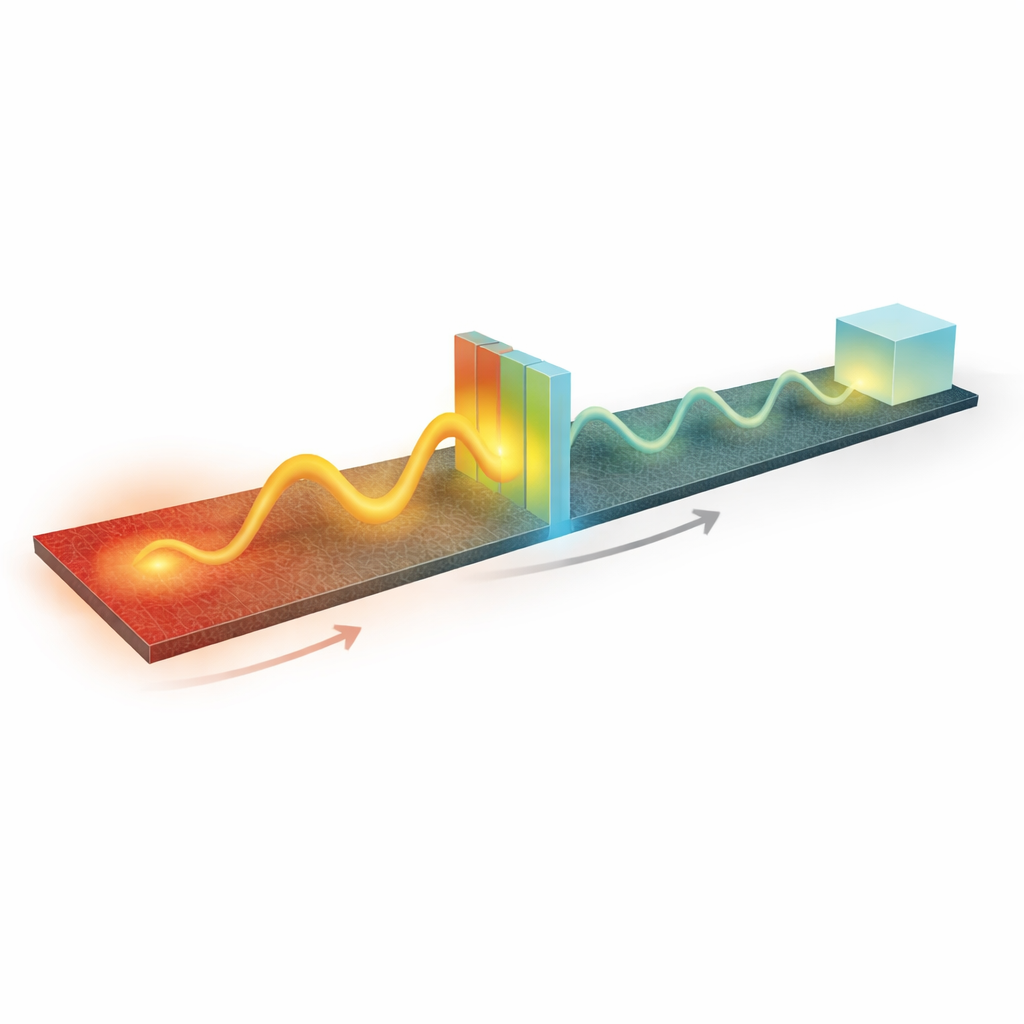
The researchers crafted a high-mobility graphene sheet sandwiched between layers of insulating hexagonal boron nitride and placed it on a tiny gold structure that doubles as both a support and an antenna for terahertz radiation. A global gate underneath the device sets the overall type and density of charge carriers in the graphene, while a narrow top gate creates a short region with independently adjustable carrier density. This gated sliver acts as a “wall” in the electron fluid along the graphene strip. To launch demon waves, ultrafast laser pulses briefly heat a small patch of the graphene, creating a sharp, localized rise in electronic temperature that fans out along the sheet as a coherent thermal wave.
Watching and switching heat waves in real time
As the entropy wave races along the graphene, its passage across a nanometer-scale gap in the underlying gold line generates a faint terahertz pulse that travels along the metal and is picked up by a fast detector. By scanning the laser spot and varying the time delay between pump and probe, the team reconstructs how the wave evolves in both space and time. They find that the wave moves much faster than sound in air, and its speed increases as the overall carrier density is raised, consistent with expectations for a collective excitation of the electron fluid. With no wall present, the heat wave propagates nearly undisturbed. When the gated wall is switched on, however, the transmitted wave downstream can be tuned continuously simply by changing the gate voltage.
A gate-controlled valve for entropy
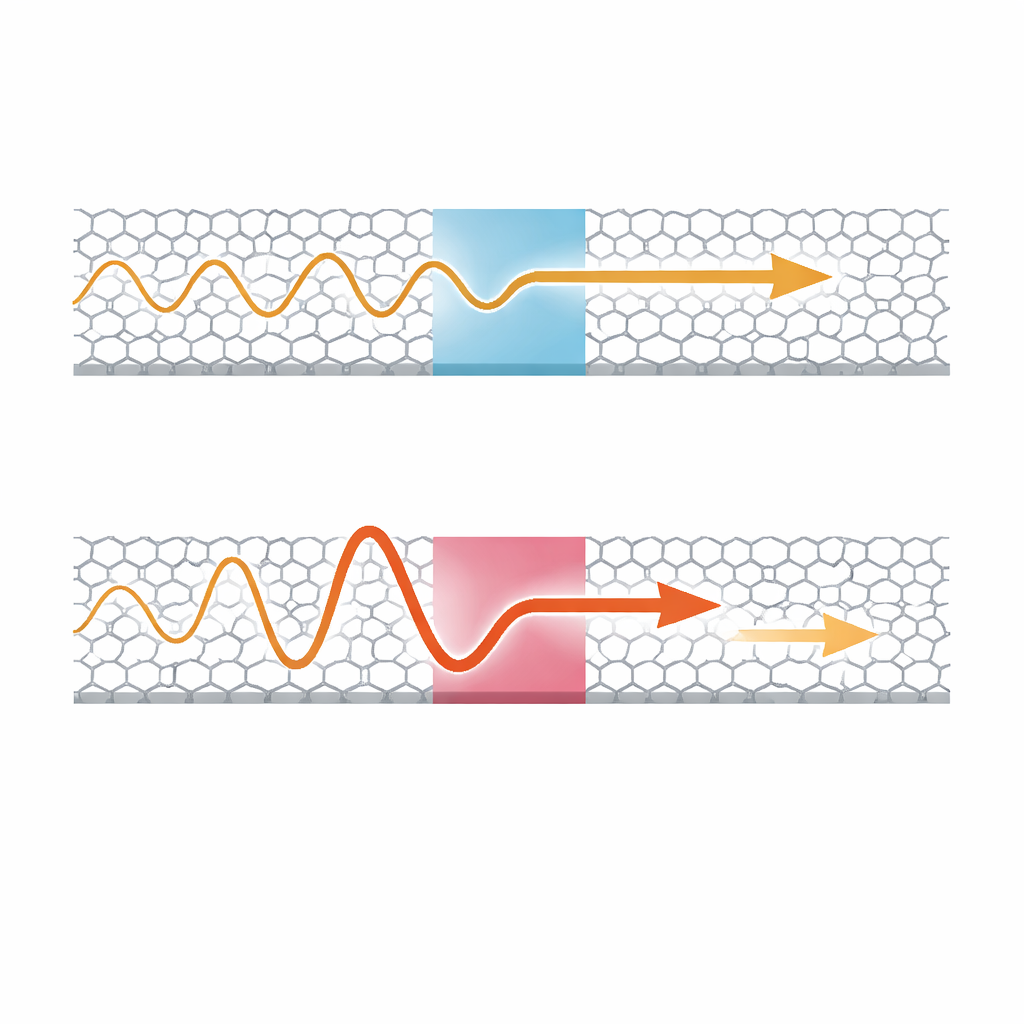
The key discovery is that the demon wave is highly sensitive to the “polarity” of the wall relative to the surrounding graphene. If the background region and the wall contain carriers of the same type—both electron-like or both hole-like—the hydrodynamic properties on either side are well matched, and the heat wave crosses with only modest loss. But when the wall reverses polarity—forming an n–p–n or p–n–p pattern—there is a strong mismatch in how the electron fluid responds to pressure and temperature changes. In this case, much of the entropy wave is reflected or damped, and the transmitted heat flux drops by more than 80 percent. Frequency-domain measurements show that this on–off control is broadband, affecting a wide slice of the terahertz spectrum.
Simulations that reveal the inner workings
To understand this behavior in detail, the authors model the graphene electrons and holes as coupled fluids obeying hydrodynamic equations similar to those used for ordinary liquids, but with extra terms to account for energy, momentum, and charge conservation in a relativistic-like electron system. In this picture, the demon mode appears naturally as a neutral entropy wave. When such a wave encounters a region of different carrier density, its transmission and reflection are governed by an effective “impedance,” combining the local entropy density, temperature, and wave speed. The simulations show that matching this impedance across the wall yields almost complete transmission, while a polarity reversal produces a large mismatch and strong reflection—precisely what the experiments observe. The model reproduces the measured transmission curves and spectra and predicts modulation of the transmitted heat flow approaching 90 percent.
From heat management to heat logic
By demonstrating that entropy waves in graphene can be gated almost as cleanly as electric current in a conventional transistor, this work opens a route toward active “thermal circuits” in which heat can be switched, routed, or even used to carry information. Because the control relies purely on voltages applied to a single material, without moving parts or structural changes, the potential switching speeds are extremely high, limited mainly by how quickly the gate capacitances can charge and discharge. In the long term, such hydrodynamic heat transistors could complement or even merge with conventional electronics, offering new ways to manage heat in densely packed chips and to build logic elements that operate on energy flow itself rather than just on electrical charge.
Citation: Zhuang, Y., Jin, Z., Niu, G. et al. Graphene demon wave transistor. Nat Commun 17, 3106 (2026). https://doi.org/10.1038/s41467-026-69839-6
Keywords: graphene, thermal transistor, electron hydrodynamics, terahertz waves, heat transport