Clear Sky Science · en
Graphene oxide synthesis at a nonthermal plasma-water interface
Turning Gas and Water into Smart Carbon Sheets
Graphene oxide is a remarkably thin form of carbon that underpins future technologies from faster electronics to cleaner water. But making it today usually involves harsh acids, toxic gases, and costly processing. This study introduces a cleaner, low-energy way to grow graphene oxide by combining natural gas and water in a special kind of electrical glow, potentially opening the door to greener batteries, filters, sensors, and building materials.
A New Way to Grow Useful Carbon
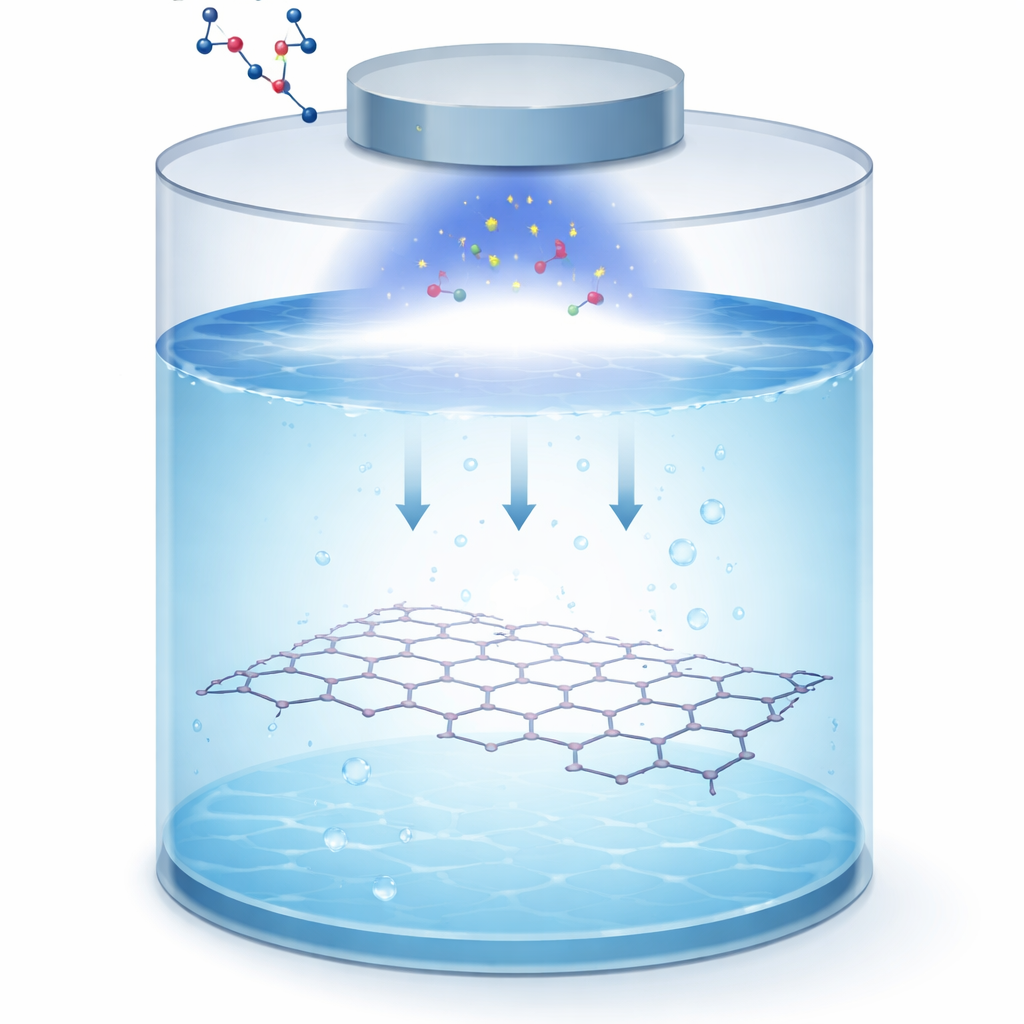
The researchers set out to replace traditional “top-down” methods, which carve graphene oxide from solid graphite using strong chemicals, with a “bottom-up” route that builds it directly from simple molecules. Instead of hot furnaces and corrosive liquids, they use methane (the main component of natural gas) and plain water. The key ingredient is a nonthermal plasma—a cold, electrically energized gas—created between a metal electrode and the surface of the water. When methane bubbles through this glowing region, its molecules are torn apart and reassembled into thin, sheet-like flakes of graphene oxide that float on the water surface.
How Lightning on Water Makes Carbon Sheets
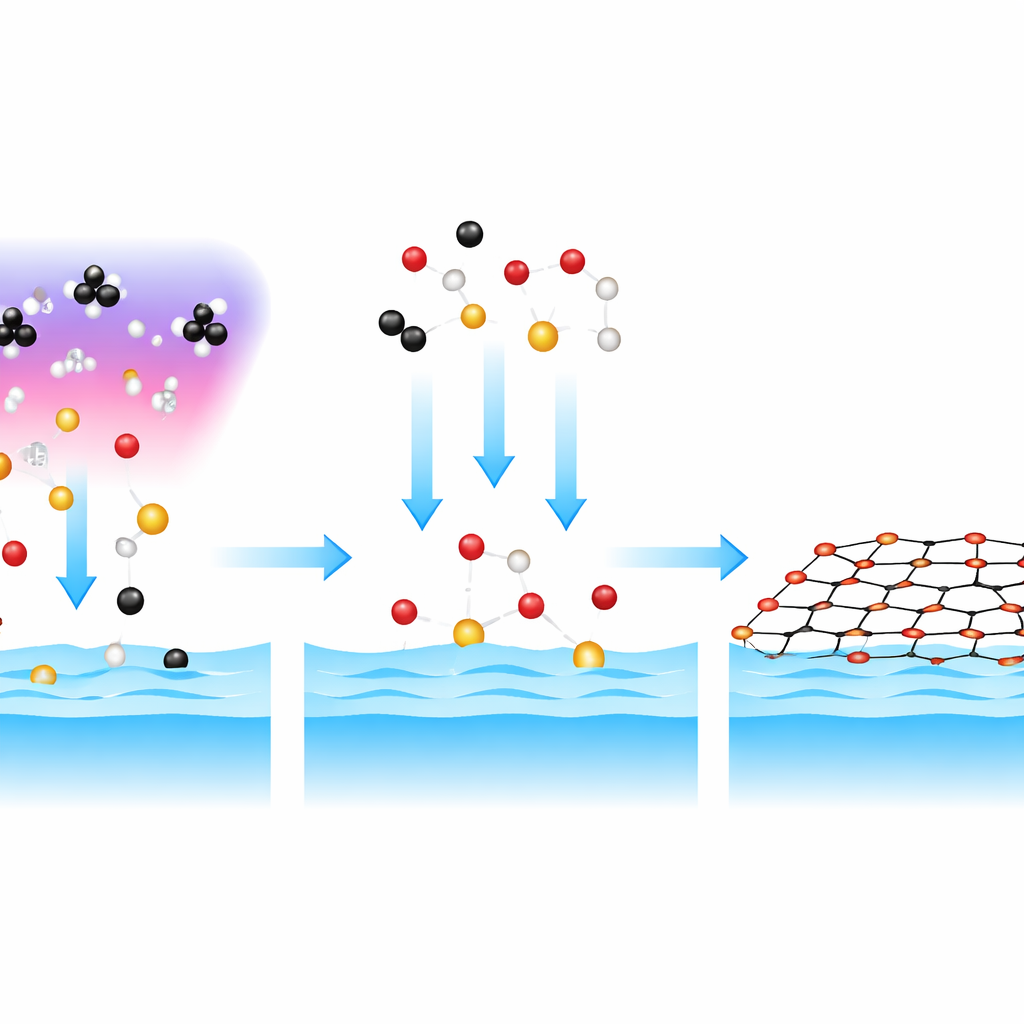
In their reactor, distilled water partially fills a glass tube. A high-voltage rod above the water and a small metal tube below create short, powerful electric pulses that turn the gas above the water into plasma, somewhat like tiny controlled lightning strikes. Methane entering this zone breaks into highly reactive fragments, while the plasma also splits water into oxygen- and hydrogen-containing species. At the water’s surface, carbon fragments link together into flat carbon networks, and the oxygen species attach to them. Over time, these networks grow and spread into a continuous layer of graphene oxide, which is then mixed into the water as bubbles rise and break, making it easy to collect in bulk.
Probing the Structure of the New Material
The team used a suite of imaging and spectroscopy tools to confirm that their material truly behaves like standard graphene oxide. Electron microscopes show thin, flaky particles a few micrometers across, often folded but still continuous. Atomic force measurements reveal a typical thickness of about one to two atomic layers, meaning the sheets are essentially two-dimensional. Other techniques that probe how atoms are arranged and bonded show that carbon and oxygen are distributed evenly, with the right balance between them, and that unwanted elements from salts, acids, or metals are absent. In short, the plasma-grown material closely matches commercial graphene oxide in structure and chemistry, without the usual contaminants.
Tuning Properties and Scaling Up
Because the plasma is driven by short electrical pulses, the researchers can adjust the energy in each pulse to influence how the flakes form. Higher pulse energies shrink the flake size and increase the oxygen content, allowing the material’s texture and chemical activity to be tailored for different uses, such as coatings or energy storage. Importantly, the sheets stay stable in water for at least six months, comparable to high-end commercial products. The same graphene oxide can also be heated in an inert environment to remove oxygen and convert it into conductive graphene-like material, showing that it serves as a good starting point for electronic applications. By redesigning the reactor with multiple discharge gaps and parallel modules, the team already achieves gram-per-day production and outlines a path to kilogram-per-day output.
Cleaner Production with Useful Side Benefits
Beyond material quality, the process offers environmental and economic advantages. Gas analysis shows that a significant fraction of the methane is converted into hydrogen gas, a valuable clean fuel, while only small amounts of carbon monoxide and almost no carbon dioxide are produced. Cost estimates suggest that graphene oxide made this way could be sold for a few hundred dollars per kilogram, far below current market prices that often exceed a thousand dollars per kilogram, and with much lower greenhouse gas emissions. Because it avoids strong acids, toxic fumes, and complicated washing steps, the method is easier to scale and safer for workers and the environment.
What This Means for Everyday Technologies
For non-specialists, the key message is that it may soon be possible to make large quantities of high-quality graphene oxide from simple ingredients—natural gas and water—using electricity instead of aggressive chemistry. This gentle “lightning over water” approach could supply cleaner, cheaper carbon sheets for better batteries, stronger yet lighter concrete, advanced filters for water and air, and smart coatings and sensors. By marrying plasma physics with materials science, the work points toward a future where cutting-edge nanomaterials can be manufactured in a more sustainable and scalable way.
Citation: Banavath, R., Zhang, Y., Akhter, M. et al. Graphene oxide synthesis at a nonthermal plasma-water interface. Nat Commun 17, 3908 (2026). https://doi.org/10.1038/s41467-026-69831-0
Keywords: graphene oxide, nonthermal plasma, green nanomaterials, hydrogen co-production, sustainable synthesis