Clear Sky Science · en
An interfacial-intramolecular electron highway for accelerated electrocatalytic CO2 reduction by an O2-tolerant formate dehydrogenase
Turning a Climate Problem into a Useful Ingredient
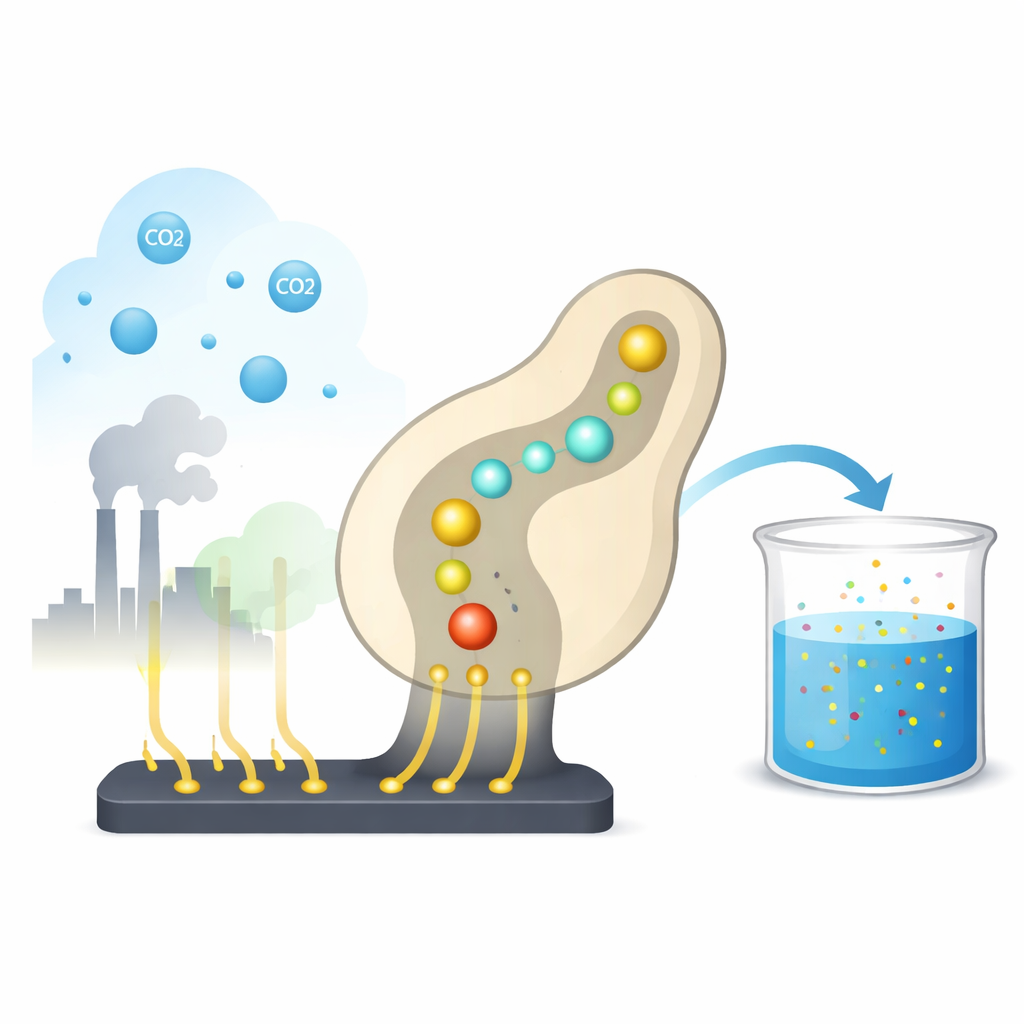
Carbon dioxide is usually cast as a climate villain, but it is also a cheap, abundant source of carbon that could feed future chemical and fuel production. This study shows how a specially discovered enzyme can pull CO2 out of a gas stream and convert it into formate, a simple liquid molecule that can store energy or serve as a building block for other products—even when oxygen is present, which normally disables such enzymes. The work combines modern biology, structural imaging, and electrochemistry to design a compact CO2-to-formate device that runs efficiently for days.
Finding a Better Natural Machine
The authors began by searching nature’s vast protein catalog for a formate dehydrogenase—an enzyme that interconverts CO2 and formate—that is both fast and tolerant to oxygen. Using artificial-intelligence tools on more than 30,000 related sequences, they narrowed the field to a few hundred promising candidates that were likely metal-containing, efficient, and produced by microbes able to live with oxygen. One enzyme, dubbed SoFdhAB from the bacterium Shewanella oneidensis, stood out. Tests showed that this tungsten-based enzyme converts CO2 to formate roughly five times faster than a previous benchmark, and unlike many of its cousins, it keeps its activity during normal handling in air, making it far more practical for real-world applications.
Building a Direct Electron Highway
To turn the enzyme into an efficient electrocatalyst, the team attached SoFdhAB onto carbon nanotube electrodes so that electrons could flow straight from the electrode into the protein without the help of extra redox chemicals. On these electrodes, SoFdhAB catalyzed the reversible conversion between CO2 and formate at voltages very close to the ideal thermodynamic value, meaning minimal wasted energy. Remarkably, more than 90 percent of the catalytic current came from direct electron transfer, an unusually high figure that shows electrons are taking a short, well-defined path from the carbon surface into the enzyme’s active center.
Seeing the Inner Wiring and Oxygen Shield
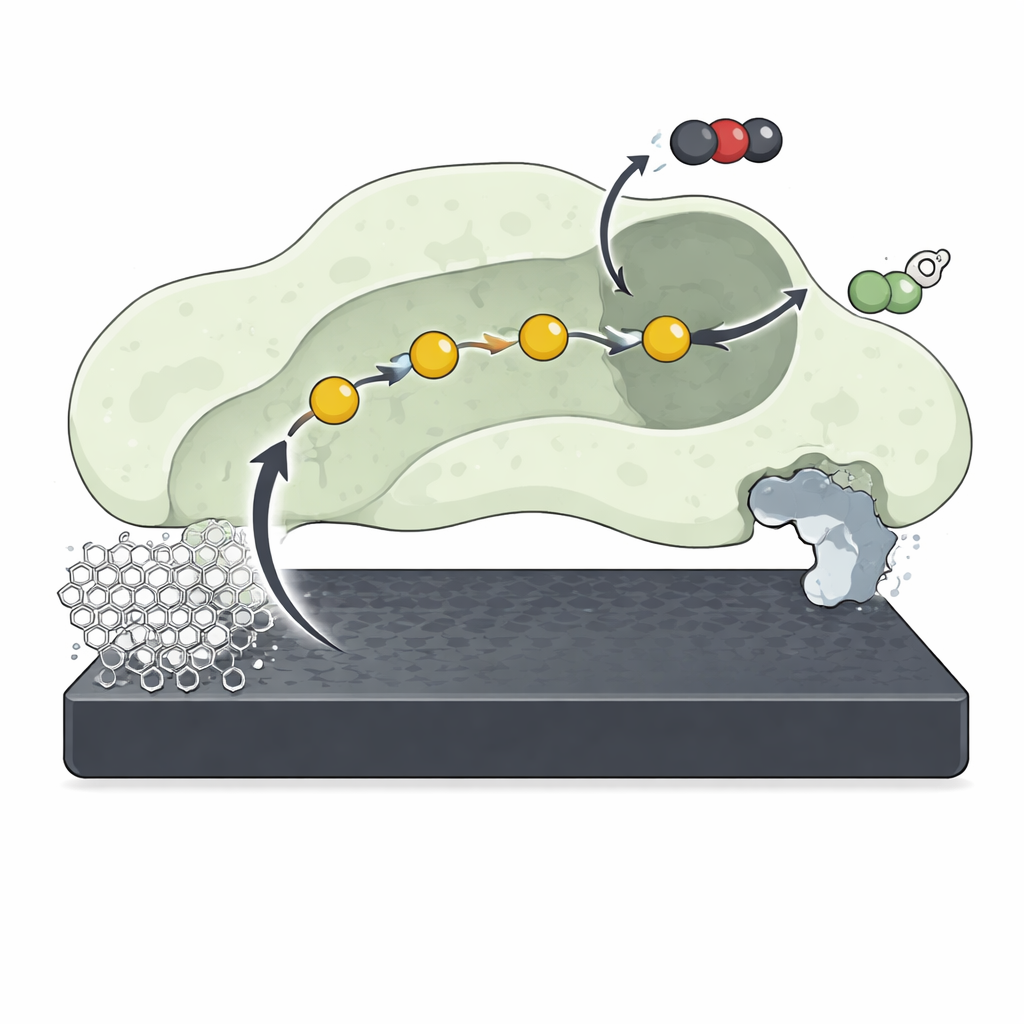
Cryo-electron microscopy provided a high-resolution 3D picture of SoFdhAB. The structure revealed a “built-in wire”: five iron–sulfur clusters arranged in a chain between the tungsten active site and the protein surface, with distances short enough for rapid electron tunneling. At the outer end of this chain, the final cluster sits close to the protein surface, surrounded by aromatic amino acids that make favorable face-to-face contact with the carbon electrode. This arrangement helps the enzyme land in an orientation that maximizes electron flow. Structural comparisons and targeted mutations also uncovered how SoFdhAB resists oxygen. A narrow gas tunnel leading to the active site is partially blocked by specific bulky amino acids, which act like a gate: when these are altered, the enzyme becomes more vulnerable to oxygen under air but regains activity in oxygen-free conditions, indicating that the gate helps keep damaging oxygen away from the catalytic center.
Tuning the Interface for Stronger Performance
The researchers further engineered both the enzyme and the electrode surface. By changing a single amino acid near the distal iron–sulfur cluster (Y94S), they shortened the distance between the electron relay and the carbon support and strengthened hydrogen-bonding interactions. This variant, SoFdhAB-Y94S, delivered higher electrocatalytic currents without increasing the amount of enzyme or its basic activity in solution, confirming that the improvement came from a better electrical connection. Experiments with different types of carbon nanotubes showed that a combination of hydrogen bonding and π–π interactions between aromatic residues and the carbon surface creates a robust, oriented attachment that is hard to disrupt.
From Fundamental Insight to Practical CO2 Conversion
Armed with the improved enzyme, the team built a larger bioelectrode on carbon paper. In a simple cell running at modest voltage, this system steadily converted CO2 into formate for 64 hours, reaching production rates over 45 micromoles per hour per square centimeter and energy efficiencies above 90 percent—among the best reported for enzyme-based CO2 reduction. Importantly, the device also worked with gas mixtures that included oxygen or typical industrial “syngas,” still producing formate at useful rates. To a layperson, the main takeaway is that the authors have created a durable, oxygen-tolerant biological wire for CO2, using an enzyme that naturally channels electrons from a solid surface to turn a troublesome greenhouse gas into a valuable liquid chemical. This combination of smart enzyme discovery, structural understanding, and electrode design brings enzymatic CO2-to-formate conversion closer to technologies that could help recycle carbon at scale.
Citation: Liu, W., Zhang, P., Wang, X. et al. An interfacial-intramolecular electron highway for accelerated electrocatalytic CO2 reduction by an O2-tolerant formate dehydrogenase. Nat Commun 17, 3370 (2026). https://doi.org/10.1038/s41467-026-69827-w
Keywords: carbon dioxide reduction, formate dehydrogenase, bioelectrocatalysis, enzyme engineering, electrochemical CO2 conversion