Clear Sky Science · en
Formation of charge-polarized regions at dual single-atom sites for C-H bond activation in methane
Turning a tough gas into useful liquids
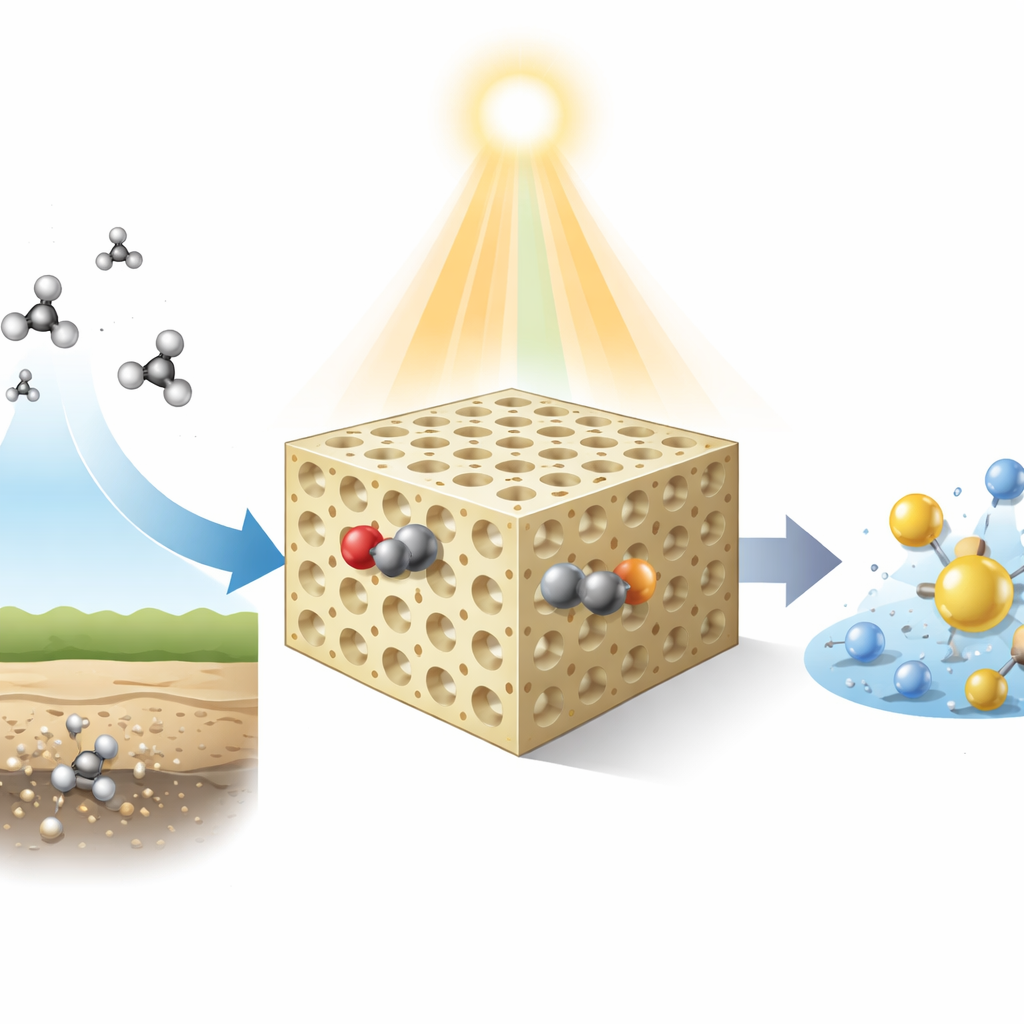
Methane, the main ingredient in natural gas, is both a valuable resource and a climate concern. Industry usually transforms methane into useful fuels and chemicals only at very high temperatures, which wastes energy and can generate unwanted carbon dioxide. This study demonstrates a new catalyst that can turn methane directly into liquid products such as methanol under much milder conditions by carefully arranging single metal atoms and manipulating how electric charge is distributed around them.
Why methane is hard to tame
Methane looks simple—a small, tightly bound molecule made of one carbon and four hydrogens—but its carbon–hydrogen bonds are exceptionally strong and evenly shared, making them reluctant to break. Existing industrial routes first rip methane apart at 700–1000 °C to make synthesis gas, then recombine it into liquids in multiple steps. This high-temperature approach consumes large amounts of energy and tends to over-oxidize methane all the way to carbon dioxide or solid carbon. Chemists have long sought ways to activate methane at low temperatures and stop the reaction at valuable “partial oxidation” products like methanol and formic acid.
Learning from nature’s metal centers
In living organisms, enzymes such as methane monooxygenase can oxidize methane near room temperature. They do this using one or two metal atoms held in precise environments that guide electrons and stabilize fleeting reaction fragments. Inspired by this, researchers have been building “single-atom catalysts,” in which isolated metal atoms sit on solid supports and mimic enzyme active sites. The team behind this work went a step further: instead of a single type of metal atom, they placed pairs of iron and palladium atoms close together inside an ordered, sponge-like carbon framework doped with nitrogen. This material, called Fe1–Pd1 OMNC, provides a regular network of large pores to expose many such dual sites to methane and light.
Creating a tiny charged hotspot
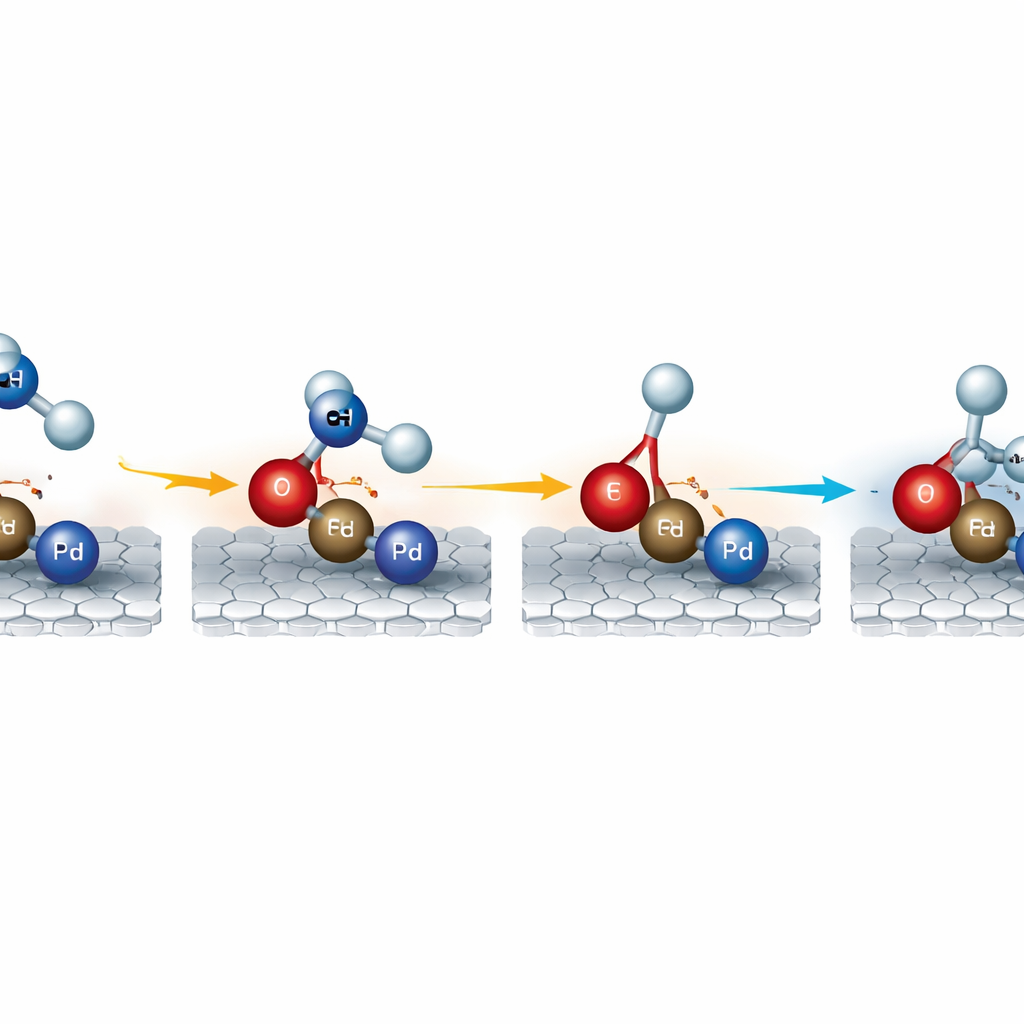
The key innovation is how the catalyst reshapes electric charge around the paired metals when an oxidant such as hydrogen peroxide or oxygen is present. Experiments and computer simulations show that the oxidant prefers to react first at the iron atom, forming a strongly bound oxygen species on top of it. This transforms the local region into an uneven electrical landscape: the new oxygen becomes electron-rich, while the nearby palladium becomes electron-poor. The authors describe this as a charge-polarized O–Fe–Pd region. When a methane molecule approaches, the slightly positive hydrogen end is drawn toward the negatively charged oxygen, while the carbon-based fragment is attracted to the electron-deficient palladium. This split handling of the hydrogen and methyl pieces lowers the energy needed to break the first C–H bond.
Using light and heat together
To drive the reaction, the researchers shine a xenon lamp onto the suspension of catalyst, methane, and oxidant. The carbon framework, loaded with single metal atoms, absorbs light across a broad range and efficiently converts it into both excited electrons and moderate heating—up to about 60 °C in the liquid phase. Careful control experiments show that neither light alone nor heat alone can match the performance; the best results arise when photochemical and thermal effects work together. Under these photothermal conditions, the catalyst converts methane selectively to one-carbon oxygenated liquids with high rates and essentially no over-oxidation. The ordered macropores help by increasing surface area, improving transport of methane and products, and trapping light within the structure.
What this means for cleaner chemistry
In plain terms, the researchers have built a tiny factory where pairs of single metal atoms and a bound oxygen atom cooperate to pull methane apart in a controlled way. By steering where electrons and partial charges reside, the catalyst gently opens one C–H bond, parks the hydrogen on oxygen, and anchors the carbon fragment on palladium, paving the way to methanol and related liquids rather than wasteful carbon dioxide. Although the system is still at the laboratory stage, it offers a promising blueprint for converting abundant natural gas into higher-value chemicals under far milder conditions, potentially reducing energy use and emissions associated with methane processing.
Citation: Chen, D., Zhou, J., Lyu, W. et al. Formation of charge-polarized regions at dual single-atom sites for C-H bond activation in methane. Nat Commun 17, 2999 (2026). https://doi.org/10.1038/s41467-026-69822-1
Keywords: methane oxidation, single atom catalyst, photothermal catalysis, methanol production, charge polarization