Clear Sky Science · en
Detecting glycosyl-oxonium and glycosyl-nitrilium ions using exchange NMR to investigate solvent effects in glycosylation reactions
Why sugar linkages and solvents matter
Many of the sugars that decorate our cells are built by stitching together simple sugar units through chemical bonds called glycosidic linkages. These bonds can connect in subtly different ways that profoundly change biological behavior, influencing everything from viral infection to drug activity. Chemists know that adding certain solvents to a reaction flask can push the outcome toward one form or the other, but exactly how these liquids exert such control has remained murky. This study uses advanced nuclear magnetic resonance (NMR) methods to directly observe some of the short‑lived charged species that form when sugars react in different solvents, helping to explain how solvent choice steers sugar chemistry.

How chemists currently build sugar chains
To link two sugar molecules, chemists typically activate one as a "donor" and let the other attack as an "acceptor." The donor passes through highly reactive intermediates before settling into a stable bond. The key challenge is controlling which face of the donor the acceptor attacks, giving either an alpha or beta linkage that differ in three‑dimensional shape. Over the years, practitioners learned empirically that adding nitrile solvents such as acetonitrile tends to favor beta products, while certain ether solvents, especially tetrahydrofuran (THF), favor alpha products. Other ethers like diethyl ether and 1,4‑dioxane also bias reactions but seemed less powerful. Theories ranged from direct bonding of the solvent to the sugar to more subtle effects on the shape and charge distribution of the reactive species, yet firm experimental evidence for the most reactive intermediates was lacking.
Catching fleeting species with exchange NMR
The researchers turned to a suite of NMR techniques specifically designed to detect molecules that are present only in tiny amounts and exchange rapidly with more abundant forms. They focused on a commonly used protected glucose donor that forms a charged "glycosyl triflate" when activated. By monitoring how the NMR relaxation behavior of deuterium‑labeled solvents changed upon activation, they could sense when a solvent molecule temporarily attached to the sugar, becoming heavier and less symmetric. They complemented this with fluorine‑based exchange spectroscopy to measure how quickly the triflate group left, and with chemical exchange saturation transfer (CEST) experiments that reveal otherwise invisible sugar species by watching how they exchange magnetization with the main intermediate.
What happens in nitrile and ether solvents
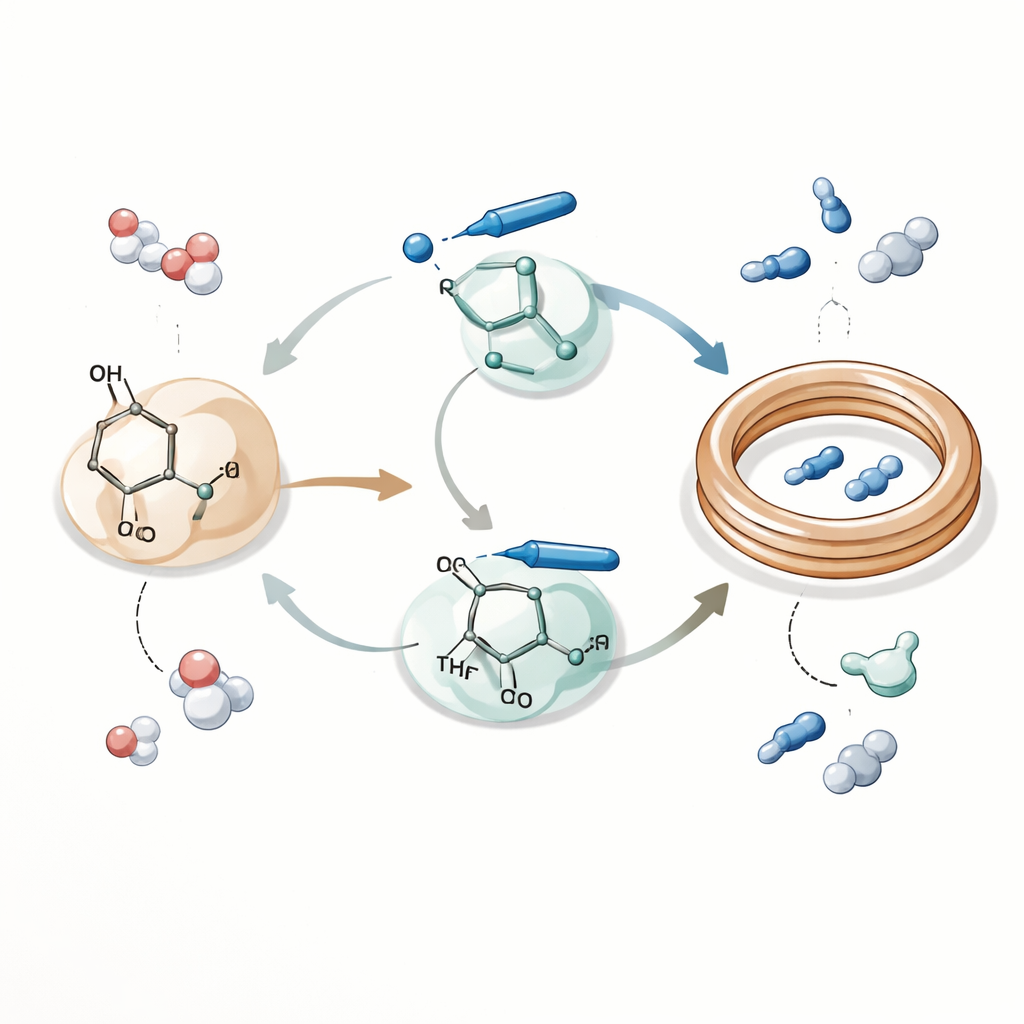
The NMR data show that acetonitrile and THF do much more than simply sit around the reactive sugar. Acetonitrile forms a covalent "glycosyl–nitrilium" ion: the solvent binds directly at the reactive carbon where the triflate had been, creating a positively charged sugar–solvent adduct. This new species was detected as a distinct NMR signal whose position matches earlier work done in pure acetonitrile. THF, in turn, forms covalent "glycosyl–oxonium" ions, in which the ether ring of THF bonds to the sugar. CEST experiments revealed two such THF adducts, consistent with different orientations around the sugar ring, and quantum‑chemical calculations reproduced their carbon‑13 chemical shifts. Importantly, these adducts exist only in very low populations, but exchange NMR is sensitive enough to reveal them. In contrast, diethyl ether and 1,4‑dioxane showed almost no change in relaxation behavior, did not speed up triflate departure, and produced no new CEST signals, indicating that they do not form covalent sugar–solvent adducts under the same conditions.
Testing different sugars and solvent environments
The team extended these measurements to several other common sugar donors, including derivatives of glucosamine, mannose, and galactose, and also repeated experiments in a less polar solvent, toluene, that alters the balance between different triflate forms. Across this wider set, the same pattern emerged: acetonitrile and THF consistently promoted formation of glycosyl–nitrilium and glycosyl–oxonium ions, while diethyl ether and 1,4‑dioxane did not. Changing the main solvent from dichloromethane to toluene affected how fast these species formed and broke apart but did not change which adducts could form. In some cases, donors decomposed more slowly in toluene, making it easier to detect the elusive intermediates. These systematic studies show that the ability to form covalent sugar–solvent complexes depends both on the solvent’s basicity and its detailed structure.
What this means for designing sugar chemistry
The work demonstrates that certain stereodirecting solvents, notably acetonitrile and THF, steer glycosylation reactions at least in part by forming real, covalent adducts with the sugar donor, even though these species are present only fleetingly. Other ethers that still influence product ratios likely act through different mechanisms, such as reshaping the charged intermediates and their counterions rather than binding directly. By proving that exchange NMR can visualize these low‑population adducts, the study adds a powerful tool for dissecting complex reaction networks. For chemists aiming to build precise sugar architectures for vaccines, diagnostics, or materials, this deeper mechanistic picture should eventually translate into more predictable and tunable reaction conditions, making it easier to choose the right solvent blend to obtain the desired linkage every time.
Citation: de Kleijne, F.F.J., Ter Braak, F., Moons, P.H. et al. Detecting glycosyl-oxonium and glycosyl-nitrilium ions using exchange NMR to investigate solvent effects in glycosylation reactions. Nat Commun 17, 2987 (2026). https://doi.org/10.1038/s41467-026-69820-3
Keywords: glycosylation, reaction mechanisms, solvent effects, exchange NMR, carbohydrate chemistry