Clear Sky Science · en
Disordered light-harvesting aggregates can host functional vibronic couplings at room temperature
Why this study matters
Plants and bacteria move sunlight energy with astonishing efficiency, even though their light-harvesting machinery is made from soft, disordered molecules jostling at room temperature. This paper asks a deceptively simple question with big implications: can subtle quantum-like vibrations that have been seen at ultracold temperatures actually help steer energy flow in large, messy light-harvesting structures under everyday conditions? The authors build and probe artificial nanotubes made from porphyrin dyes, close chemical cousins of chlorophyll, to find out.
Building tube-shaped light antennas
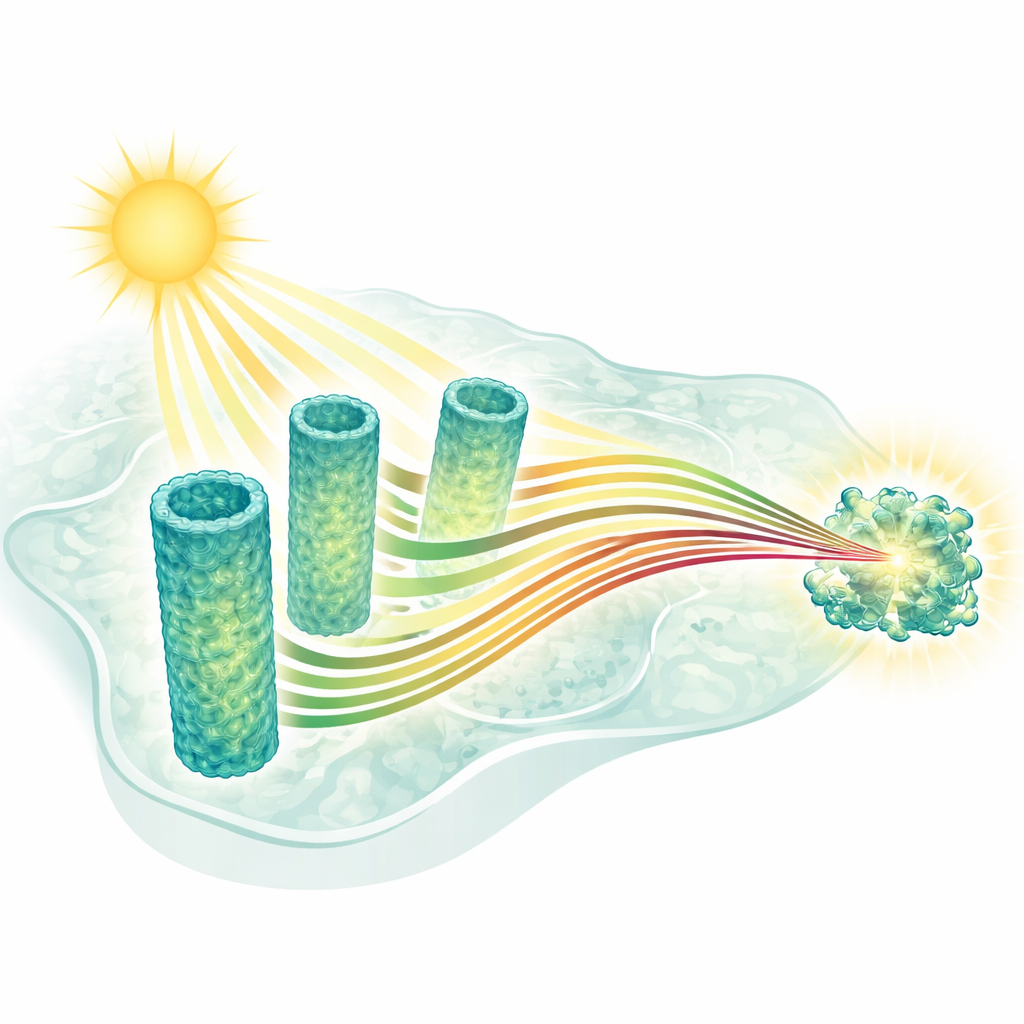
The researchers work with self-assembled porphyrin nanotubes—hollow cylinders formed when many dye molecules stack and wrap into a tube. These tubes mimic key features of natural antennas in photosynthetic bacteria, such as “chlorosomes.” Each porphyrin carries two closely spaced light-absorbing states (often called Qx and Qy) and a forest of gentle vibrational motions, much like chlorophyll. When packed into a tube, these molecules share their excitation, creating extended states that can transport energy along the structure. The central puzzle is whether vibrations and electronic excitations can mix in a useful way inside these crowded aggregates at room temperature, or whether random thermal motion simply wipes out any delicate quantum effects.
Watching energy move in two dimensions
To peer inside this process, the team uses ultrafast laser techniques that act like high-speed cameras for electronic motion. In particular, they apply two-dimensional electronic spectroscopy, which sends in pairs of exquisitely brief light pulses and then reads out how the sample’s color response evolves over time. By carefully choosing the polarizations of the pulses, they can selectively highlight signals that only appear when the two porphyrin states are genuinely mixed. The resulting “maps” show cross peaks between spectral bands appearing in just tens of femtoseconds (quadrillionths of a second), and these peaks broaden rapidly, signatures of excitation spreading quickly within the main absorption band of the tubes.
Vibrations that matter—and those that don’t
Beyond simple population flow, the spectra contain rhythmic oscillations—quantum beats—arising from vibrational motions of the porphyrin rings. By switching to a polarization scheme that suppresses signals from purely electronic pathways, the authors can sort vibrations into two classes. Some low-frequency ring-deformation modes produce strong oscillations in ordinary measurements but vanish when only mixed-state pathways are selected, marking them as “spectators” that do not drive energy mixing. In contrast, specific out-of-plane distortions of the porphyrin macrocycle survive this filtering and remain visible as robust beats. These modes shift the energy gap between electronic states in just the right way to keep them in near resonance, allowing vibrational motion and electronic excitation to hybridize into so-called vibronic states that guide energy downhill.
Disorder as a surprising design feature
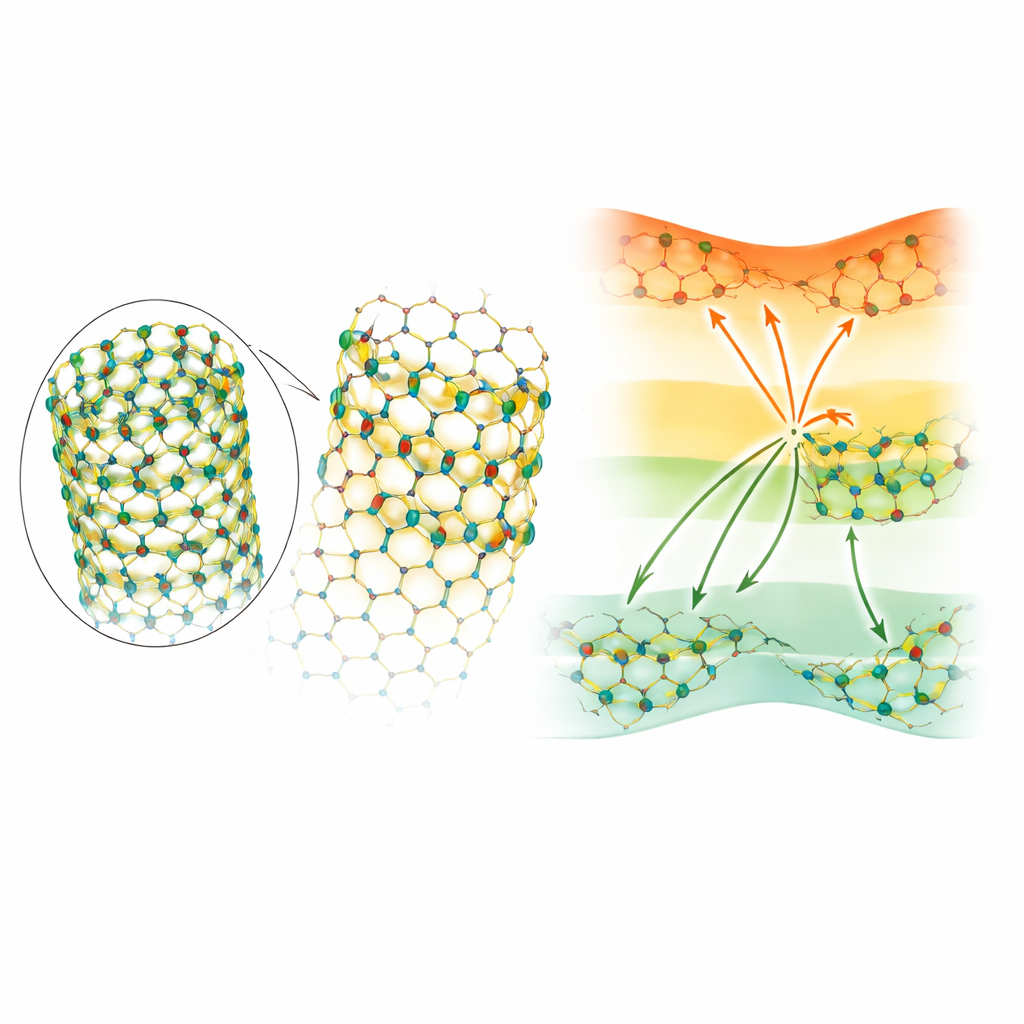
At first glance, theory for a perfectly regular nanotube predicts that the two main absorption bands should remain largely separate, with little mixing between them. To reconcile this with the experiments, the authors construct a more realistic model that explicitly includes both vibrations and energetic disorder—small random variations in molecular energies that are unavoidable in large aggregates. This added disorder breaks strict symmetry, allows weakly absorbing “dark” states near the band bottom to borrow intensity, and, crucially, enables the vibrations to couple electronic bands over a much broader energy range. Calculations show that for certain low-frequency modes, the fraction of states with strong vibrational–electronic mixing increases dramatically once disorder is present, extending vibronic coupling across the entire main band rather than confining it to a narrow resonance window.
What this means for harvesting light
Put together, the experiments and models paint a counterintuitive picture: structural disorder, usually blamed for disrupting quantum behavior, can actually strengthen the very vibronic couplings that help energy flow efficiently in large light-harvesting assemblies. In porphyrin nanotubes—proxies for natural chlorosome antennas—vibrations and electronic excitations remain functionally intertwined at room temperature, supporting fast, robust intraband energy transfer. This suggests that real photosynthetic systems may deliberately operate in a regime where the random energy variations match the frequencies of gentle, low-energy vibrations, turning disorder from a flaw into a design principle. Such insights could guide the design of artificial light-harvesting materials that blend molecular softness, disorder, and quantum coherence to capture and move solar energy with biological finesse.
Citation: Thomas, A.S., Roy, C., Roy, I. et al. Disordered light-harvesting aggregates can host functional vibronic couplings at room temperature. Nat Commun 17, 3127 (2026). https://doi.org/10.1038/s41467-026-69815-0
Keywords: photosynthesis, porphyrin nanotubes, vibronic coupling, energy transfer, molecular aggregates