Clear Sky Science · en
A strategy for biomass-derived matrix with facile moulding and closed-loop recycling capabilities
Turning Silk Waste into Useful Materials
Most of the plastics and high-tech composites that make our cars, planes, and wind turbines lighter and stronger are nearly impossible to recycle. This study shows a new way to build those tough materials from silk—the same substance in silkworm cocoons—so that the parts can be molded at room temperature, used in demanding conditions, and then taken apart again with almost no loss of quality. For anyone worried about plastic waste and the energy used to make new materials, this work offers a glimpse of a cleaner, circular future.
Why Today’s Composites Are Hard to Recycle
Modern fiber-reinforced composites are built like reinforced concrete: stiff fibers such as carbon or glass are locked inside a hard plastic “glue” called a matrix. This combination gives excellent strength and stiffness, so production has soared to more than ten million tons a year. But the glue is usually a tightly cross-linked plastic that cannot be melted or easily broken down. Cutting or grinding ruins the long fibers, while high-temperature chemical methods burn up the plastic and can even weaken the fibers. As a result, less than one percent of these composites are recycled, and most end up in landfills or are incinerated, wasting valuable carbon fiber and creating pollution.
A New Route: Using Silk Itself as the Glue
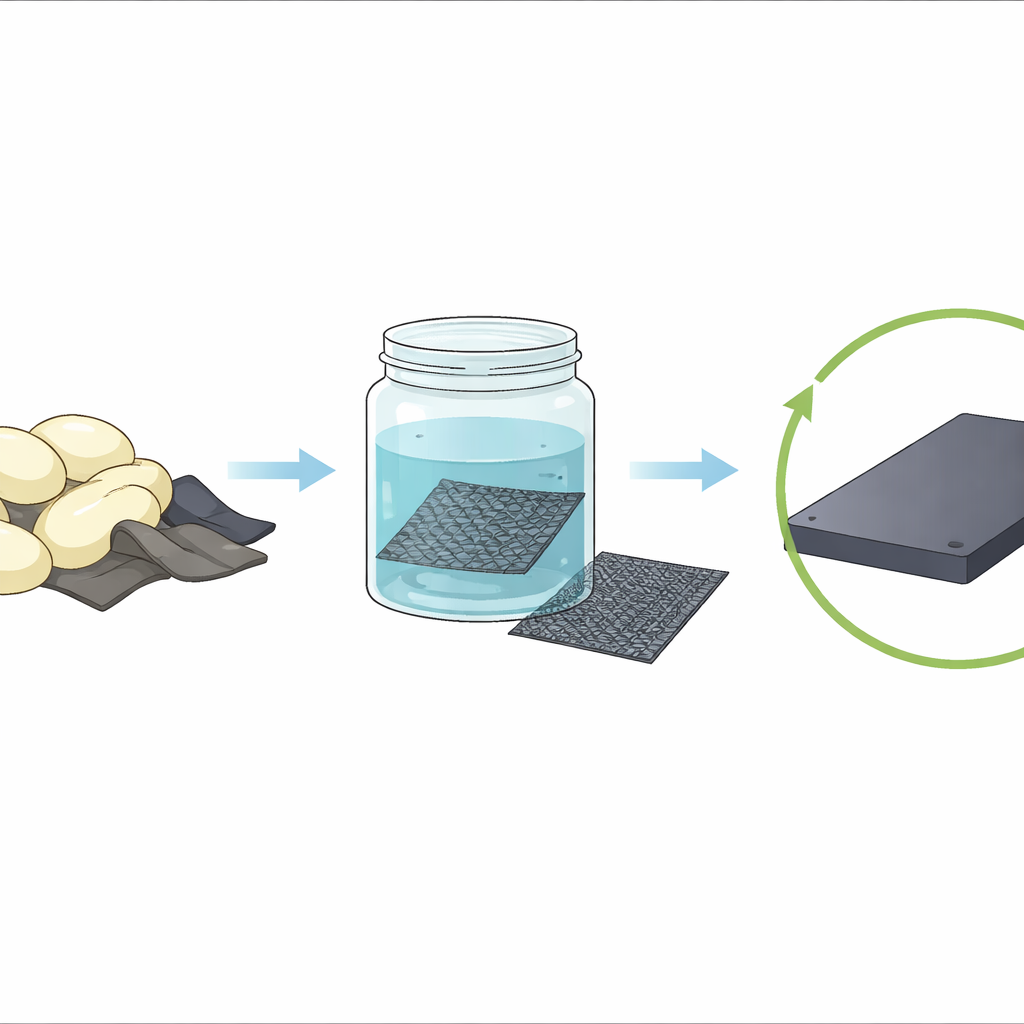
The authors propose changing how we think about bio-based plastics. Instead of breaking natural polymers down into small building blocks and then repolymerizing them with extra additives and heat, they keep the original large molecules largely intact. In this case, they start from unprocessable silkworm cocoons and discarded silk textiles. The silk is cleaned, dissolved, and dried into powdered protein called regenerated silk fibroin. When this powder is dissolved in a special organic solvent and left to dry at room temperature, the silk molecules spontaneously rearrange into a stable network. This creates a solid matrix without any added crosslinkers, curing agents, or catalysts, and without heating above room temperature.
Building Strong, Durable Composites
To turn the silk matrix into a true structural material, the team soaked woven carbon-fiber fabrics in the silk solution and simply let the solvent evaporate. The silk flowed around and between the fibers and then “locked” into a more ordered structure as it dried. By adjusting how much silk solution was added, they made composite plates with different fiber contents. At about two-thirds carbon fiber by weight, the plates reached tensile strengths above 1.1 gigapascals and stiffness above 30 gigapascals—figures that rival or surpass many recyclable composites made from conventional petroleum-based or bio-based resins. The material also withstood hot, humid air and intense ultraviolet light with only minor loss in performance, indicating that the silk matrix remains stable in challenging real-world environments.
Closing the Loop with Gentle Recycling
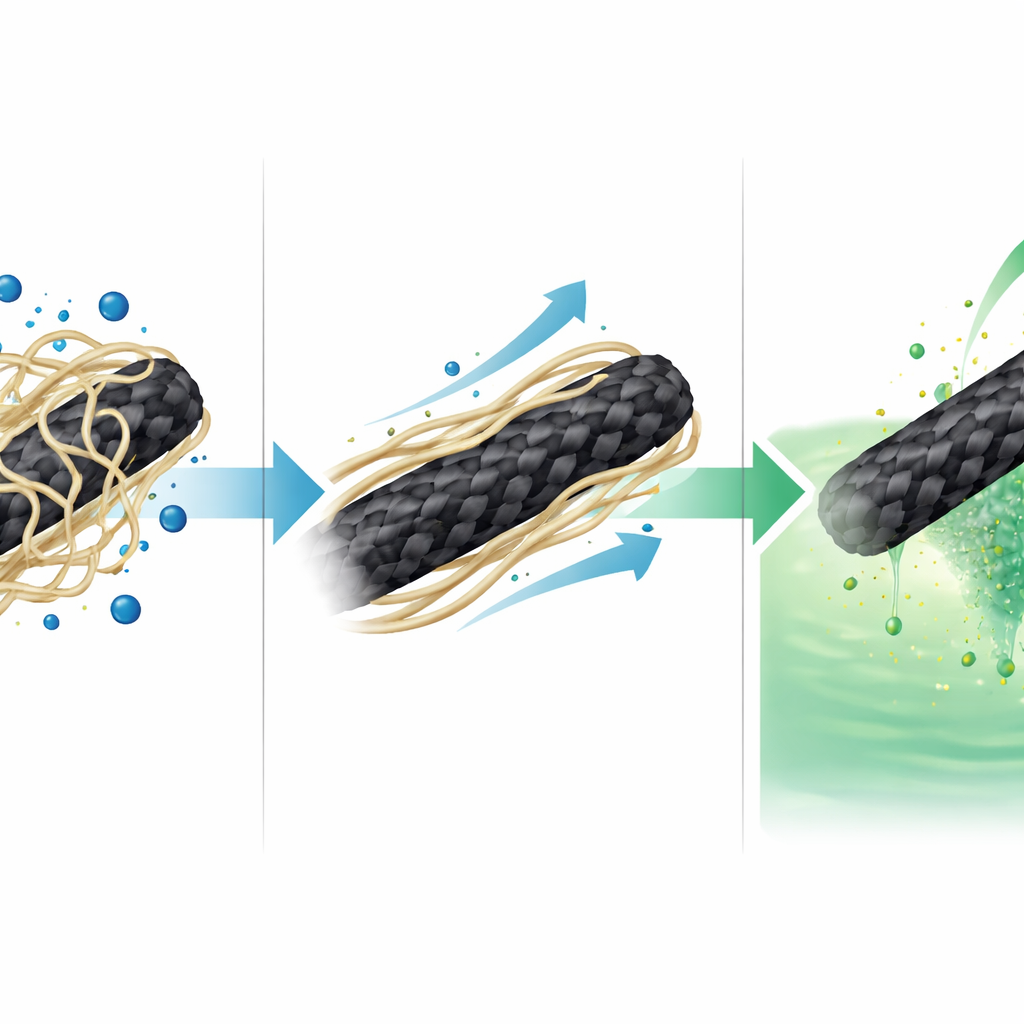
Perhaps the most striking aspect of this system is how easily it can be taken apart. The researchers immersed the used composite plates in a mild mixture of calcium salt, ethanol, and water at room temperature. This liquid selectively dissolved the silk matrix while leaving the carbon fibers untouched. The fibers could then be pulled out as intact fabrics that kept nearly all of their original strength, even after three recycling rounds. At the same time, the dissolved silk was recovered, cleaned, and dried back into powder, ready to be redissolved and used again to make new composites. The same approach also worked for aramid and glass fibers. Moreover, silk solutions collected during recycling were cast into thin membranes that showed good compatibility with living cells and in mouse tests, hinting at future biomedical uses for this reclaimed protein.
What This Means for a Cleaner Materials Future
By showing that silk protein can act as a high-performance, room-temperature-molded, and fully recyclable glue for fiber composites, this work outlines a different path for sustainable materials. Instead of complex chemistries that demand heat and multiple additives, the process relies on the natural tendency of silk molecules to assemble into strong structures and to re-dissolve under gentle conditions. The result is a composite that uses renewable feedstocks, delivers mechanical properties suitable for demanding applications, and can be repeatedly broken down into its original fiber and protein ingredients. For lay readers, the key message is simple: waste silk and advanced fibers can be combined into strong parts that no longer have to be thrown away—they can be reborn again and again.
Citation: He, F., Ying, S., Liu, H. et al. A strategy for biomass-derived matrix with facile moulding and closed-loop recycling capabilities. Nat Commun 17, 3013 (2026). https://doi.org/10.1038/s41467-026-69813-2
Keywords: silk composites, closed-loop recycling, biomass materials, carbon fiber, sustainable polymers