Clear Sky Science · en
Photooxidative Copper(II) Catalysis for Promoting anti-Markovnikov Hydration of Alkenes
Turning Simple Plant-Like Oils into Useful Alcohols
Many everyday products, from medicines to fragrances, are built from molecules that look a lot like the oils found in plants: chains of carbon atoms linked by carbon–carbon double bonds known as alkenes. Chemists have long wanted an easy way to turn these double bonds into alcohol groups at specific positions, because that small change can transform how a molecule behaves in the body or in materials. This paper describes a new light-driven method that uses an inexpensive copper compound to carry out this transformation gently and precisely, opening a path toward more sustainable production of fine chemicals and drugs.
Why Usual Routes Miss the Target
When water adds across a carbon–carbon double bond, it typically does so in a way that follows a rule first described in the 19th century: the Markovnikov rule. In practice, that means the resulting alcohol tends to land on the more substituted carbon, giving secondary or tertiary alcohols. While useful, this pattern is often the opposite of what chemists want; primary alcohols, attached to the less substituted end of the double bond, can be more versatile building blocks. Achieving this so-called anti-Markovnikov addition with water has been a long-standing challenge. Earlier successes relied on rare-metal catalysts based on ruthenium or iridium, or on intricate organic dyes, which can be costly, less robust, and harder to recycle.
Light, Copper, and a Clever Ligand Design
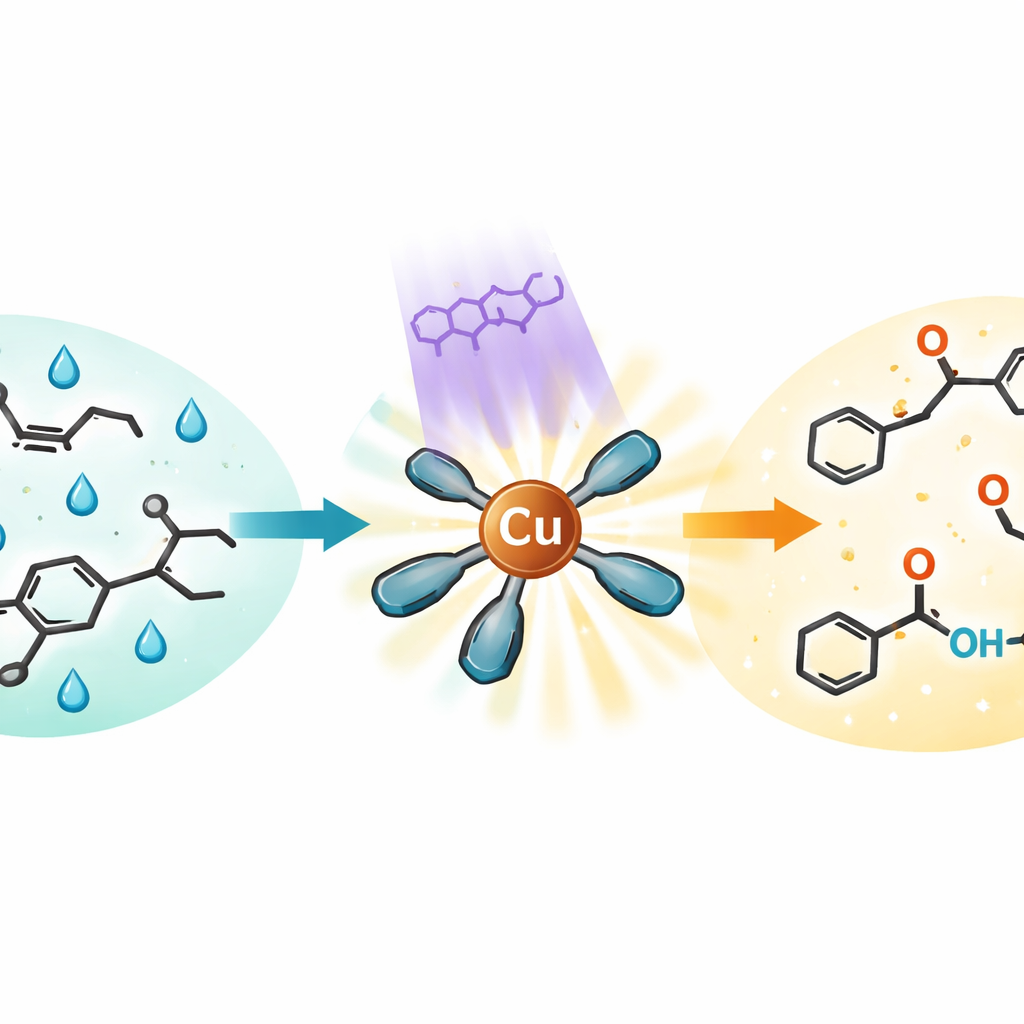
The researchers set out to harness copper, an abundant metal, as the heart of a powerful light-activated catalyst. They prepared a copper(II) complex in which the metal is bound to a large, flat nitrogen-containing ring (bathophenanthroline) and, under reaction conditions, to sulfur-containing pieces derived from a simple thiol. This design does two important jobs. First, it tunes the way the complex absorbs visible light, giving it an unusually long-lived excited state for a 3d metal system. Second, it pushes the excited copper species to be strongly oxidizing: energetic enough to pull an electron from many different alkenes, including relatively unreactive aliphatic ones. Spectroscopy and electrochemistry showed that the in situ–formed copper–thiolate complex can reach excited-state oxidation strengths beyond most common precious-metal catalysts.
How the Reaction Pathway Is Re-Routed
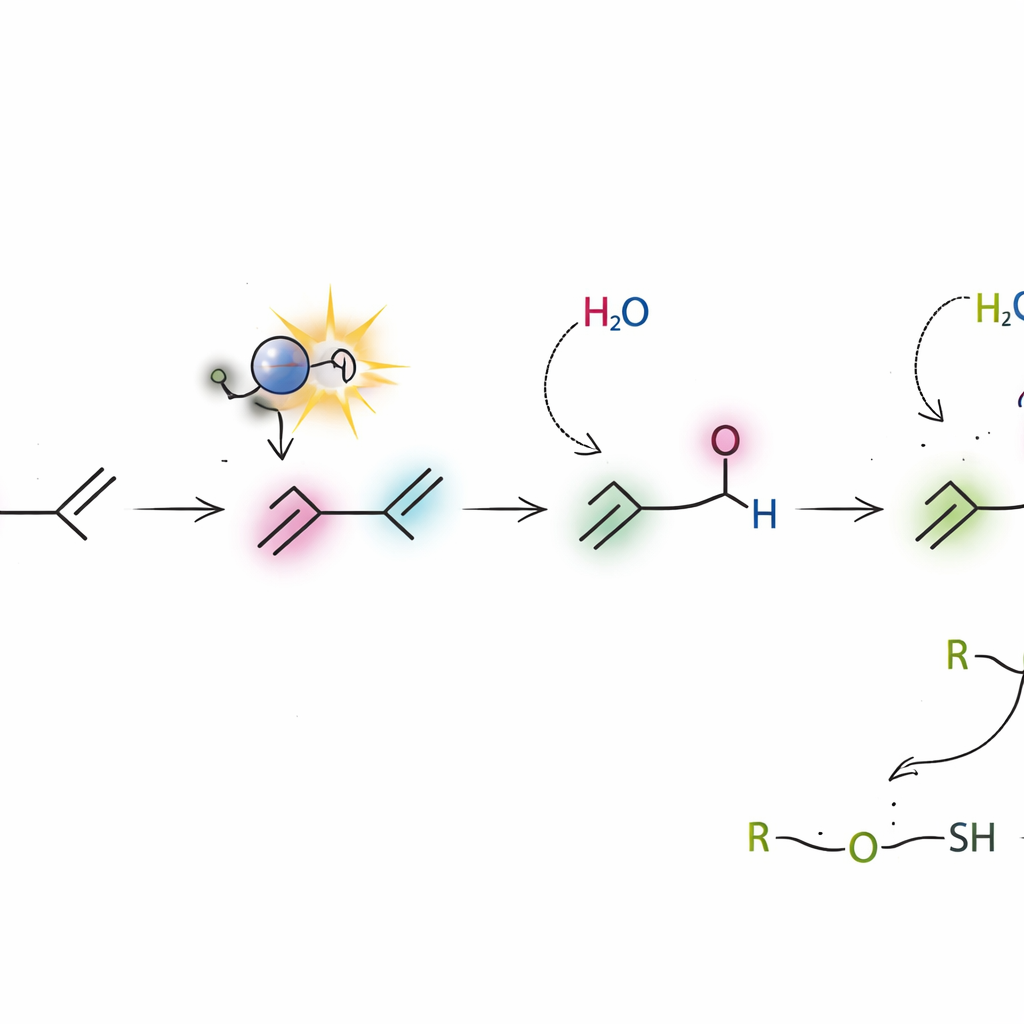
Under purple light in a mixture of water and organic solvent, the copper complex absorbs photons and is promoted to its excited state. Instead of breaking one of its own bonds, as many copper(II) complexes do, this excited species transfers an electron from the alkene to itself. That step creates a pair of partners: a reduced copper(I) complex and an alkene radical cation, where the double bond now actively seeks a partner. Water attacks the less substituted carbon of this activated alkene, steering the reaction along the anti-Markovnikov pathway and generating a new carbon–oxygen bond. After deprotonation, a carbon-centered radical remains, which then grabs a hydrogen atom from the thiol additive. This final step produces the desired alcohol and a thiyl radical, which in turn reoxidizes copper(I) back to copper(II), closing the catalytic cycle.
What Molecules Can Be Transformed
To test the reach of their method, the team applied it to many different alkenes. A broad range of aromatic alkenes related to styrene were cleanly converted to primary or secondary alcohols, with water adding in the anti-Markovnikov fashion and little to no competing Markovnikov product. More impressively, a variety of aliphatic alkenes—molecules that more closely resemble real-world feedstocks and natural products—also underwent smooth hydration, including challenging di- and trisubstituted examples. The method tolerated complex molecular frameworks found in natural products and drug-like compounds such as steroids, fragrances, and pharmaceutical derivatives, decorating them with new alcohol groups late in the synthesis without disrupting sensitive features elsewhere in the molecule.
Beyond Water: Building Other Bonds
Because the key step is the generation of a highly reactive alkene radical cation, the same platform can do more than just add water. By swapping water for other nucleophiles such as alcohols or nitrogen-containing rings, the authors demonstrated anti-Markovnikov formation of ethers and nitrogen-containing products. They also showed that suitably designed alkenes can loop back on themselves in intramolecular reactions to form ring structures like tetrahydrofurans and pyrrolidines. These experiments highlight that the copper catalyst is a general, strongly oxidizing light absorber that can enable a family of transformations, rather than a single specialized reaction.
A Step Toward Greener Precision Chemistry
In plain terms, this work shows that a carefully engineered copper complex, energized by visible light, can add water and related partners to the "far end" of a carbon–carbon double bond across a wide range of molecules. By combining earth-abundant copper, simple ligands, and mild conditions, the method offers a more sustainable alternative to rare-metal and elaborate organic photocatalysts while achieving comparable or even superior oxidation power. For non-specialists, the key takeaway is that chemists are learning to use inexpensive metals and light to place single atoms with great precision, which can streamline the manufacture of medicines and other high-value chemicals with less waste and lower environmental impact.
Citation: Oku, N., Fuke, K., Masui, R. et al. Photooxidative Copper(II) Catalysis for Promoting anti-Markovnikov Hydration of Alkenes. Nat Commun 17, 3003 (2026). https://doi.org/10.1038/s41467-026-69807-0
Keywords: photoredox catalysis, copper catalysis, anti-Markovnikov hydration, alkene functionalization, sustainable chemistry