Clear Sky Science · en
Feedback neurons based on perovskite memristor with nickel single-atom engineered reduced graphene oxide cathode
Brain-Inspired Chips for Smarter Machines
Modern computers are fast but surprisingly inefficient at tasks our brains handle with ease, like recognizing a flower or planning an efficient route across many cities. This article reports a new kind of electronic component that behaves more like a real neuron in the brain, handling both “go” and “stop” signals in a single tiny device. By carefully engineering materials at the level of single atoms, the researchers create artificial neurons that can learn patterns and solve complex optimization problems using far less hardware than today’s processors.
Why We Need New Kinds of Neurons in Hardware
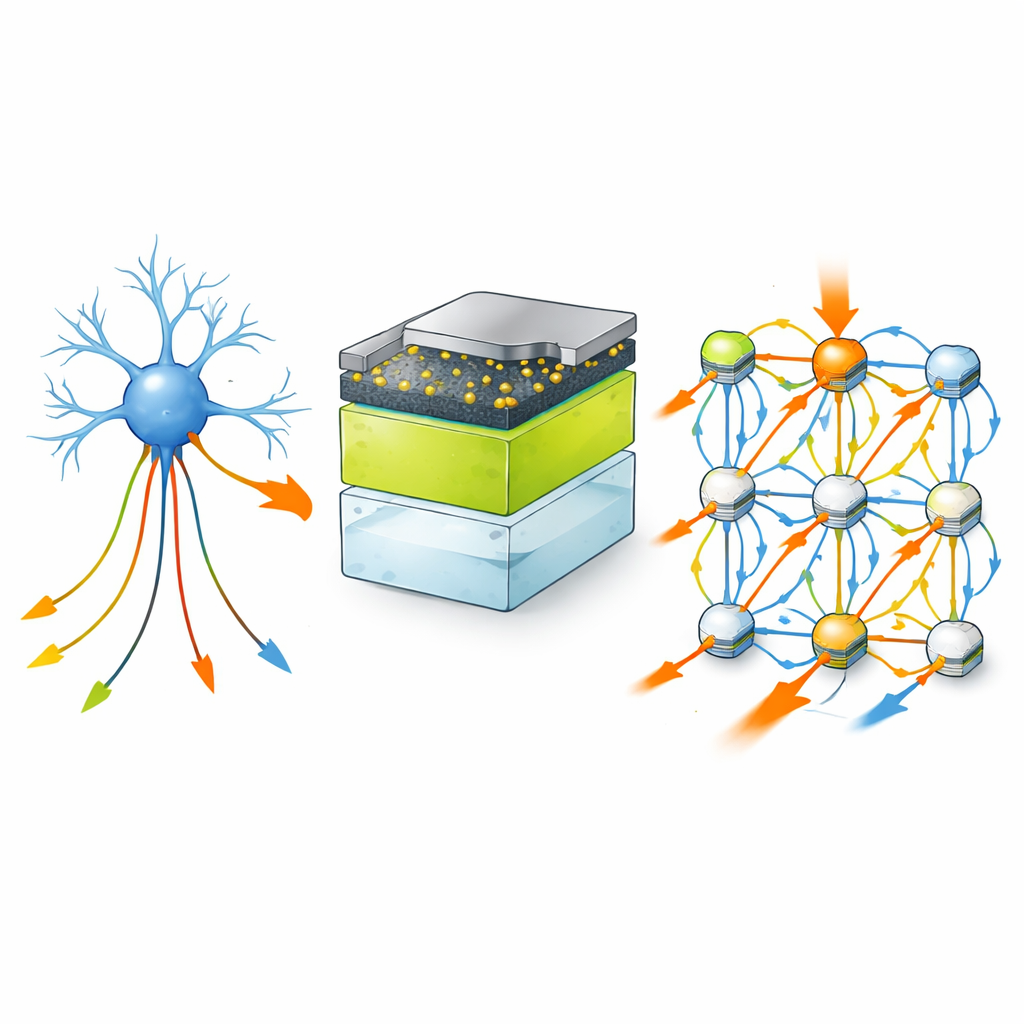
Biological neurons constantly juggle two types of signals: excitatory ones that push them toward firing, and inhibitory ones that hold them back. The balance between these is crucial for stable thinking, perception, and decision-making. A special class called feedback neurons mixes incoming “forward” signals with “backward” inhibitory signals, enabling behaviors such as competition between neurons and winner-take-all decisions, where only the strongest response survives. Recreating this dual, finely balanced behavior in electronics has been difficult. Most existing “memristor” devices, which remember their electrical history, conduct current mainly in one direction and relax too quickly, making them poor stand-ins for neurons that must integrate signals over milliseconds.
Building a Smarter Electronic Device
The team tackles these limits using a perovskite-based memristor—a device whose conductance can change gradually—combined with an unusual cathode made from reduced graphene oxide decorated with isolated nickel atoms. This nickel single-atom layer is not just a passive contact. First, it tunes the energy landscape at the interface so that electrons can flow more symmetrically in both directions, supporting balanced excitatory and inhibitory behaviors. Second, it raises the energy barrier for iodide ions moving into the electrode. Instead of racing freely, ions become partially confined and move more slowly and reversibly. This controlled motion stretches the device’s “memory” of past signals into the biologically relevant millisecond range without needing bulky external capacitors.
How Atomic Design Shapes Behavior
Using advanced microscopy and spectroscopy, the researchers confirm that nickel atoms are individually anchored to oxygen sites within the graphene-based layer rather than clumping into particles. Computer simulations show that this atomic arrangement shifts the electronic energy levels of the carbon sheet, making it more metallic and better matched to the perovskite beneath. At the same time, calculations reveal a higher diffusion barrier for iodide ions when nickel is present. Experimentally, devices with this engineered cathode can smoothly step through about 1,000 distinct conductance levels and show almost mirror-symmetric responses for positive and negative voltage sweeps. Their current decays over about 780 milliseconds after stimulation—a timescale close to that of real nerve cells—allowing the device to faithfully mimic leaky integrate-and-fire dynamics.
From Single Device to Learning Network

By driving these memristors with tailored voltage pulses, the team demonstrates that a single device can act as a feedback neuron: it sums incoming pulses, fires when its current crosses a threshold, and then slowly leaks back toward its resting state. Negative pulses suppress its conductance, providing an electronic form of inhibition. Networks of these neurons are arranged in crossbar arrays and linked to simple control electronics based on field-programmable gate arrays. In one demonstration, the system performs unsupervised competitive learning on floral data, clustering three types of flowers by their measured features, with each neuron specializing in a particular type. In another test, a cooperative learning scheme based on a self-organizing map uses the same kind of neurons to solve the travelling salesman problem, a classic challenge in logistics, converging on efficient routes up to six times faster than a standard simulated annealing algorithm.
What This Means for Future Computing
In everyday terms, this work shows that we can increasingly build electronic components that behave like tiny, tunable brain cells rather than simple on–off switches. By placing single nickel atoms in just the right spots inside a graphene-based layer, the authors gain precise control over both electrons and ions, yielding a device that can excite, inhibit, and slowly forget in a brain-like fashion. These artificial feedback neurons can be densely packed, require little supporting circuitry, and already handle realistic learning tasks and optimization problems. As such devices continue to improve, they may form the foundation of compact, energy-efficient hardware that complements or even replaces parts of today’s power-hungry digital processors in applications from pattern recognition to smart planning.
Citation: Li, QX., Li, HX., Sun, T. et al. Feedback neurons based on perovskite memristor with nickel single-atom engineered reduced graphene oxide cathode. Nat Commun 17, 3085 (2026). https://doi.org/10.1038/s41467-026-69805-2
Keywords: neuromorphic computing, memristor, perovskite devices, graphene electronics, hardware learning