Clear Sky Science · en
Voltage-controlled topological spin textures in the monolayer limit
Why twisting spins in a single sheet matters
Imagine information stored not in electric charges, but in tiny magnetic whirlpools that can be created and erased with a simple voltage pulse. This study shows that such whirlpools—called spin textures—can be controlled in a material only one atom thick. By using an electric field rather than power-hungry electric currents, the work points toward faster, denser, and more energy‑efficient memory and computing devices, while also offering a clean playground to test ideas from fundamental physics.
A magnet as thin as a single layer
The researchers focus on CrI3, a crystal that can be peeled down to a single atomic sheet, much like graphene. In this extreme two‑dimensional limit, ordinary rules say long‑range magnetism should be fragile. Yet CrI3 remains ferromagnetic at low temperatures, meaning its atomic magnets tend to point in the same direction. This makes it an ideal stage for exploring more exotic magnetic patterns, where spins twist and wrap in space in ways that are protected by topology, the same branch of mathematics that distinguishes a donut from a sphere.
From simple magnets to swirling patterns
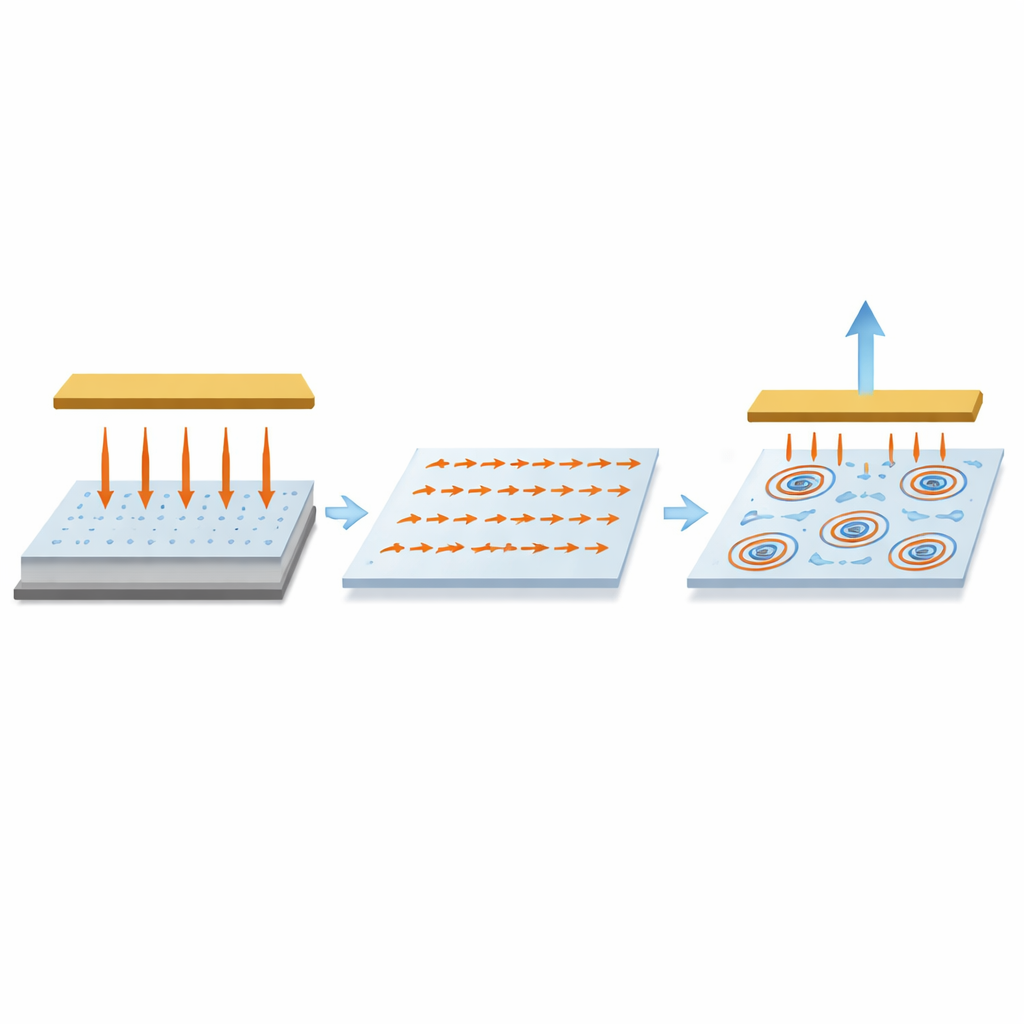
To see and control these patterns, the team builds tiny devices by stacking a monolayer of CrI3 between insulating and conducting layers. By applying a gate voltage across this sandwich, they create an electric field through the CrI3 and also add or remove electrons from it. At low voltage, the material behaves like a simple out‑of‑plane magnet: its spins point mostly up or down, and the optical signal they measure—a technique called reflective magnetic circular dichroism—follows a standard magnetic hysteresis curve. As the voltage increases, however, sharp peaks appear in the optical response near the field where the magnet switches direction. These peaks are fingerprints of topological spin textures: localized swirling configurations that behave like particle‑like objects.
Turning voltage into topological phases
By systematically mapping the optical signal as a function of both magnetic field and gate voltage, the authors draw a phase diagram of the monolayer magnet. They find that voltage controls two key ingredients: the magnetic anisotropy, which determines whether spins prefer to point out of the plane or lie in it, and an interaction that favors twisting between neighboring spins. At moderate positive voltage, the magnet’s easy axis weakens and then flips into the plane, creating a sweet spot where skyrmion‑like textures are stabilized. The team distinguishes two regimes: one where skyrmions live on top of a magnet that still prefers out‑of‑plane order (type‑I), and another where they emerge in a mostly in‑plane magnet (type‑II). In both cases, increasing voltage smoothly shifts the magnetic field range where these textures appear and raises their density, demonstrating precise electrical tuning of a topological state.
Watching the textures melt with heat
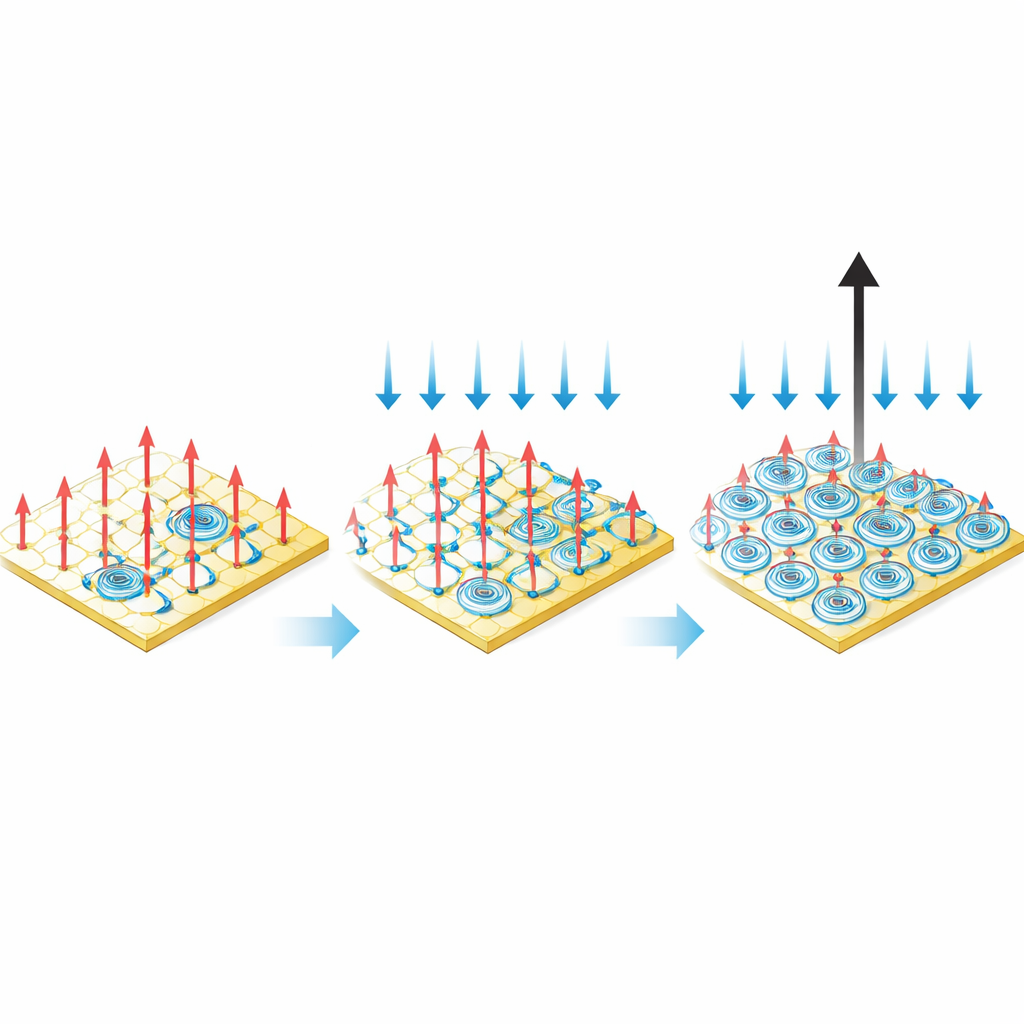
Temperature adds another control knob. Under a fixed voltage that favors in‑plane order and abundant skyrmions, the authors track how the optical signatures evolve as they warm the sample. They observe that the skyrmion‑rich phase shrinks and eventually disappears around 24 kelvin, giving way first to a simple in‑plane ferromagnet and then to a nonmagnetic, disordered state. The magnetic field required to stabilize skyrmions decreases roughly linearly with temperature, and the range of fields over which they survive also narrows. These trends mirror behaviors seen in bulk skyrmion‑hosting crystals, confirming that the swirling textures in monolayer CrI3 behave as genuine, thermally fragile topological quasiparticles.
What this means for future technology
In plain terms, the study shows that a single‑layer magnet can host robust, electrically controllable whirlpools of magnetization, and that a simple voltage knob can turn a uniform magnet into a landscape of topological bits. Because the control relies on electric fields and subtle changes in spin–orbit coupling rather than strong currents, it offers a path toward ultra‑low‑power magnetic memory, logic, and even neuromorphic devices built from skyrmions. At the same time, this two‑dimensional platform provides a clean laboratory for testing deep ideas about topological phase transitions that also appear in superfluids and superconductors.
Citation: Wu, Y., Peng, B., Zeng, Z. et al. Voltage-controlled topological spin textures in the monolayer limit. Nat Commun 17, 2923 (2026). https://doi.org/10.1038/s41467-026-69800-7
Keywords: 2D magnet, skyrmion, electric field control, spintronics, topological spin texture