Clear Sky Science · en
Knittable, thermally insulating, and sustainable aerogel fibers enabled by ion-mediated hierarchical assembly
Warmth from Thin Air
Staying warm in winter without bulky layers is a long-standing dream for outdoor workers, athletes, and everyday commuters. This research shows how to turn hard-to-recycle high‑tech fibers from old protective gear into a new kind of ultra‑light, knittable material that keeps people warmer than cotton and many common fabrics. By carefully re‑engineering these fibers at the nanoscale, the authors create aerogel fibers—materials that are mostly air—that are strong enough for industrial knitting yet insulate like a mini sleeping bag wrapped around each thread. 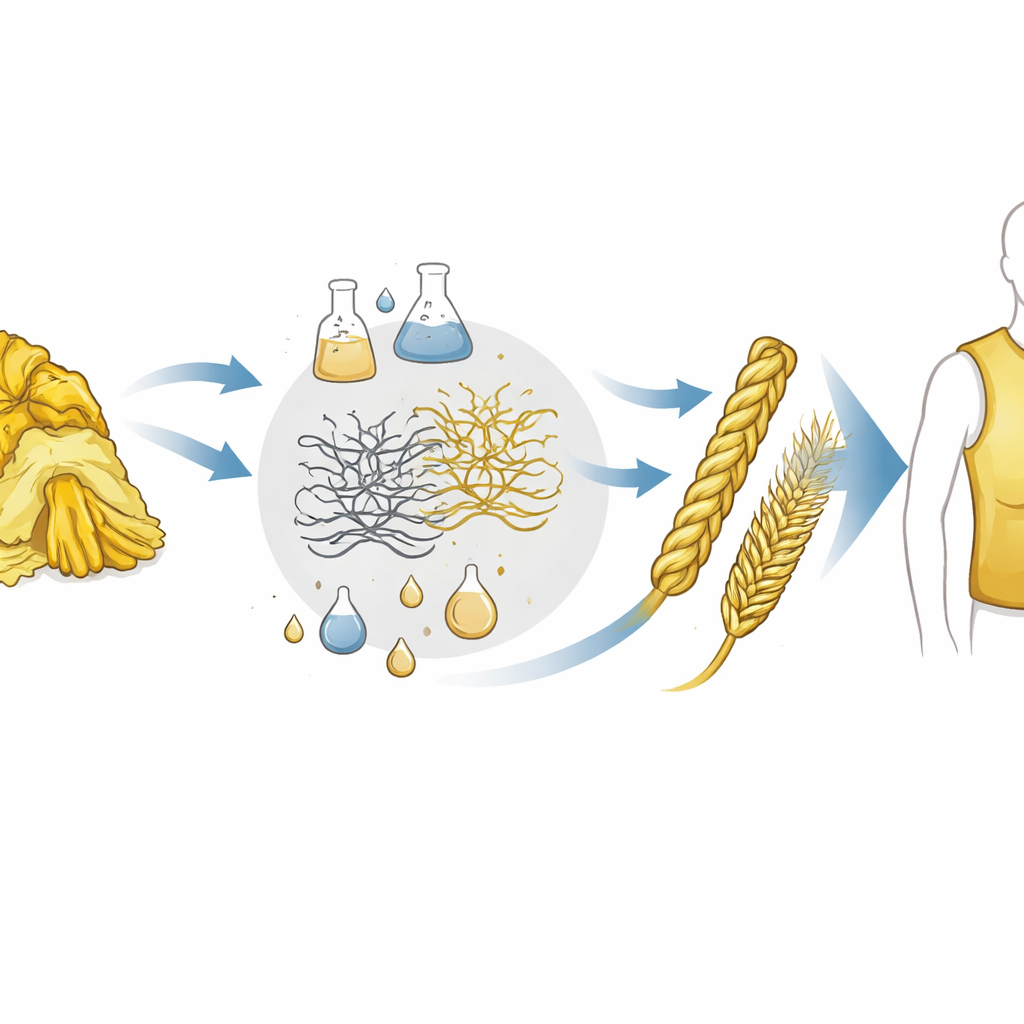
Why Regular Warm Clothes Have Limits
Most clothes keep us warm by trapping still air, which slows the escape of body heat. Natural fibers like cotton and wool, and synthetic ones like polyester, all follow this simple rule: more trapped air usually means better insulation. But making a single fiber very airy often makes it weak and fragile. Aerogels—solids that are mostly empty space—can be fantastic insulators, yet they tend to crumble or break when bent, so they are rarely used directly in everyday textiles. The central challenge has been to combine cloud‑like lightness with rope‑like toughness in a strand thin enough to weave or knit.
Turning Fiber Waste into Tiny Building Blocks
The team tackles both performance and sustainability by starting with waste aramid fibers, the same family of tough materials used in bullet‑resistant vests and fire‑protective clothing. These fibers are normally so tightly packed and chemically stable that they are nearly impossible to recycle. The researchers immerse chopped waste fibers in a special liquid that pries apart the strong bonds between molecules, swelling the fibers and peeling them down into nanofibers just a few billionths of a meter wide. These ultrafine strands carry electrical charges that keep them dispersed like spaghetti in broth, creating a reusable “soup” of building blocks ready to be spun into new life.
Guiding Self‑Assembly into a Double‑Layered Fiber
To turn this nanofiber soup into solid, usable threads, the authors use a wet‑spinning process similar to industrial fiber making. As the liquid dope exits tiny holes into an acid bath, ions in the bath gradually neutralize the charge on the nanofibers. This controlled change in charge acts like a volume knob on how strongly the tiny strands attract each other. At first they remain separate; as more ions arrive, they start bundling, then lock into a continuous network. Because the acid and solvent diffuse at different rates from the outside in, the resulting fiber develops a clever internal layout: a shell with larger, cell‑like pores surrounding a core filled with an even finer nano‑porous network. Computer simulations and microscopy confirm that this stepwise assembly and graded structure distribute stress evenly while creating efficient pathways for trapping air and blocking heat flow. 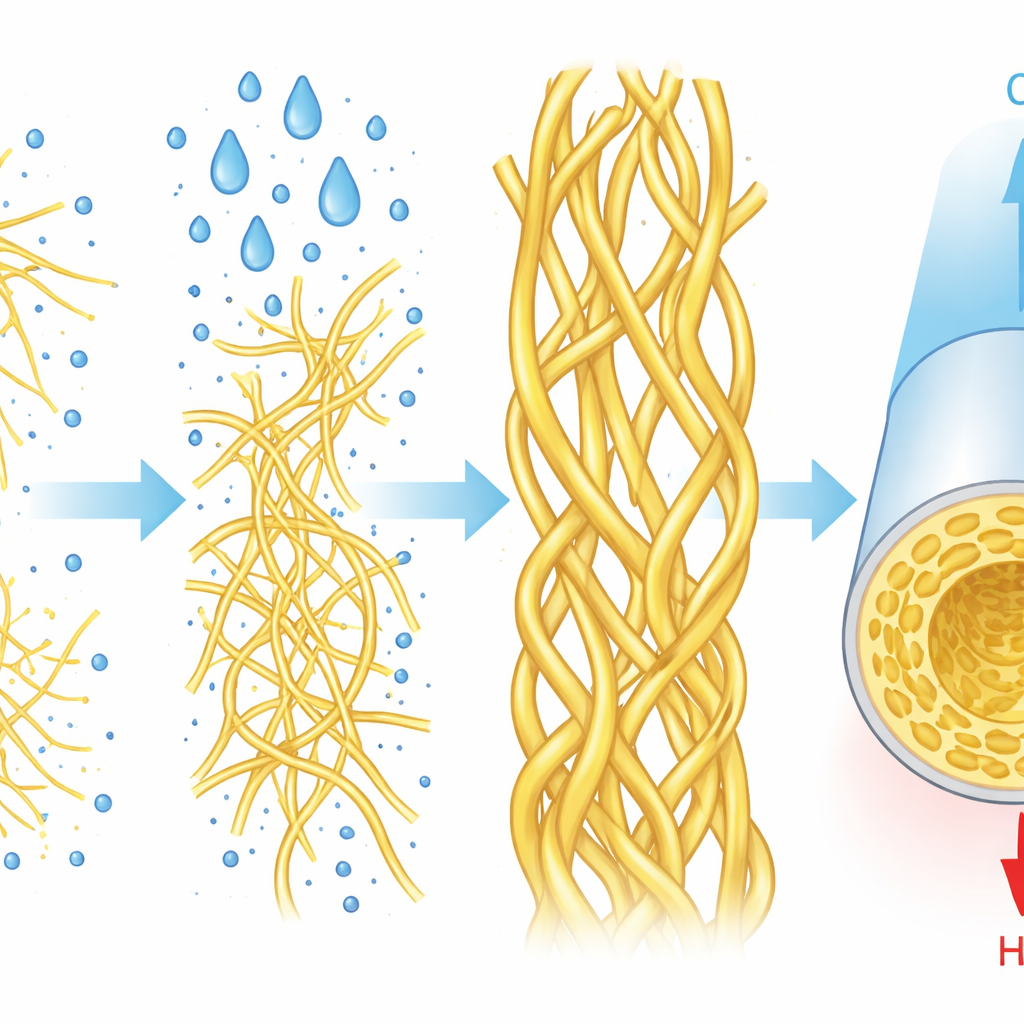
Super Insulation Without Sacrificing Strength
The finished aerogel fibers achieve an unusual combination: they are up to about three times stronger than many earlier aerogel threads while still being up to around 95% empty space. Their thermal conductivity—the measure of how easily heat passes through—is as low as 22 milliwatts per meter‑Kelvin, far below that of cotton, silk, polyester, or common aramid fabrics. The dual‑scale pores work together: tiny pores smaller than the distance air molecules typically travel suppress heat conduction and miniature air currents, while larger, closed cells break up bigger currents and lengthen the path heat must take. At the same time, the nanofiber skeleton scatters heat‑carrying vibrations, and the structure reflects a portion of radiant heat, so all major heat‑transfer routes are weakened at once.
From Lab Fibers to Real Winter Vests
Crucially, these airy fibers are not laboratory curiosities. Bundled into multi‑filament yarns, they withstand the pulling and bending forces of commercial knitting machines and can be turned into soft, stretchable fabrics. The researchers knit vests in which one side is made from the new aerogel fabric and the other from standard cotton. In a cold chamber and in real outdoor winter tests, the aerogel side consistently keeps a thermal manikin or human wearer warmer, showing surface temperature differences of several degrees Celsius despite being very thin and light. The material survives repeated extreme temperature cycling and can be protected with a thin coating to tolerate water and washing.
A New Path to Slim, Sustainable Warmth
In plain terms, this work turns old high‑tech waste fibers into new, ultra‑warm threads that can be knitted like ordinary yarn. By nudging charged nanofibers to assemble in stages, the authors build a feather‑light, double‑layered structure that is both tough and exceptionally insulating. The result points toward future clothing and gear that stays slim and flexible while providing better warmth than many current fabrics, all while giving a second life to difficult‑to‑recycle materials.
Citation: Xiao, G., Ma, X., Ma, B. et al. Knittable, thermally insulating, and sustainable aerogel fibers enabled by ion-mediated hierarchical assembly. Nat Commun 17, 3335 (2026). https://doi.org/10.1038/s41467-026-69790-6
Keywords: thermal insulation textiles, aerogel fibers, recycled aramid, nanofiber assembly, personal thermal management