Clear Sky Science · en
Deviation in development of dorsal association tracts during preadolescence links to concurrent and future cognitive performance and transdiagnostic psychopathology
Why growing brains and mental health are connected
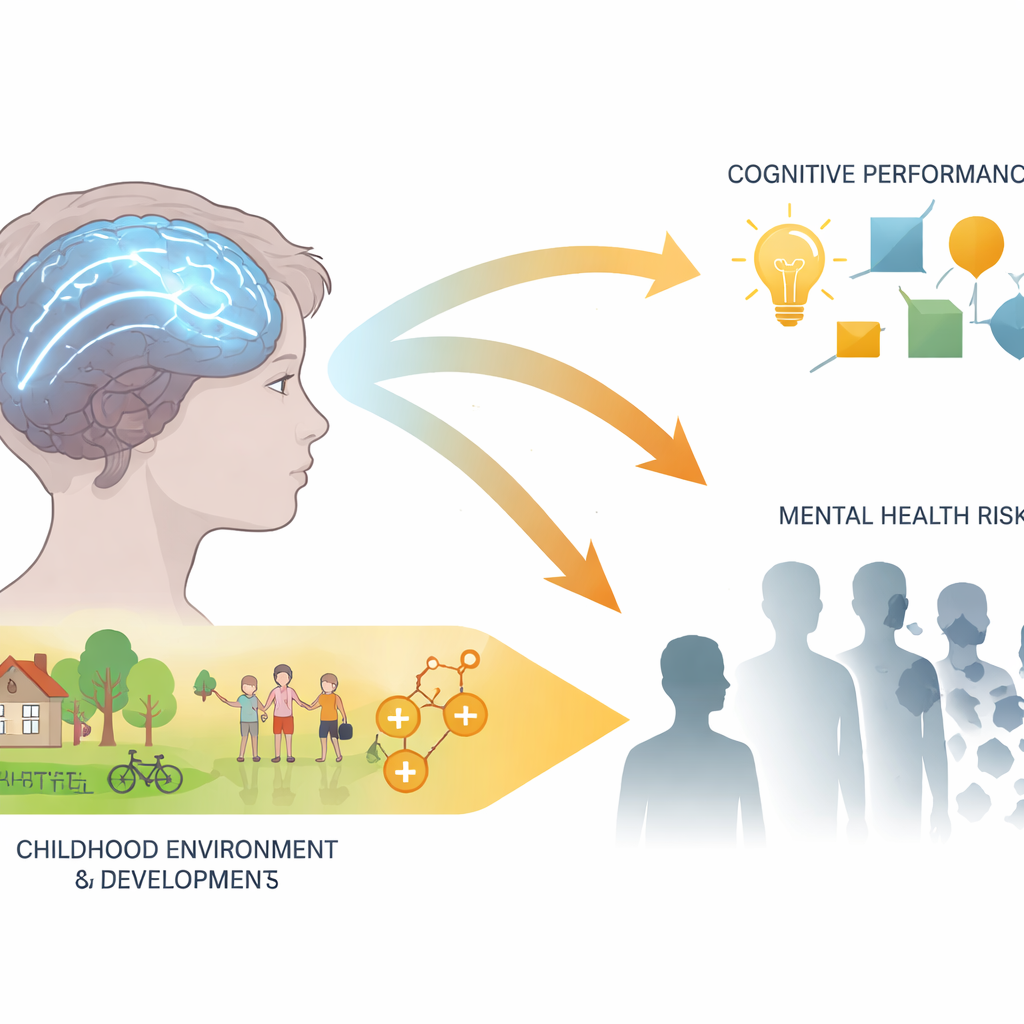
Late childhood and early teenage years are a time of rapid brain change—and also when many mental health problems first appear. This study asks a simple but powerful question: as the brain’s wiring develops during preadolescence, can delays or differences in that wiring forecast how well children will think, learn, and cope with psychiatric symptoms both now and in the near future?
Tracking the brain’s inner highways
The authors focused on white matter, the brain’s network of long-range fibers that act like communication highways between regions. Using diffusion MRI scans from about 10,000 children and adolescents across three large projects, they measured the microstructure of 54 major white-matter tracts and grouped them into systems such as “association” tracts that connect higher thinking areas and “limbic” tracts involved in emotion. They trained machine-learning models to estimate each child’s “brain age” from these tract profiles—how mature the wiring looks compared with typical development—then calculated a brain-age gap for each tract, showing whether that pathway appears ahead of or behind schedule for a child’s actual age.
Two developmental patterns that link thinking and symptoms
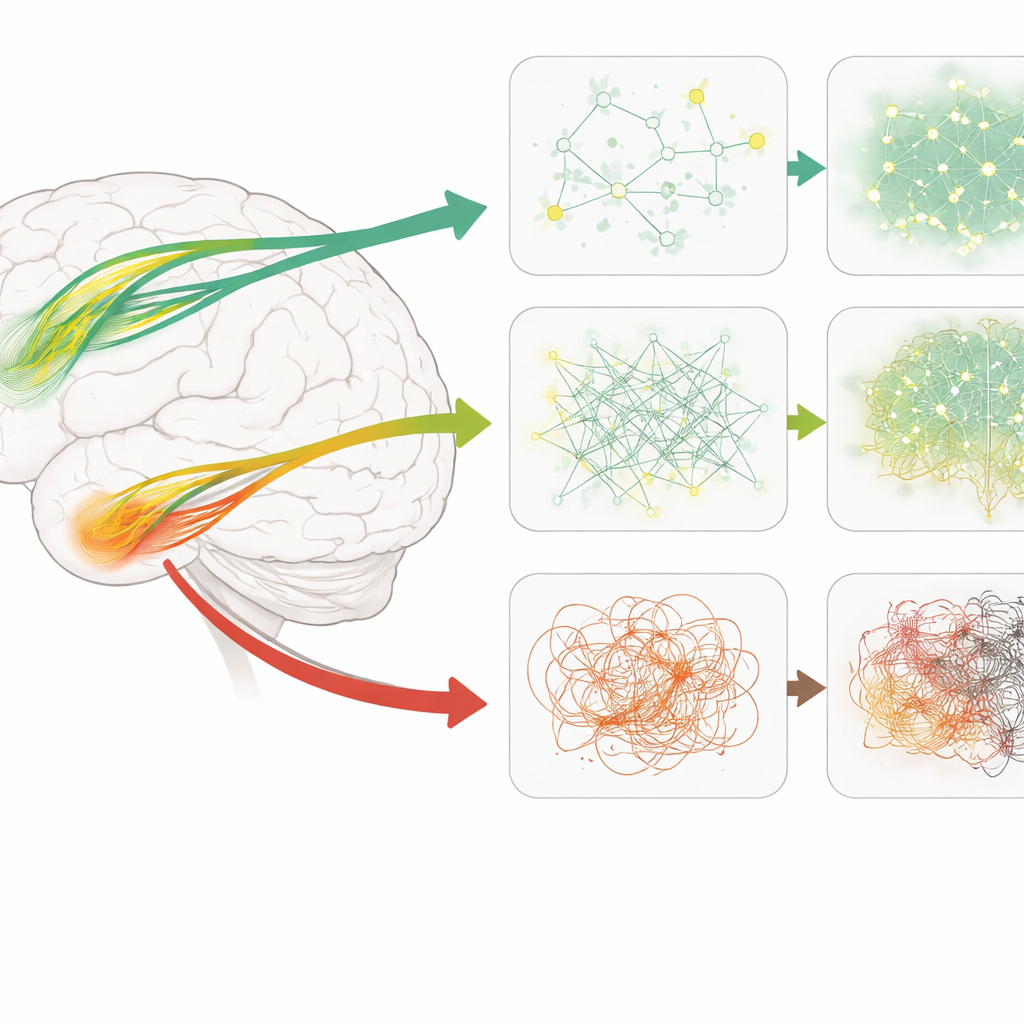
By comparing these tract-based brain-age gaps with a wide battery of cognitive tests and parent-reported behavior and symptoms, the team uncovered two broad developmental patterns. One pattern centered on association tracts, especially those running through the upper parts of the brain that support attention, language, and flexible thinking. When these tracts looked more mature than expected, children tended to have better overall and fluid intelligence and fewer attention and behavior problems. A second pattern involved limbic and subcortical tracts that connect deep emotional and reward areas; more advanced development there was tied to better performance on certain speed and spatial tasks and fewer manic-like mood symptoms.
Energy-hungry wiring and future outcomes
To probe what might make these tracts especially important, the researchers overlaid them with detailed maps of mitochondrial activity from postmortem adult brains. Association tracts that were most strongly linked to cognition and behavior showed higher levels of mitochondrial enzymes and energy capacity, suggesting they are particularly energy-hungry and potentially vulnerable during development. The team also tested whether today’s wiring foretells tomorrow’s abilities. Children whose association tracts appeared more mature at ages 9–11 went on to earn better grades, perform better on math tasks, and do better on an emotional Stroop task two to three years later. These predictive links were stronger for brain-age measures than for raw MRI metrics, implying that “how far along” a tract is on its typical growth curve carries special information.
Brain-age delays and broad psychiatric risk
The study then turned to clinical diagnoses across many psychiatric categories. Using structured parent interviews, the authors counted how many diagnoses each child had at baseline and two years later, and tracked whether children stayed healthy, developed new disorders, recovered, or had persistent problems. Children with more negative brain-age gaps—indicating delayed development—particularly in dorsal association tracts, already had more diagnoses at baseline and were more likely to have multiple diagnoses two years later. These same delayed tracts were associated with transitions from a healthy status into any psychiatric disorder, regardless of specific diagnosis, reinforcing the idea of a shared, “transdiagnostic” risk tied to how these communication highways mature.
What this means for kids and families
In everyday terms, this work suggests that how quickly certain thinking-related wiring in the brain develops during preadolescence is closely linked to both cognitive potential and vulnerability to a wide range of psychiatric conditions. More advanced maturation of key association tracts appears to support stronger school performance and fewer symptoms, whereas delays in these same pathways flag increased risk across many diagnoses. While this research does not predict any individual child’s future with certainty, it offers a framework for using brain scans to track personalized developmental trajectories, with the long-term goal of spotting at-risk youth earlier and tailoring support before serious mental health problems take hold.
Citation: Wang, D., Hammond, C.J., Salmeron, B.J. et al. Deviation in development of dorsal association tracts during preadolescence links to concurrent and future cognitive performance and transdiagnostic psychopathology. Nat Commun 17, 2943 (2026). https://doi.org/10.1038/s41467-026-69774-6
Keywords: adolescent brain development, white matter, brain age, cognitive performance, psychiatric risk