Clear Sky Science · en
Crafting moiré superlattices in twisted complex oxide–transition metal dichalcogenide heterostructures
Twisting Layers to Shape New Quantum Worlds
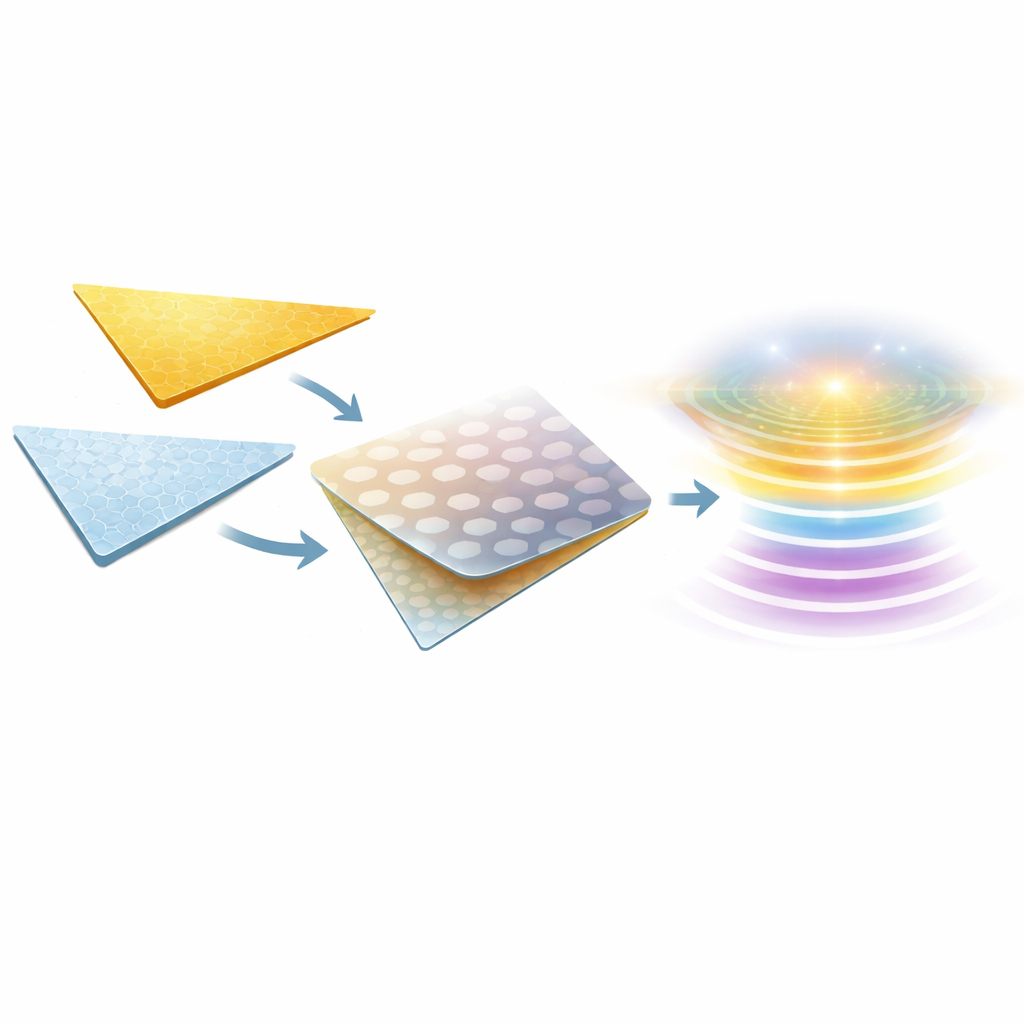
Imagine stacking two ultra-thin materials—each only a few atoms thick—and gently twisting them so their atomic grids no longer line up. This simple twist creates a larger, slow-varying pattern called a moiré superlattice, which can dramatically change how electrons and light behave. The paper summarized here shows how to build such moiré patterns not just from familiar two-dimensional materials, but by marrying them with complex oxides—solids known for hosting magnetism, ferroelectricity, and other exotic behaviors. This opens a path toward custom-designed quantum materials for future low-power electronics and photonics.
From Simple Overlays to Moiré Patterns
When two atomically thin sheets with slightly different sizes or orientations are stacked, their atomic grids interfere like two slightly misaligned window screens. The result is a larger-scale moiré pattern: a repeating landscape of regions where atoms line up differently from place to place. In conventional “twistronics,” these patterns are formed by stacking two van der Waals materials such as graphene or transition metal dichalcogenides (TMDs). They are already known to host surprising effects, including unusual superconductivity and new kinds of excitons—bound states of electrons and holes that strongly interact with light.
Bringing Complex Oxides into the Mix
The authors extend this idea by combining an oxide with strong electron correlations, strontium titanate (SrTiO₃), with a well-studied 2D semiconductor, monolayer tungsten disulfide (WS₂). They fabricate ultra-thin, freestanding oxide membranes only a few nanometers thick and transfer triangular flakes of WS₂ on top with precise control of the twist angle between their atomic lattices. Because the (111) surface of the oxide naturally forms a hexagonal pattern that almost matches the hexagonal lattice of WS₂, the two layers create clean, tunable moiré superlattices. High-resolution electron microscopy directly images these patterns and shows that as the twist angle changes, the spacing of the moiré pattern can be dialed from a few nanometers down to nearly one.
Trapping Light-Matter Particles in a Moiré Landscape
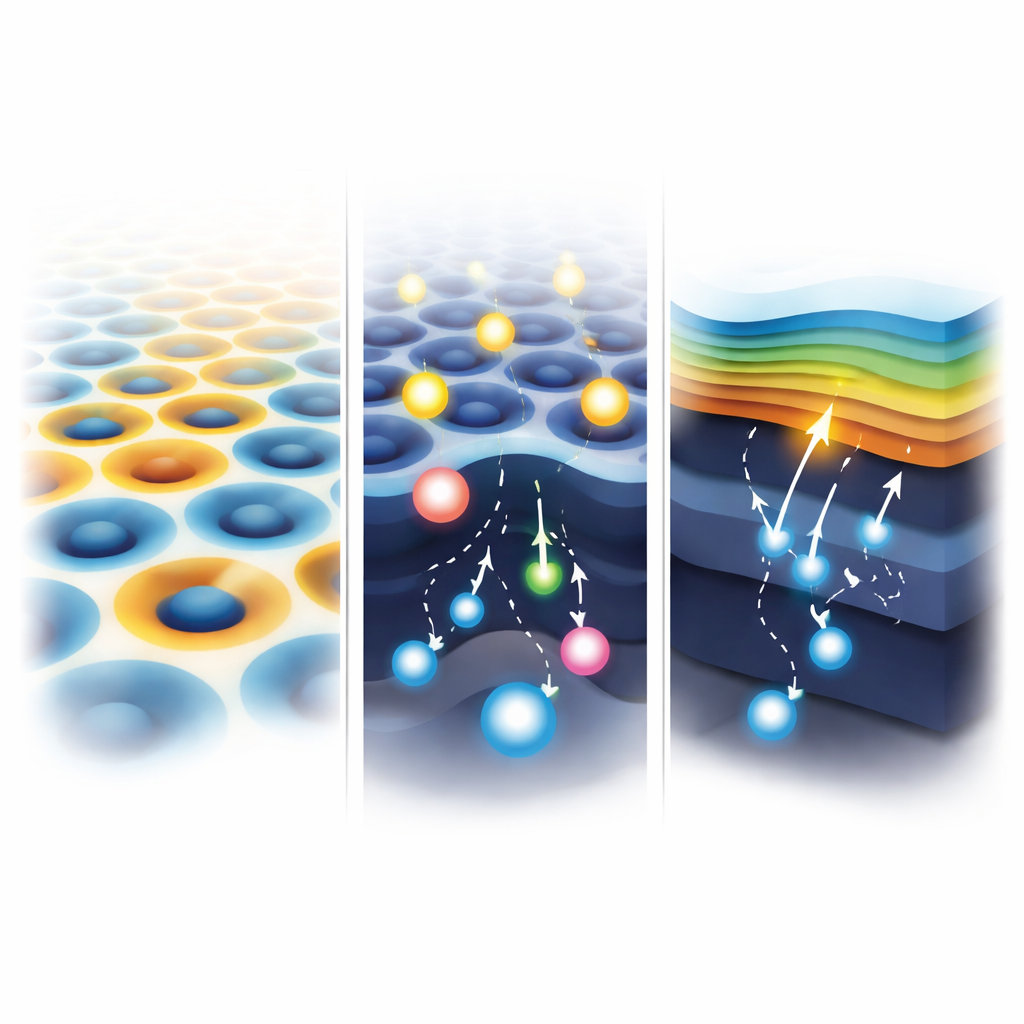
To see how this structural pattern affects electronic behavior, the team cools the samples to just a few degrees above absolute zero and shines light on them while measuring how they absorb and re-emit it. They observe new, sharp spectral features just below the main exciton line of monolayer WS₂. These extra peaks shift in energy as the twist angle changes and remain present even when defects are ruled out by temperature, spatial mapping, power dependence, and polarization studies. The authors conclude that these features arise from moiré exciton minibands—excitons that feel the periodic potential of the moiré pattern and become trapped in discrete, quantum-dot-like states whose energies can be tuned simply by twisting.
Uncovering the Origin of the Moiré Potential
To quantify this trapping landscape, the researchers use a continuum model that treats the excitons as particles moving in a periodic potential and fit the observed spectra as the twist angle varies. This yields a moiré potential depth of about 50 milli–electron volts, strong enough to confine excitons robustly. Detailed quantum-mechanical simulations (density functional theory) of different local stacking arrangements between WS₂ and the oxide reveal that the bandgap of WS₂ shifts by roughly 70 milli–electron volts depending on how tungsten and sulfur atoms sit above titanium and oxygen. Surprisingly, the calculations show that direct mixing of electronic states from the two materials plays only a minor role. Instead, the main effect comes from a stacking-dependent electric dipole at the polar oxide surface, which locally shifts the energy of WS₂’s electronic states and carves out the moiré potential landscape.
Twist-Controlled Charge and Spin Flow
Beyond the non-magnetic SrTiO₃ case, the authors also build heterostructures where WS₂ is stacked on a magnetic oxide, La₀.₇Sr₀.₃MnO₃. Using second-harmonic generation, a nonlinear optical probe that is very sensitive to symmetry and electric fields, they find that the intensity of the signal varies periodically with twist angle in a way that tracks changes in interlayer spacing and charge transfer. Ultrafast pump–probe measurements show that, at small twist angles with large moiré periodicity, electrons flow more efficiently from WS₂ into the magnetic oxide within a fraction of a trillionth of a second. This charge flow is spin-polarized by the magnetic layer and relaxes back on picosecond to hundreds-of-picoseconds timescales, effectively tying together electronic motion, lattice vibrations, and magnetism in a twist-controlled fashion.
Why This Matters for Future Technologies
By demonstrating twist-tunable moiré superlattices at the interface between complex oxides and atomically thin semiconductors, this work broadens twistronics into a much richer family of materials. The combination of strong excitonic responses in WS₂ with the electric, magnetic, and structural degrees of freedom in oxides offers a powerful toolkit for designing artificial quantum states on demand. In practical terms, this could enable devices where light emission, charge transfer, and even magnetization are steered simply by adjusting a twist angle, pointing toward reconfigurable, low-power optoelectronic switches and quantum photonic elements built on platforms compatible with existing oxide electronics.
Citation: Rahul, Kaur, P., Sun, JY. et al. Crafting moiré superlattices in twisted complex oxide–transition metal dichalcogenide heterostructures. Nat Commun 17, 3025 (2026). https://doi.org/10.1038/s41467-026-69773-7
Keywords: moiré superlattices, twistronics, transition metal dichalcogenides, complex oxides, quantum excitons