Clear Sky Science · en
Heterogeneously integrated lithium tantalate-on-silicon nitride modulators for high-speed communications
Faster Internet on a Tiny Chip
Streaming, cloud computing, and artificial intelligence all depend on moving staggering amounts of information through optical fibers. But the microscopic devices that turn electronic bits into flashes of light are straining to keep up. This work introduces a new kind of chip-scale “light switch” that combines two different materials—lithium tantalate and silicon nitride—to push data rates into the hundreds of billions of bits per second, while keeping losses low and manufacturing scalable.
Why New Light Switches Are Needed
Modern communication networks rely on photonic integrated circuits, tiny optical “motherboards” that guide light instead of electricity. Silicon nitride is a star material for these circuits because it lets light travel long distances on a chip with very little loss and can handle high optical power. However, it has a drawback: by itself, silicon nitride cannot efficiently change the brightness or phase of light when an electrical signal is applied, a function that is essential for encoding data. To overcome this, researchers are turning to ferroelectric crystals such as lithium tantalate, which respond almost instantly to electric fields through a phenomenon called the Pockels effect, enabling ultrafast modulation of light.
Building a Hybrid Photonic Platform
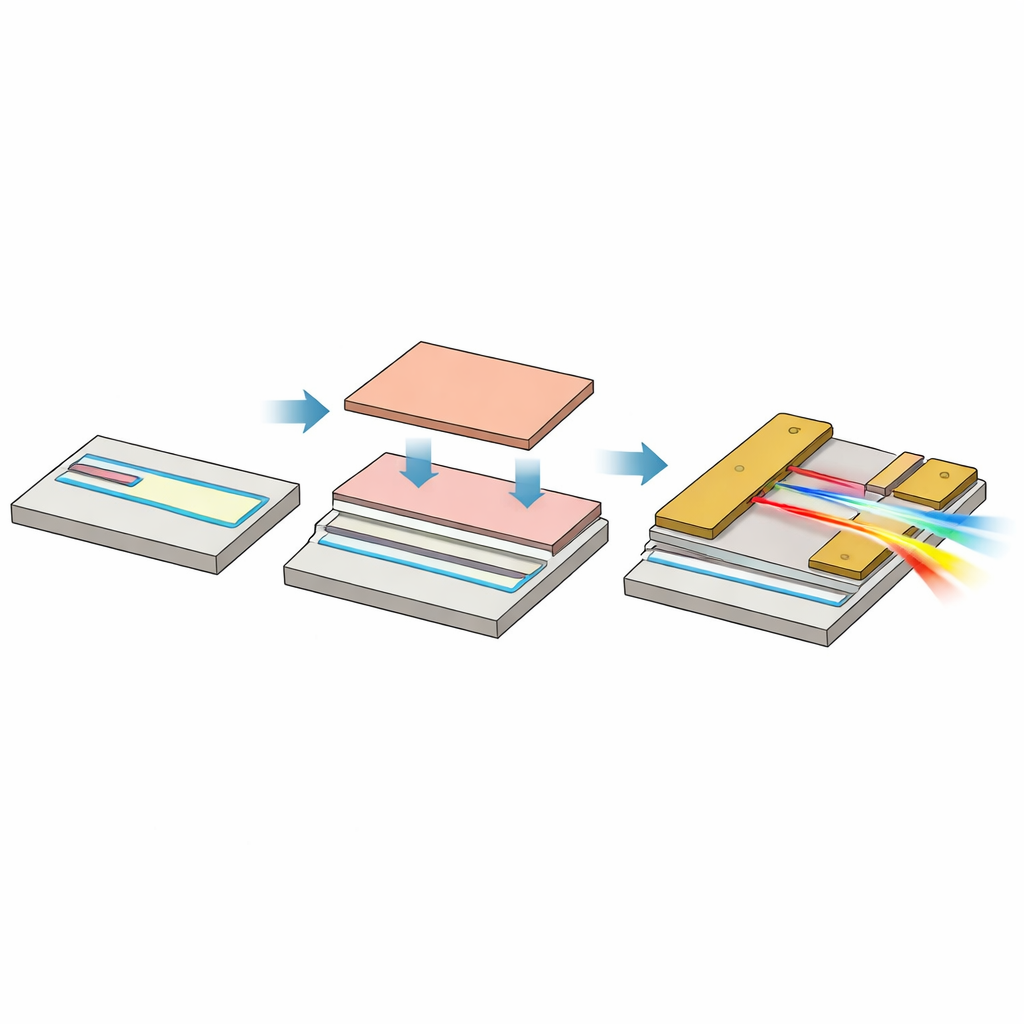
The team developed a wafer-scale process to bond an ultra-thin film of lithium tantalate directly onto pre-fabricated silicon nitride waveguides. They first create low-loss silicon nitride circuits using a so-called Damascene process, which produces smooth waveguides with strong light confinement. Separately, they prepare lithium-tantalate-on-insulator wafers. After careful surface cleaning and activation, the two wafers are brought into contact so that molecular forces bond them, and a subsequent heat treatment strengthens the connection. The silicon support under the lithium tantalate is then removed, exposing a thin ferroelectric layer precisely aligned over the silicon nitride waveguides without the need for aggressive etching that could damage the materials or add electrical losses.
Turning Electricity into Ultrahigh-Speed Light Signals
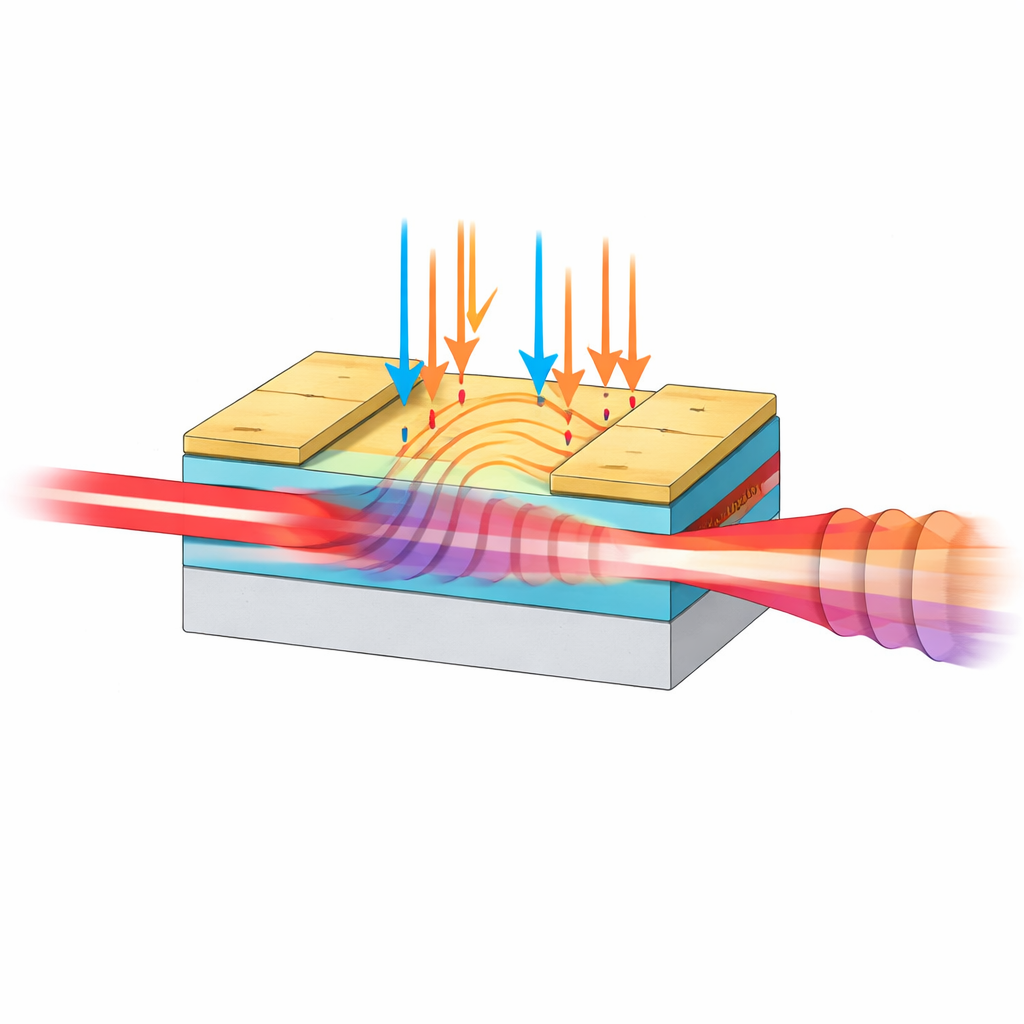
On this hybrid platform, the researchers pattern metal electrodes to build Mach–Zehnder modulators and more complex in-phase/quadrature (IQ) modulators. In these devices, light from a laser travels through a pair of paths whose interference is controlled by tiny voltage changes applied across the lithium tantalate layer. The modulators achieve a voltage–length product of about 4 V·cm, meaning they can produce a strong modulation effect over only a few millimeters of device length with modest drive voltages. Their response remains flat up to around 100 gigahertz, indicating that they can faithfully follow extremely rapid electrical changes. Importantly, the hybrid waveguides maintain low optical loss—about 14 dB per meter—and the devices show stable operation under constant bias, with very little drift over an hour, an issue that has plagued some earlier ferroelectric modulators.
Pushing Data Rates to New Levels
To test what these modulators can do in real communication settings, the team transmitted advanced optical signals over fiber. Using a single intensity modulator driven with four-level pulse-amplitude signals, they reached net data rates up to 333 gigabits per second after accounting for realistic error-correction codes. With the IQ modulators, which control both the brightness and phase of light and are standard in long-haul coherent systems, they sent more complex 16-state quadrature amplitude modulation signals. These experiments achieved line rates up to 704 gigabits per second and net data rates as high as 581 gigabits per second—figures that rival or surpass many existing integrated platforms while using the low-loss silicon nitride foundation.
What This Means for Future Networks
By marrying the low-loss, mature manufacturing of silicon nitride photonic circuits with the ultrafast electro-optic response of thin-film lithium tantalate, this work provides a practical route to faster, more efficient optical links. The hybrid devices can be produced across full wafers with high yield, making them attractive for large-scale deployment. Beyond speeding up internet backbones and data centers, the same platform could underpin compact microwave-to-optical converters, precision laser systems, and next-generation lidar sensors. In simple terms, the study shows how a carefully engineered material stack can turn a passive light-guiding chip into an active, high-speed engine for the information age.
Citation: Cai, J., Kotz, A., Larocque, H. et al. Heterogeneously integrated lithium tantalate-on-silicon nitride modulators for high-speed communications. Nat Commun 17, 3314 (2026). https://doi.org/10.1038/s41467-026-69769-3
Keywords: photonic integrated circuits, electro-optic modulators, silicon nitride, lithium tantalate, high-speed optical communications