Clear Sky Science · en
Nature-inspired solid-state proton diode membrane for high-performance force-electric conversion
Turning Touch into Power
Imagine a bandage that not only feels your pulse but powers your smartwatch every time you move. This study describes a new thin-film material that does something close: it can turn gentle pressure into electricity without any liquid inside, taking inspiration from how our own skin moves water and charged particles. The work points toward self-powered pressure sensors for health monitoring, soft robots, and wearable electronics that do not need batteries or fragile liquid components.
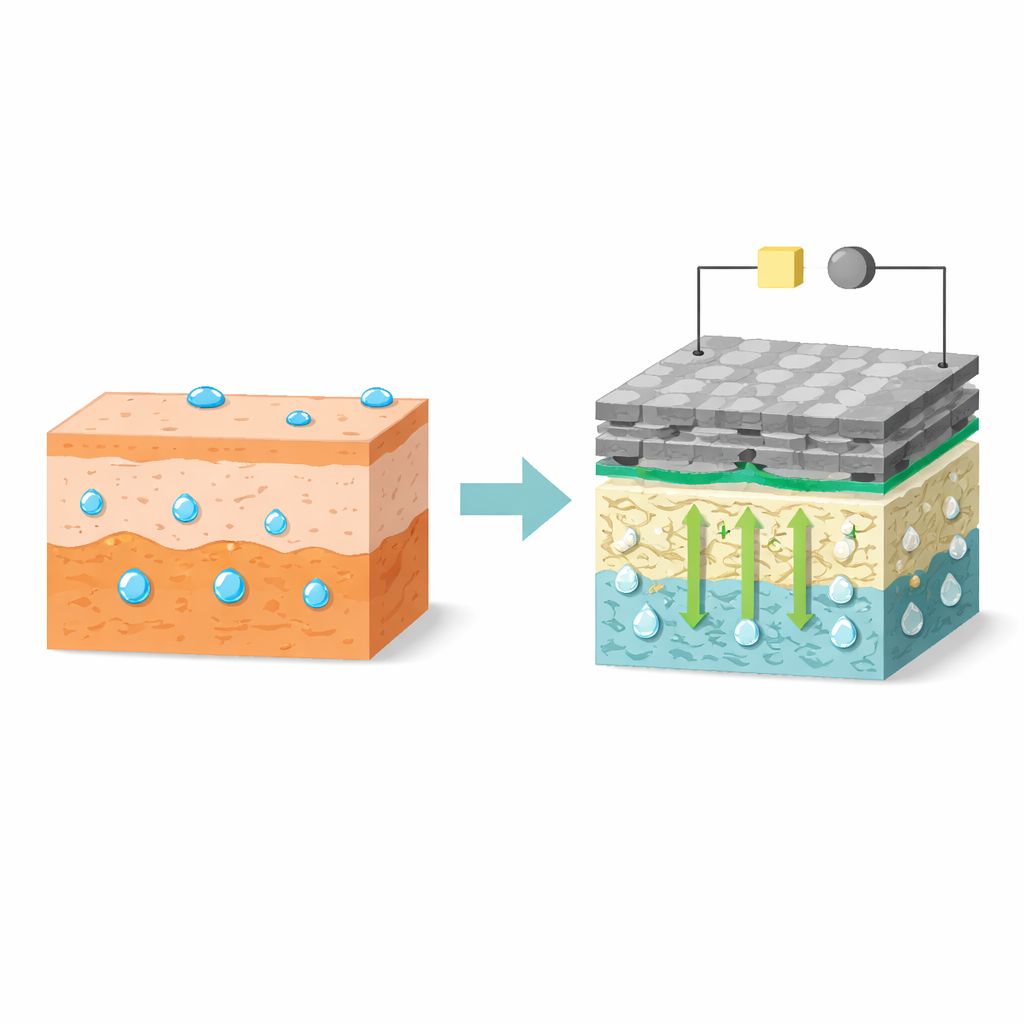
Learning from the Layers of Skin
Our skin quietly manages a gradient of moisture, from the relatively dry outer layer to the wetter inner layer. That hidden water difference helps guide the motion of ions—tiny charged particles—through tissue. The researchers borrowed this idea to build an artificial "gate" for protons, the lightest of all ions. They paired two different solid films: a stacked sheet of graphene oxide, which forms narrow two-dimensional channels, and a fibrous membrane of bacterial cellulose that was chemically linked with copper ions, which holds far more water. When these are pressed together into a single membrane, the result is a dry–wet contrast similar to skin, but now engineered for fast, one-way proton motion.
Building a One-Way Highway for Protons
In the combined membrane, the cellulose–copper side acts like a loose sponge filled with water-rich pathways, while the graphene oxide side behaves more like a dense book of pages with tight gaps in between. Protons move easily through the open, hydrated cellulose network and then encounter a much more restrictive region as they enter the graphene oxide layers. Because the energy cost of moving in one direction across this junction is far lower than in the opposite direction, the membrane behaves like an electrical diode for protons: current flows strongly one way but is greatly suppressed the other. Experiments show a rectification ratio of about 125, meaning the forward current is roughly 125 times higher than the reverse current, a record value for a solid proton-conducting device.
Peeking Inside the Hidden Pathways
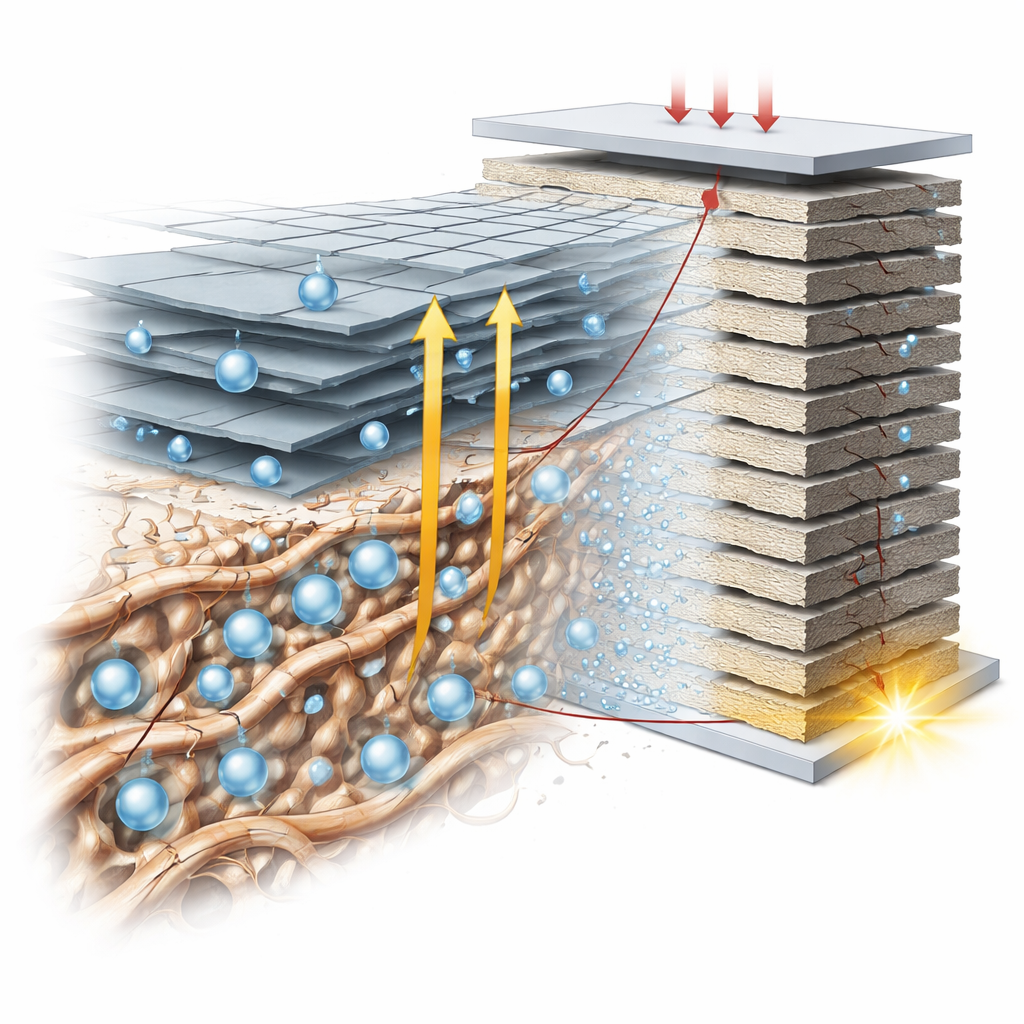
To understand why the one-way effect is so strong, the team used computer simulations to follow individual protons as they wandered through the two materials. In the cellulose–copper region, protons had freedom to move in all directions along water-assisted paths. In graphene oxide, most motion was confined within the plane of each layer, making it difficult to hop between layers. Calculations of the energy landscape at the junction showed that crossing from cellulose–copper into graphene oxide requires surmounting a moderate barrier, while moving in the reverse direction faces a much steeper barrier, about three times higher. This asymmetry explains the strongly directional current: protons tend to flow from the low-resistance, low-binding side into the high-resistance, strongly binding side, but not back again.
From Gentle Press to Steady Current
Because the membrane is solid and flexible, mechanical pressure can squeeze its internal channels and push protons along the preferred direction. When the researchers sandwiched the film between electrodes and pressed on it, a single device produced up to about half a volt and several microamperes of current, with efficiency high enough to outperform many similar ion-based systems. The electrical output rose with applied force and remained stable over many cycles, enabling it to act as a precise pressure sensor. By arranging many diode units into arrays, the team mapped pressure patterns from small objects and even captured detailed wrist pulse signals. Strings and stacks of dozens of diodes increased the voltage to tens of volts—enough to light LEDs and even charge a mobile phone under repeated pressing.
Why This Matters
In plain terms, the researchers have shown how to make a thin, flexible, entirely solid film that lets protons travel mostly in one direction, and how that built-in one-way flow can convert slow or static pressure into useful direct current power. Inspired by the moisture gradient in human skin, their design combines a wet, open proton reservoir with a dry, tighter region to create a robust proton diode. Because it does not rely on liquid electrolytes, the membrane avoids leakage and dehydration problems that limit many existing devices. This nature-inspired approach could underpin a new generation of safe, wearable, and self-powered pressure sensors and may also feed into emerging technologies that process information using ions instead of electrons.
Citation: Lei, D., Zhang, Q., Wang, Y. et al. Nature-inspired solid-state proton diode membrane for high-performance force-electric conversion. Nat Commun 17, 3138 (2026). https://doi.org/10.1038/s41467-026-69763-9
Keywords: proton diode, solid-state ion transport, pressure sensing, bioinspired materials, energy harvesting