Clear Sky Science · en
Adaptive optical waveguide system for large-area and overheating-preventing phototherapy in deep tissue
Light as a Gentle Medical Tool
Many modern cancer treatments rely on cutting, burning, or poisoning tissue. Phototherapy offers a gentler alternative: it uses carefully targeted light to heat or chemically damage disease while sparing surrounding healthy cells. Yet there is a catch—light has trouble reaching deep inside the body, and when doctors turn up the power to compensate, nearby healthy tissue can overheat. This study introduces a smart, needle-like light guide that can reach deep lesions and automatically dial back the light when things get too hot, making deep-tissue phototherapy safer and more precise.
Why Treating Deeper Tissue Is Hard
When light shines on the skin, much of it is scattered or absorbed before it can reach tissue several centimeters below the surface. That works for shallow problems, but not for tumors or other lesions buried deeper in the body. One solution is to snake a thin optical fiber directly into or near the diseased area, guiding the light from the inside. However, standard fibers spread light over a narrow cone, so they must sit several centimeters away to cover a large lesion. The light then travels through normal tissue, which heats up and can be damaged. Even when the fiber is inserted into the lesion itself, current systems cannot sense local temperature or respond fast enough to prevent overheating of nearby healthy tissue.
A Self-Protecting Deep-Tissue Light Guide
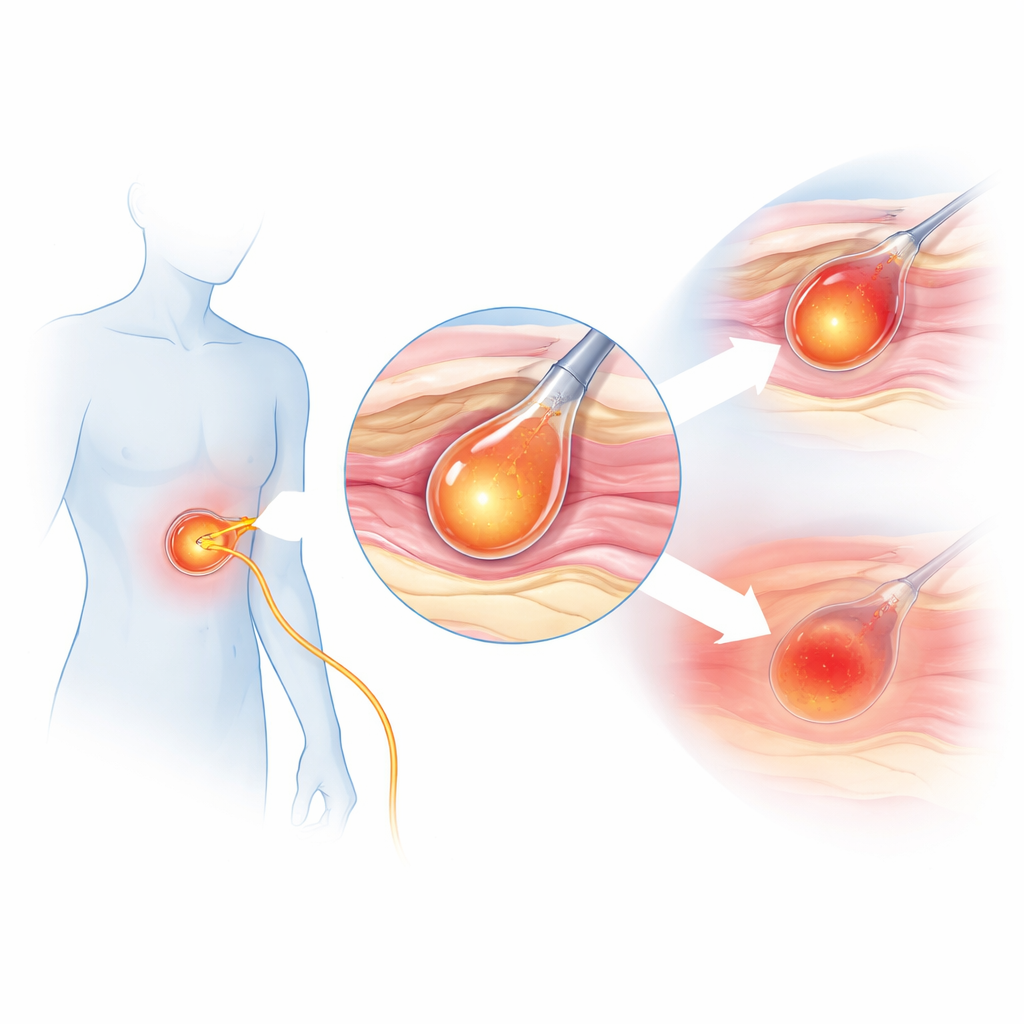
The researchers designed an adaptive optical waveguide system (AOWS) to solve these problems. At its core is a flexible optical fiber whose tip is encased in a small, soft capsule filled with a special temperature-sensitive liquid. This liquid is clear at normal body temperatures, allowing light to travel straight through to the target. But at a carefully tuned threshold—around the highest temperature considered safe for tissue—it suddenly turns cloudy and scatters the light in many directions, acting like a built-in safety valve. Because this “on–off” behavior depends on temperature rather than on preset laser power, the device can automatically regulate the delivered light without any manual adjustment.
A Liquid That Knows When to Turn Cloudy
The key to this behavior is a tailor-made salt-like liquid that mixes well with water when cool but separates into tiny droplets when warm. By adjusting the ratio of this liquid to water, and by dissolving common table salt into the mixture, the team could set the exact temperature at which it turns cloudy—within about one degree Celsius. Detailed laboratory tests showed that as the liquid heats, the attraction between its charged components and water weakens, prompting them to clump together into microscopic droplets. Adding salt competes for water, pushing the liquid to separate at even lower temperatures. This transition is fully reversible: as the mixture cools, it clears again, restoring the high-transparency pathway for light.
Spreading Light Safely Where It’s Needed
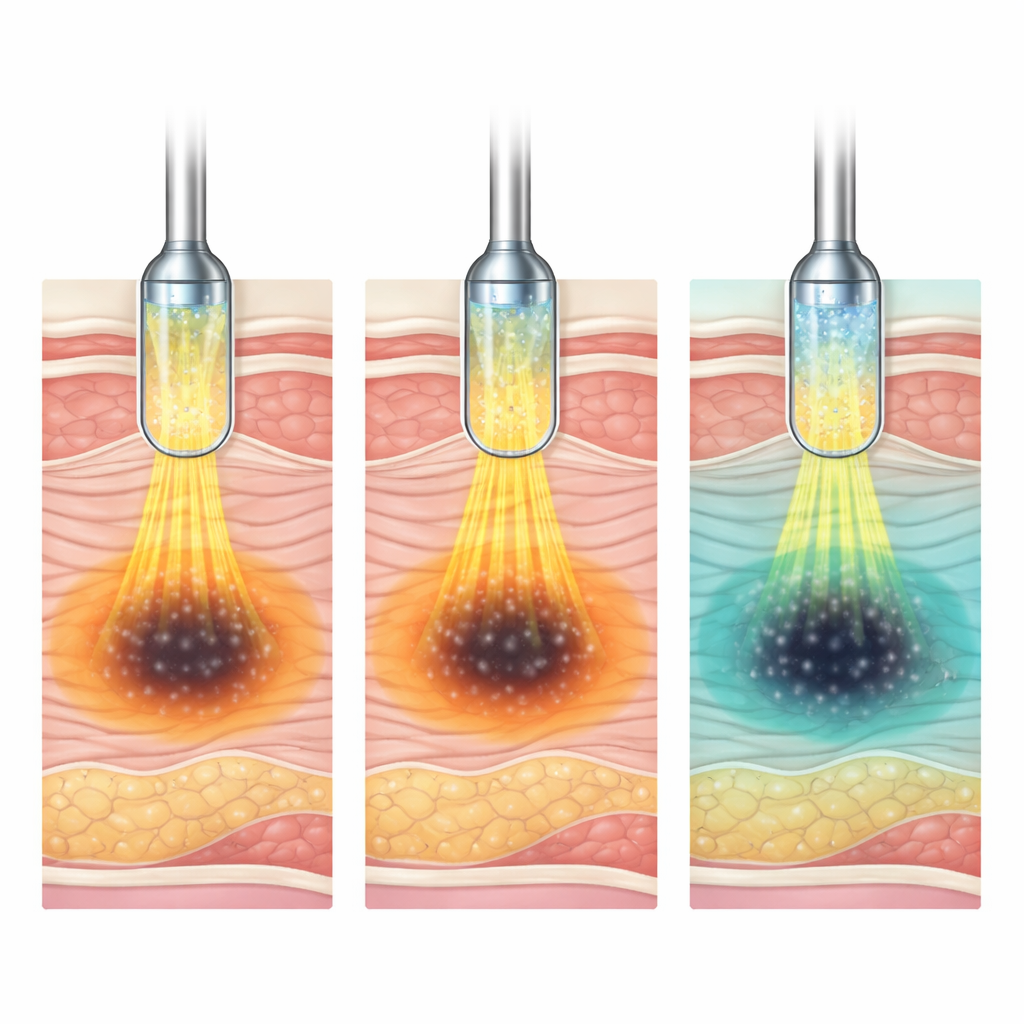
The AOWS tip does more than just shut off light when it gets too hot; its shape can also be adjusted to control how widely the light spreads. By inflating the capsule so that its surface is convex, flat, or concave, the team could tune the beam to cover a small or large area right next to the lesion. In soft gel “tissues” containing light-absorbing particles, the adaptive system delivered enough heat to the target while keeping the surrounding region below harmful temperatures, even when the input laser power was high. The temperature at the fiber tip cycled gently around the preset limit, showing how the device continuously turned light delivery up and down through a built-in negative feedback loop. Tests in pig muscle confirmed that, compared with a standard fiber, the adaptive system confined heat and tissue damage to the intended zone while sparing muscle farther away.
Safer Deep-Light Treatments on the Horizon
In everyday terms, this work is like giving doctors a smart flashlight that can be threaded deep into the body and knows when to dim itself to avoid burning what it illuminates. By combining a tunable, temperature-sensitive liquid with a flexible fiber and adjustable tip, the adaptive waveguide can both reach deep lesions and prevent overheating of healthy tissue. This approach could complement or even replace some forms of thermal treatments that currently risk collateral damage, bringing truly targeted, large-area light therapy for deep-seated disease a step closer to clinical reality.
Citation: Wang, Z., Yang, Z., Ma, Y. et al. Adaptive optical waveguide system for large-area and overheating-preventing phototherapy in deep tissue. Nat Commun 17, 3308 (2026). https://doi.org/10.1038/s41467-026-69759-5
Keywords: phototherapy, optical fibers, deep tissue treatment, heat-responsive materials, cancer ablation