Clear Sky Science · en
Redefining catalyst reconstruction and Cl--repulsion correlation to delineate a dynamic protective skeleton for seawater splitting
Turning Seawater into a Clean Fuel Source
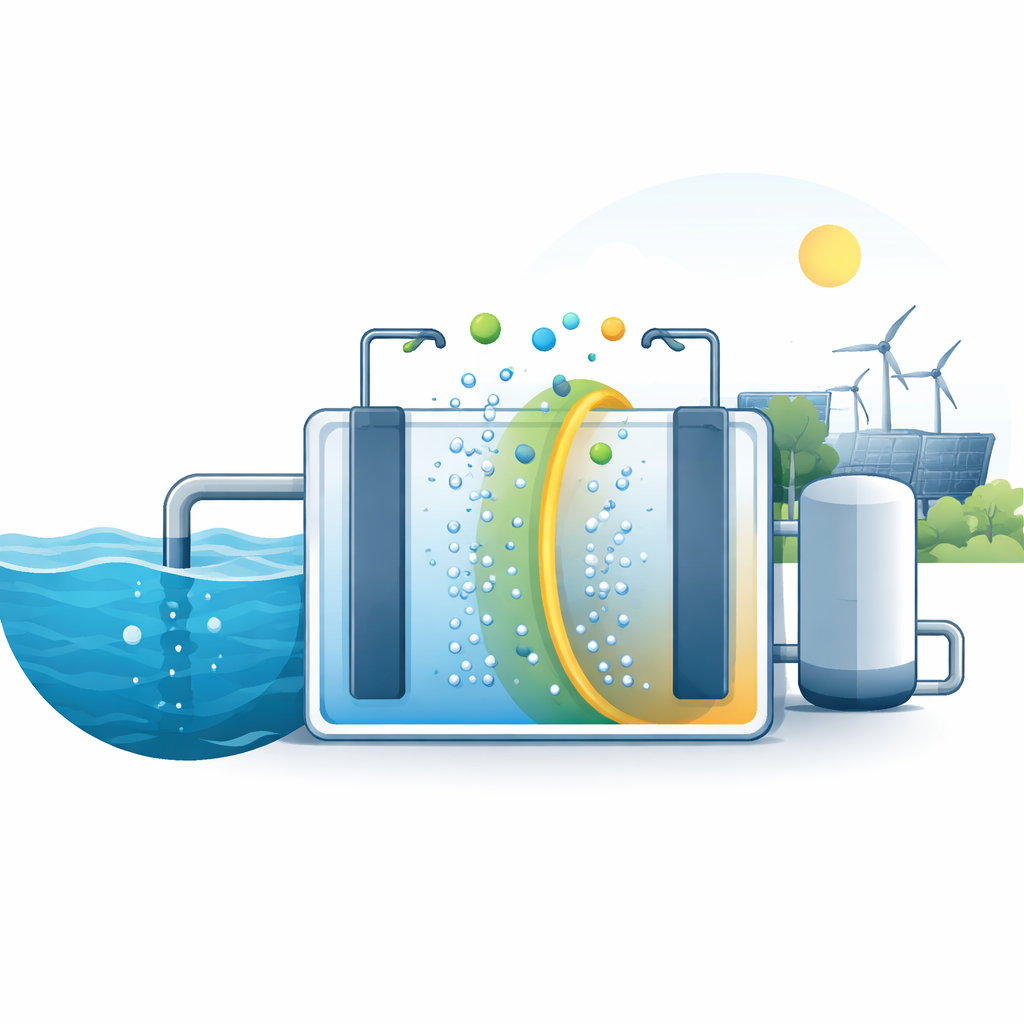
Hydrogen is often hailed as a clean fuel of the future, but making it sustainably is not trivial. Most industrial hydrogen still comes from fossil fuels. Splitting water with electricity offers a greener path, yet it normally demands large amounts of purified freshwater—an uncomfortable prospect on a thirsty planet. This study explores how to tap the vast reservoir of seawater instead, by designing a smart, self-adjusting material that can keep working in the harsh, salty environment without being eaten away by corrosion.
The Hidden Problem with Salty Water
Using seawater for electrolysis sounds simple: run electricity through salt water to separate hydrogen and oxygen. In reality, the salt—especially chloride ions—creates serious trouble at the oxygen-producing electrode. Instead of just making oxygen, the device can generate chlorine gas and bleach-like byproducts, which waste energy and attack the metal surface. A popular class of catalysts based on nickel and iron is efficient in alkaline water, but in seawater these materials corrode, dissolve, and quickly lose performance. Scientists have noticed that some catalysts rebuild their surfaces during operation, forming protective layers that seem to push chloride away, yet a basic puzzle remains: chloride and hydroxide both carry the same negative charge, so why is only chloride strongly excluded?
A Catalyst That Rebuilds Its Own Armor
The researchers engineered a nickel–iron–sulfur material, grown as thin, leafy sheets on a porous metal foam. During use in real seawater, sulfur atoms near the surface are gradually oxidized and transformed into sulfate groups. At the same time, the nickel and iron reorganize into a highly active layered hydroxide structure. This transformation creates a thin, sulfate-rich “skin” on the catalyst. Careful microscopy, surface analysis, and in‑situ measurements taken while the device is running show that this new skin forms uniformly and stays attached, even when the device is pushed to industrial-scale current densities. The result is a catalyst that needs less voltage to drive the oxygen reaction than commercial noble-metal catalysts, and that keeps working for thousands of hours.
How Water Bonds Help Push Salt Away
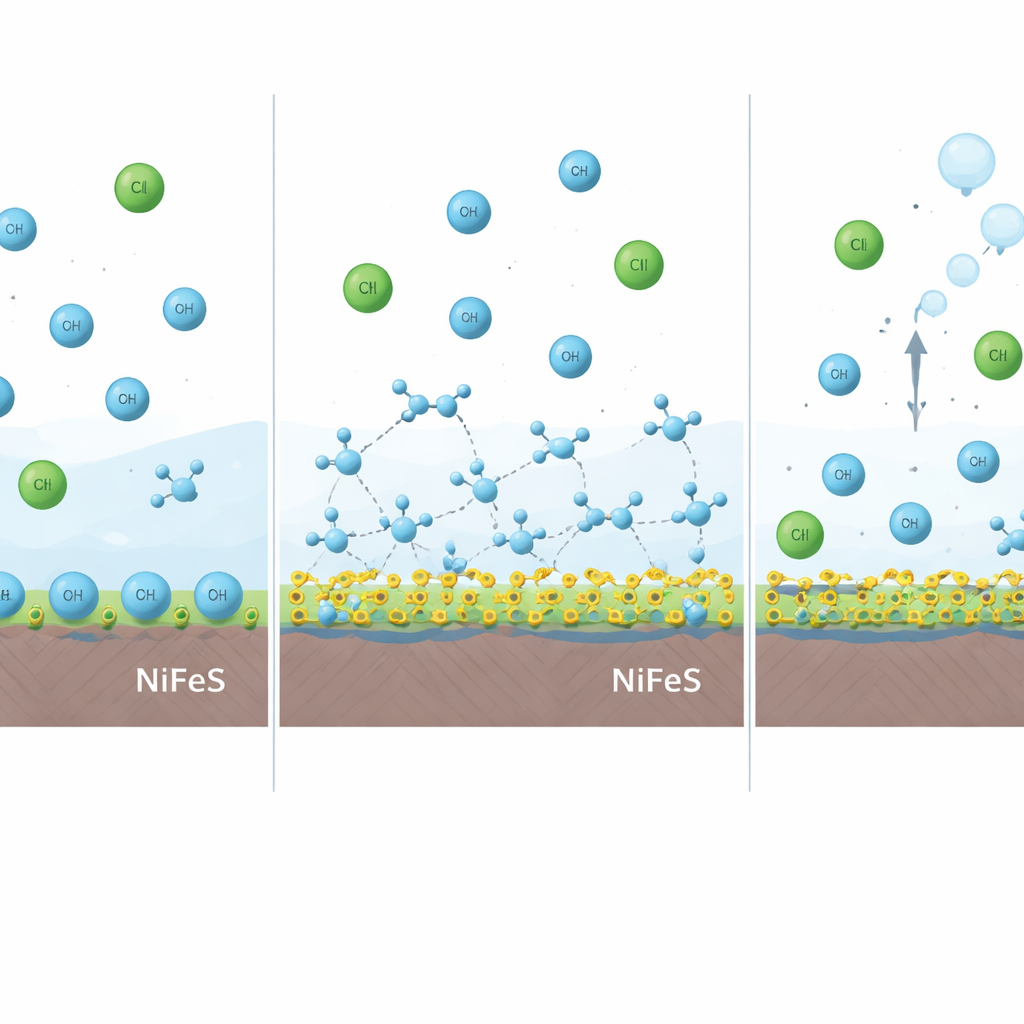
To understand why chloride is repelled but hydroxide is not, the team looked beyond simple charge effects and focused on the network of hydrogen bonds among water and ions at the catalyst surface. Using vibrational spectroscopy during operation, they found that the sulfate-rich layer strengthens the hydrogen-bond network in the thin film of water at the interface. Computer simulations backed this up: near sulfate, water molecules form a denser, more strongly connected network. In this environment, hydroxide still binds strongly, helping it reach the surface and participate in the oxygen‑forming reaction. Chloride, in contrast, forms weaker interactions within this reinforced network and is held farther from the surface. Additional thermodynamic calculations showed that it costs much more free energy for chloride to migrate from the bulk solution into the interfacial region when sulfate is present, quantitatively explaining its exclusion.
From Laboratory Cell to Real-World Operation
Armed with this mechanistic insight, the team built full electrolysis cells using their nickel–iron–sulfur electrodes in both simple two‑electrode setups and in more advanced membrane-based devices. In alkaline seawater, their system produced high currents at relatively low cell voltages, beating commercial platinum and ruthenium oxide combinations. It ran continuously at one ampere per square centimeter for 2000 hours with only minor performance loss, and endured 1500 start–stop cycles, mimicking the fluctuating power supply from solar panels or wind turbines. In a membrane cell, the device delivered industrially relevant currents with good energy efficiency, low estimated hydrogen cost, and little evidence of chloride sneaking through the membrane or attacking the electrodes. The researchers also demonstrated that the catalyst can be manufactured over square‑meter areas with uniform structure and corrosion resistance.
Why This Matters for Future Hydrogen
In essence, the work shows that the key to stable seawater splitting is not just carrying the right charge, but sculpting the microscopic water environment so that it welcomes helpful ions and discourages harmful ones. By allowing the catalyst to reconstruct into a sulfate-rich protective skeleton, the device builds a dynamic hydrogen-bond network that selectively ushers hydroxide to the surface while pushing chloride away. This subtle control over interfacial chemistry enables efficient, long‑lived seawater electrolysis that could, in principle, pair directly with renewable power. If developed further, such systems could turn abundant seawater into a practical, large-scale source of green hydrogen without competing for scarce freshwater resources.
Citation: Yu, Y., Zhou, W., Yuan, J. et al. Redefining catalyst reconstruction and Cl--repulsion correlation to delineate a dynamic protective skeleton for seawater splitting. Nat Commun 17, 3014 (2026). https://doi.org/10.1038/s41467-026-69755-9
Keywords: seawater electrolysis, green hydrogen, nickel iron catalyst, chloride corrosion, sulfate protection