Clear Sky Science · en
Substorm expansion embedded in a global cycle of field-aligned currents and auroral electrojets
Lights in the Sky and Storms in Space
When shimmering auroras dance across polar skies, they are the visible glow of powerful space storms unfolding around Earth. These geomagnetic "substorms" can disrupt radio communications, damage satellites, and shake power grids far below. Yet scientists have long struggled to explain how the most explosive part of a substorm unfolds. This study uses a rare combination of satellite and ground-based observations to show that the dramatic burst of activity is not an isolated event, but part of a repeating global cycle that links the solar wind, Earth’s magnetic shield, and electric currents flowing over the polar regions. 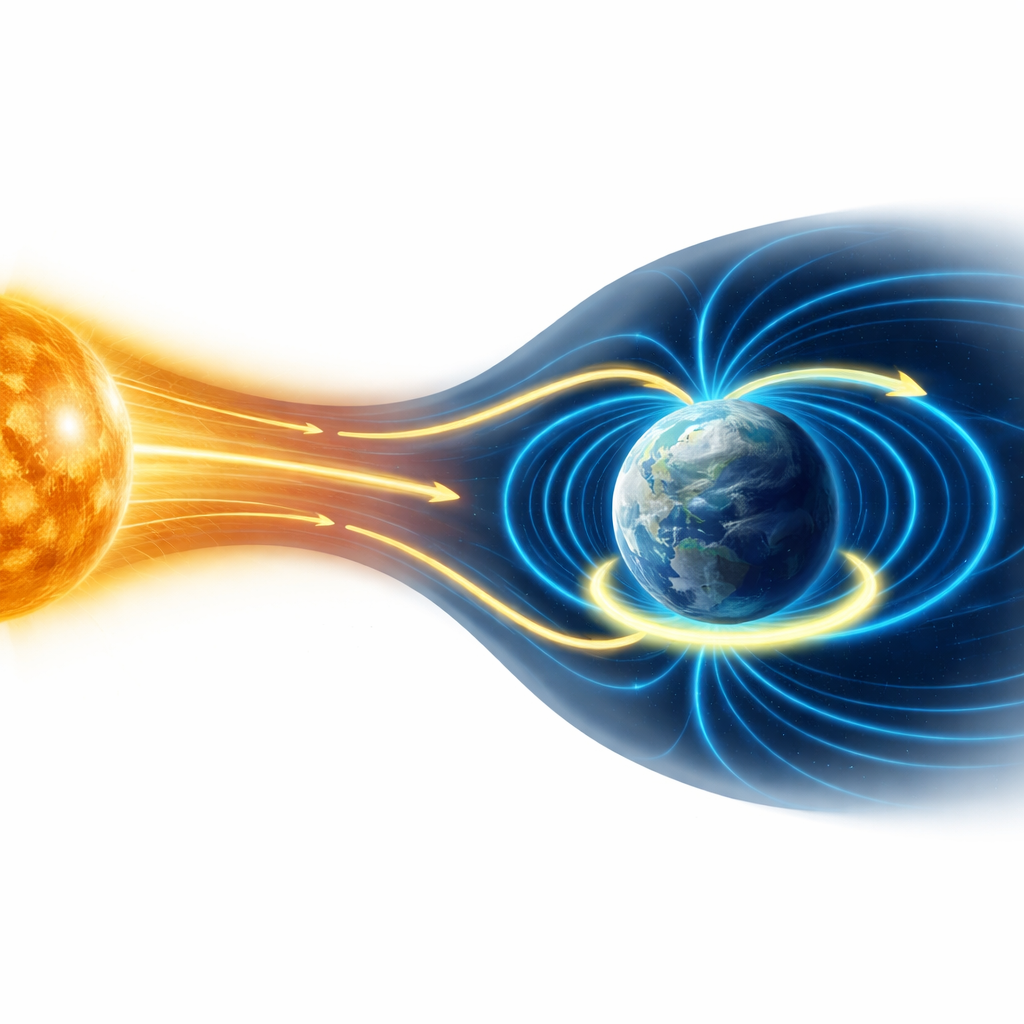
A Global Engine Behind Polar Storms
Earth is surrounded by a magnetic bubble, the magnetosphere, which channels electrically charged particles from the Sun toward the poles. During a substorm, energy from the solar wind is first stored in this magnetic bubble and then suddenly released, powering bright auroras and strong electric currents in the upper atmosphere. The new work focuses on how these currents, especially so‑called auroral electrojets that flow around the polar regions, are organized on a global scale during intense substorms that occurred during the powerful geomagnetic storm of 17 March 2015.
Two Key Current Systems Working Together
The authors separate the polar current system into two main components. One, called DP‑2, is driven directly by large-scale plasma flows set up when the solar wind reconnects with Earth’s magnetic field on the dayside. The other, DP‑1, is associated with the sudden surge of energy and particle bombardment that marks the substorm’s expansion phase and is strongest on the nightside. By tracking where and when the strongest currents appear across different longitudes and latitudes, and comparing them with measurements of plasma motion and the interplanetary magnetic field, the team shows that these two systems are tightly linked rather than acting independently. 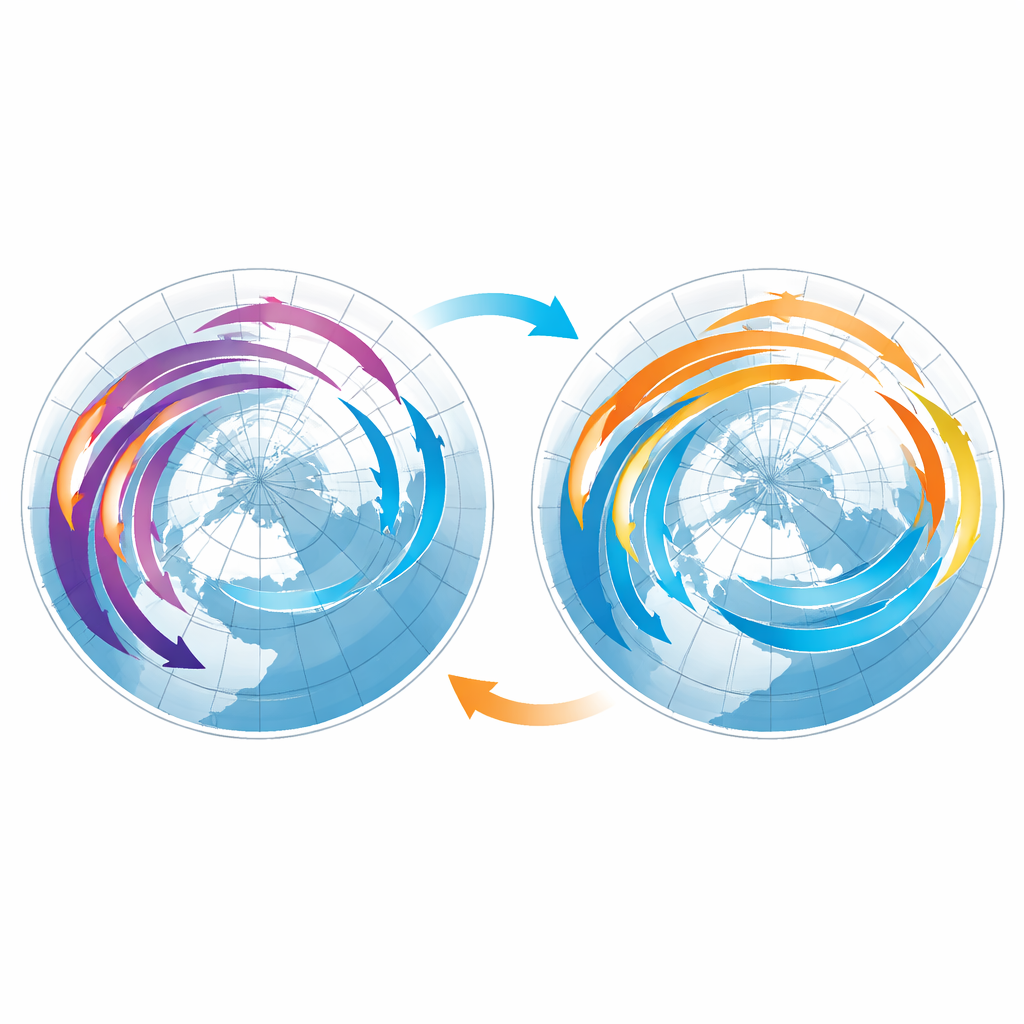
A Repeating Two-Step Dance Around the Pole
The observations reveal a striking pattern: during each substorm, the peaks of the field-aligned currents (which connect space to the ionosphere), the strongest westward auroral electrojets, and the fastest ionospheric flows all move together in a large-scale cycle. First, they drift antisunward and toward lower latitudes, corresponding to a period when the dayside connection to the solar wind dominates and energy is being loaded into the system. Then they reverse, marching sunward and toward higher latitudes as nightside reconnection and unloading of stored energy take over. This cyclic motion repeats across multiple substorms, sometimes in a smooth way and sometimes in stepwise jumps, depending on how strongly the nightside current system flares up.
When and Where the Explosion Begins
An important outcome is that the explosive expansion phase of each substorm is always embedded within this broader cycle. In some events, the expansion begins while dayside reconnection is strongest, implying that direct solar wind driving can help trigger the onset. In others, the expansion happens mainly when nightside reconnection dominates, after substantial magnetic flux has piled up in Earth’s tail. In all cases, the full strengthening of the DP‑1 current system—the part most closely tied to bright auroras and strong magnetic disturbances—relies on significant activity on the nightside. Local plasma instabilities and narrow jets of fast flow then shape the detailed structure of the auroral surge within this global framework.
What This Means for Space Weather
For non-specialists, the core message is that substorm "explosions" are not random bursts, but phases of an organized global cycle that shuttles energy around Earth’s magnetic environment. The study links two previously separate ways of thinking about polar currents—one based on how the polar cap grows and shrinks, and one based on the DP‑1 and DP‑2 current systems—into a single picture. This integrated view helps explain why auroras brighten when they do, and under what solar wind conditions they become most intense. It also supports the goals of missions like SMILE, which aim to watch the entire magnetosphere–ionosphere system as it breathes in rhythm with the solar wind.
Citation: Wang, T., Dai, L., Escoubet, C.P. et al. Substorm expansion embedded in a global cycle of field-aligned currents and auroral electrojets. Nat Commun 17, 2970 (2026). https://doi.org/10.1038/s41467-026-69753-x
Keywords: auroral substorms, space weather, Earth magnetosphere, solar wind coupling, auroral currents