Clear Sky Science · en
A highly utilized and practical lithium-sulfur positive electrode enabled in all-solid-state batteries
Why These New Batteries Matter
Modern life runs on rechargeable batteries, from smartphones to electric cars and, soon, perhaps even electric airplanes. But today’s lithium-ion batteries are approaching their limits in how much energy they can store, how safe they are, and how much they cost. This research explores a promising alternative chemistry based on sulfur and solid materials, aiming to pack more energy into the same space while using abundant, low-cost ingredients and improving safety by removing flammable liquids.
Building a Better Battery From the Inside Out
The study focuses on all-solid-state batteries, which replace liquid electrolytes with solid ones and use sulfur as the positive electrode material. Sulfur can, in theory, store much more charge than today’s common battery materials, but it usually suffers from poor electrical contact, slow reactions, and severe expansion and contraction as the battery charges and discharges. These issues waste much of sulfur’s potential and cause the battery to degrade quickly. The researchers tackle this by redesigning the microscopic structure of the sulfur-based electrode to keep the reacting materials in close contact and allow ions and electrons to move efficiently.

Creating a Helpful Boundary Layer
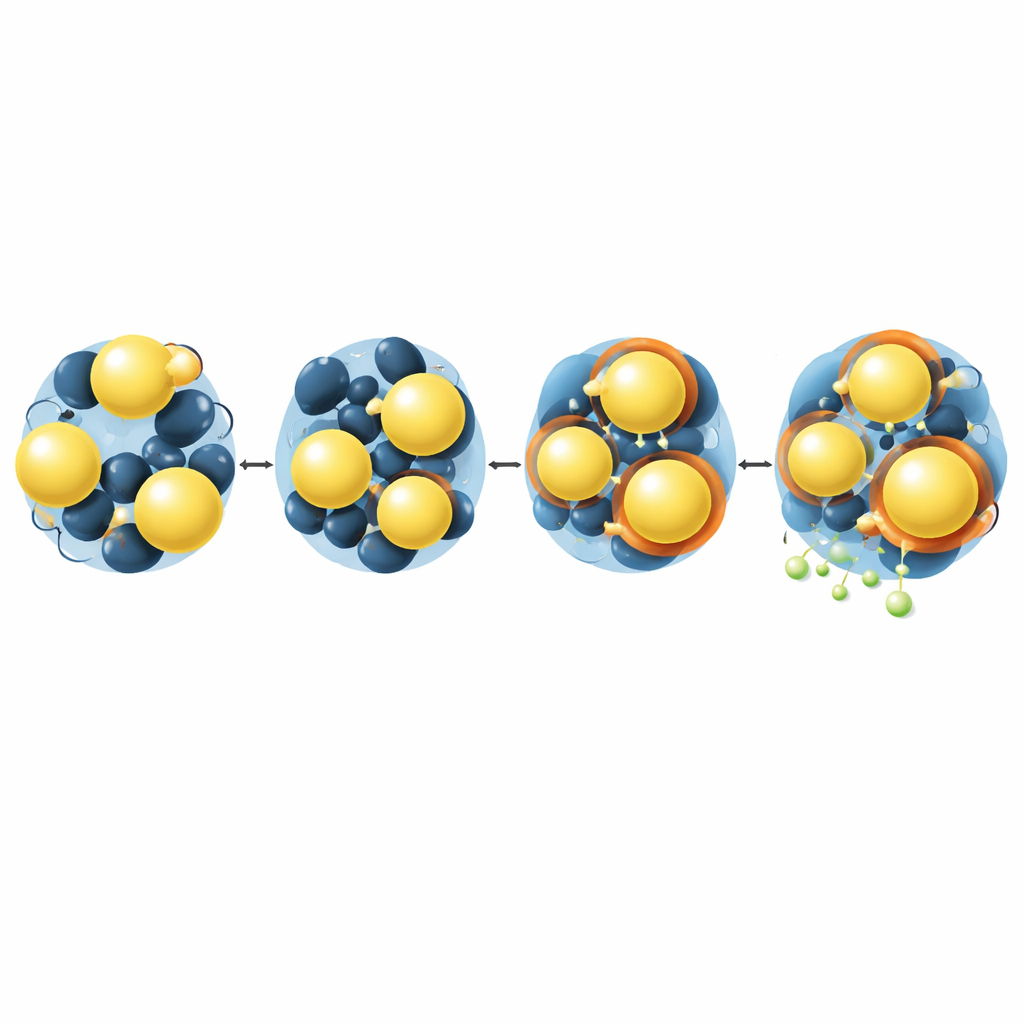
A key innovation is a high-energy, one-step mixing process that makes the sulfur, solid electrolyte, and carbon additives react just enough at their surfaces. This treatment forms a thin, ion-conducting boundary layer around sulfur particles, rather than leaving them bare and poorly connected. Using tools such as X-ray scattering, Raman spectroscopy, and X-ray absorption, the team shows that new sulfur-rich compounds appear at this boundary. These compounds act like an express lane for lithium ions, lowering the energy barrier for the chemical changes that store and release energy. Remarkably, the solid electrolyte itself also participates in reversible reactions, adding extra usable capacity instead of just serving as passive scaffolding.
Finding the Right Particle Size Sweet Spot
The researchers also explore how the size of sulfur particles affects performance. Very large particles hinder ion flow, while extremely tiny ones, though highly reactive, create complex pathways and high internal stresses during expansion and contraction. By combining computer-generated 3D models with lab tests, the team discovers that sulfur particles in the micron range (millionths of a meter) offer the best compromise. These particles provide enough surface area for good contact and fast reactions, but they avoid the excessive stress and damage seen with ultra-small particles. Batteries using micron-sized sulfur maintain more than 80% of their capacity even after 500 cycles at relatively fast charging and discharging rates.
Balancing the Battery’s Internal Push and Pull
Another unusual advantage of sulfur-based solid electrodes is how their volume changes interact with those of the negative electrode. As sulfur takes in lithium during charging, it expands significantly; as it gives up lithium, it shrinks. The team shows that this breathing can partially counterbalance the expansion and contraction of high-capacity negative materials like silicon, which are otherwise prone to cracking and losing contact. Using detailed imaging and in-battery pressure measurements, they find that carefully designed sulfur and lithium sulfide electrodes can reduce internal pressure swings and mechanical damage, allowing the whole cell to operate more stably over many cycles.
Moving Toward Practical High-Energy Cells
Finally, the researchers build high-loading, room-temperature cells and even a small pouch cell using lithium sulfide without any added negative electrode metal, a so-called anode-free design. These prototypes achieve high areal capacities (up to about 11 milliamp-hours per square centimeter) while cycling stably under relatively low mechanical pressure—conditions more relevant for real devices than many earlier laboratory tests. To a layperson, the takeaway is that by engineering the surfaces, sizes, and structures of sulfur-based components, and by making the solid electrolyte an active partner rather than dead weight, this work outlines a practical blueprint for safer, lighter, and more energy-dense solid-state batteries that could power future electric vehicles and other demanding applications.
Citation: Cronk, A., Wang, X., Oh, J.A.S. et al. A highly utilized and practical lithium-sulfur positive electrode enabled in all-solid-state batteries. Nat Commun 17, 3298 (2026). https://doi.org/10.1038/s41467-026-69750-0
Keywords: solid-state batteries, lithium-sulfur, energy storage, battery materials, electrode design