Clear Sky Science · en
Enabling low-temperature aqueous zinc/copper-sulfur hybrid batteries through electrolyte design
Powering the Coldest Corners of the World
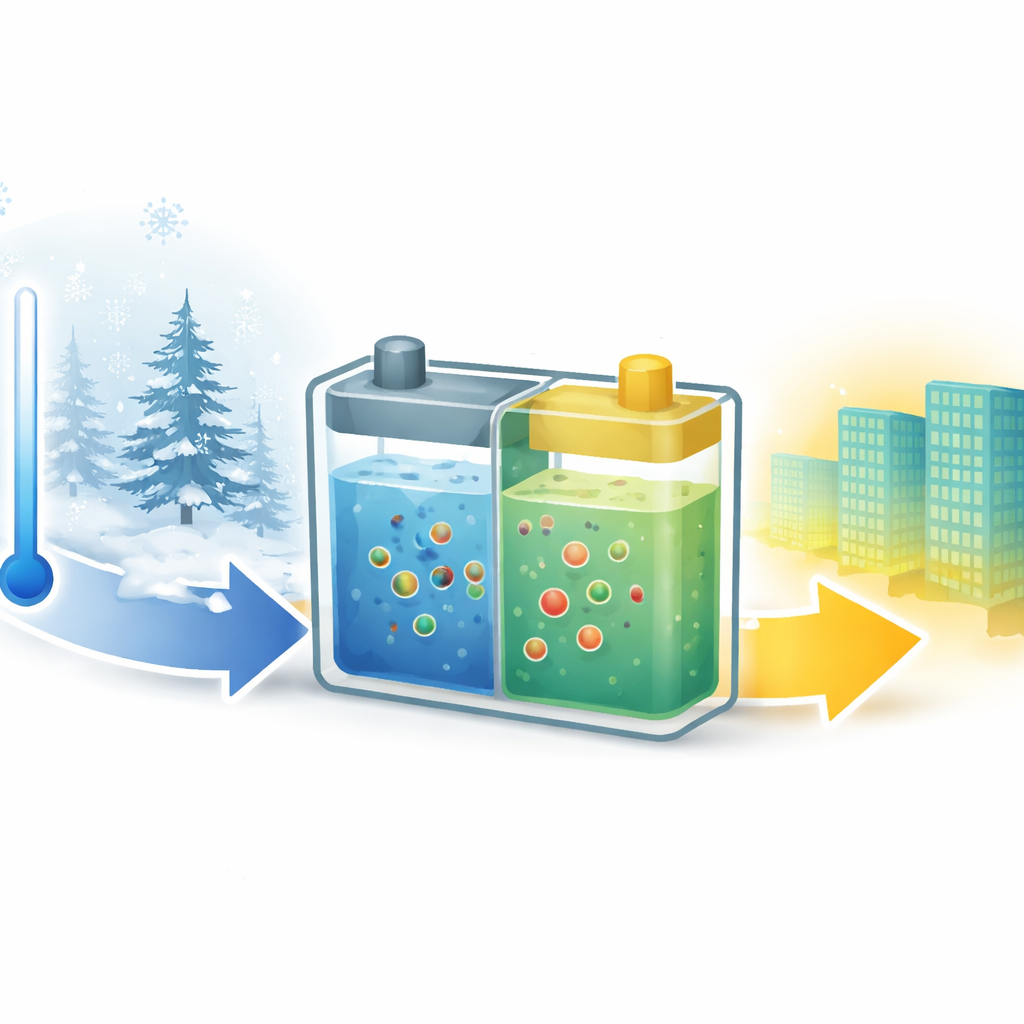
As our energy systems lean more heavily on wind and solar power, we need batteries that can safely store large amounts of electricity in all kinds of weather. Most existing water-based (aqueous) batteries struggle when temperatures plunge far below freezing, especially if we also ask them to pack a lot of energy. This research shows how a clever redesign of the battery’s liquid interior—the electrolyte—can unlock a new type of zinc–sulfur battery that keeps working even in intense cold, potentially serving remote grids, high‑altitude stations, and other harsh environments.
Why Regular Water Batteries Freeze Out
Aqueous batteries are appealing because they rely on water instead of flammable organic liquids, making them safer, cheaper, and more environmentally friendly. However, they face two big problems: their energy per kilogram is often modest, and their performance collapses at low temperatures. Many state-of-the-art cold‑tolerant designs use positive electrodes that simply insert and remove ions, which keeps capacity low, or they add large amounts of inactive anti‑freeze additives that dilute the energy content. Sulfur, by contrast, can store far more charge than typical electrode materials, but sulfur-based aqueous batteries have so far relied on copper sulfate solutions that freeze or become sluggish just below 0 °C, making them unsuitable for deep‑cold settings like high mountains, deep sea, or space.
Redesigning the Liquid Heart of the Battery
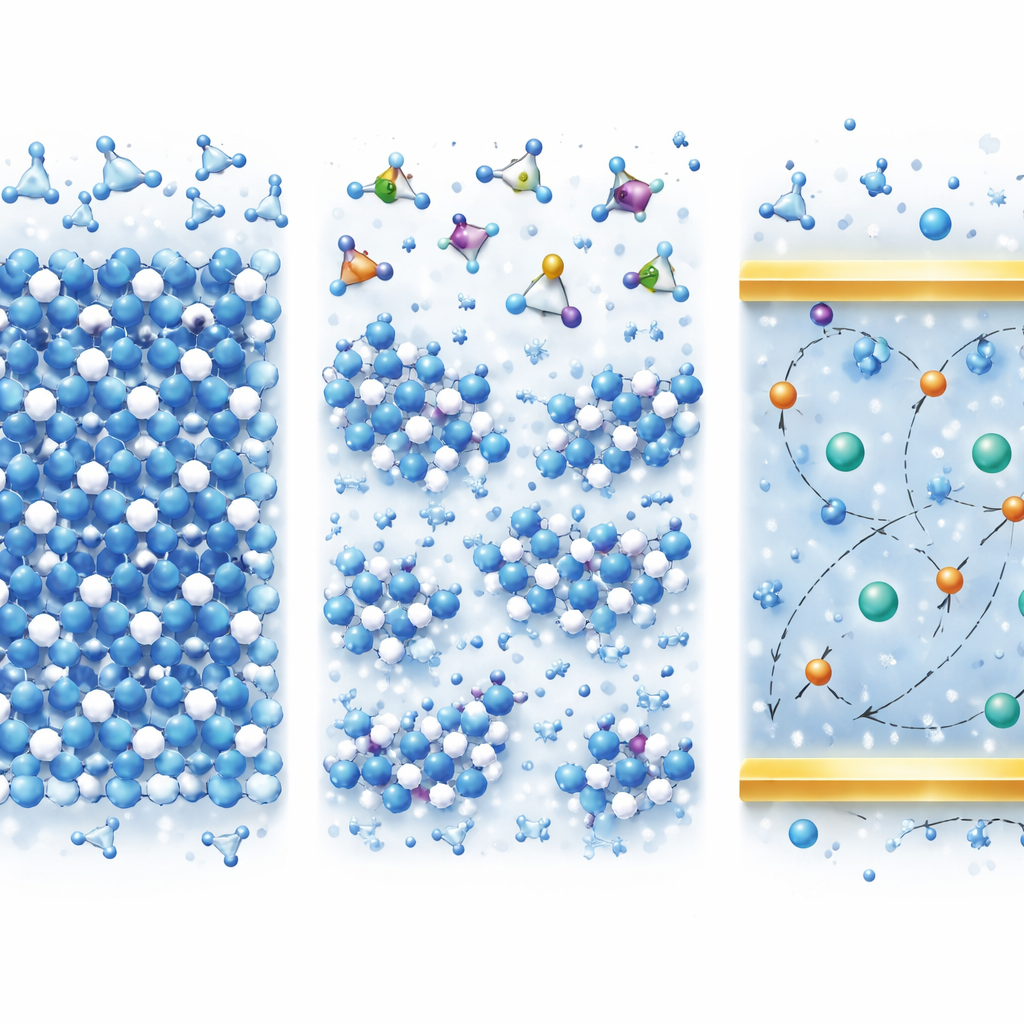
The authors tackle this issue by replacing the traditional copper sulfate solution with a copper tetrafluoroborate solution, Cu(BF4)2, carefully tuned to a concentration of 3.5 mol per liter. At this point, the mixture behaves almost like a liquid glass: it does not crystallize easily and shows a very low glass transition temperature of about −115 °C. Crucially, it still conducts ions well, maintaining an impressive ionic conductivity of 5.16 millisiemens per centimeter at −60 °C—competitive with the best low‑temperature electrolytes reported. Experiments and computer simulations reveal why: the BF4⁻ anions strongly interact with water molecules in a way that breaks up their usual hydrogen‑bonded network, making it much harder for ice‑like structures to form while still allowing ions to move.
How the New Electrolyte Speeds Up Reactions
Beyond preventing freezing, the Cu(BF4)2 solution also makes the battery’s internal reactions faster. When combined with a sulfur electrode supported on conductive carbon nanotubes, it delivers much higher capacities and power than a comparable cell using copper sulfate. Even at very high charge and discharge rates, the new system maintains large capacities, and the voltage difference between charge and discharge remains small, indicating low energy loss. Detailed measurements show that ions face less resistance when crossing the interface between liquid and solid, and copper ions diffuse more quickly within the sulfur electrode. Simulations suggest that BF4⁻ anions partly wrap around copper ions in a loose shell that is easy to peel off near the electrode surface, lowering the energy barrier for electron transfer and speeding up the overall reaction.
Staying Strong When Temperatures Plunge
The team then pushed the battery into deep‑cold conditions. In a copper–sulfur test cell at −60 °C, the sulfur electrode delivered very high charge storage in the first cycle and retained a large, reversible capacity afterward, while continuing to cycle stably for hundreds of rounds at substantial current. Turning this chemistry into a practical device, the researchers built a full zinc–sulfur battery, with zinc metal as the negative side and separated copper and zinc electrolytes connected through an anion‑exchange membrane. At −50 °C, this full cell reached a discharge capacity of 348 milliampere‑hours per gram of active metals and an energy density of 339 watt‑hours per kilogram, based on both electrodes together—figures that rival or exceed other cutting-edge low‑temperature aqueous batteries.
From Lab Cell to Real-World Storage
To explore real‑world potential, the authors also constructed a flow‑battery version, where the liquids are stored in tanks and pumped past the electrodes—a promising architecture for large-scale grid storage. At −30 °C, this prototype delivered high areal capacities, showing that the chemistry can be scaled. Cost analysis indicates that sulfur electrodes are much cheaper per unit of stored energy than many rivals, and further savings are possible by optimizing the membrane layout. Although the system still does not fully convert all sulfur back to its original form on each charge, leading to some efficiency loss, the work clearly demonstrates that careful electrolyte design can marry high energy, safety, and deep‑cold operation. For general readers, the takeaway is that smart chemistry in the liquid part of a battery can turn a once temperature‑sensitive technology into a robust energy reservoir for some of the coldest places where we need reliable power.
Citation: Zhou, H., Hu, L., Liu, G. et al. Enabling low-temperature aqueous zinc/copper-sulfur hybrid batteries through electrolyte design. Nat Commun 17, 3167 (2026). https://doi.org/10.1038/s41467-026-69742-0
Keywords: low-temperature batteries, aqueous zinc batteries, sulfur cathodes, electrolyte design, energy storage