Clear Sky Science · en
CF2H: a cell-free two-hybrid platform for rapid protein binder screening
Why this new lab shortcut matters
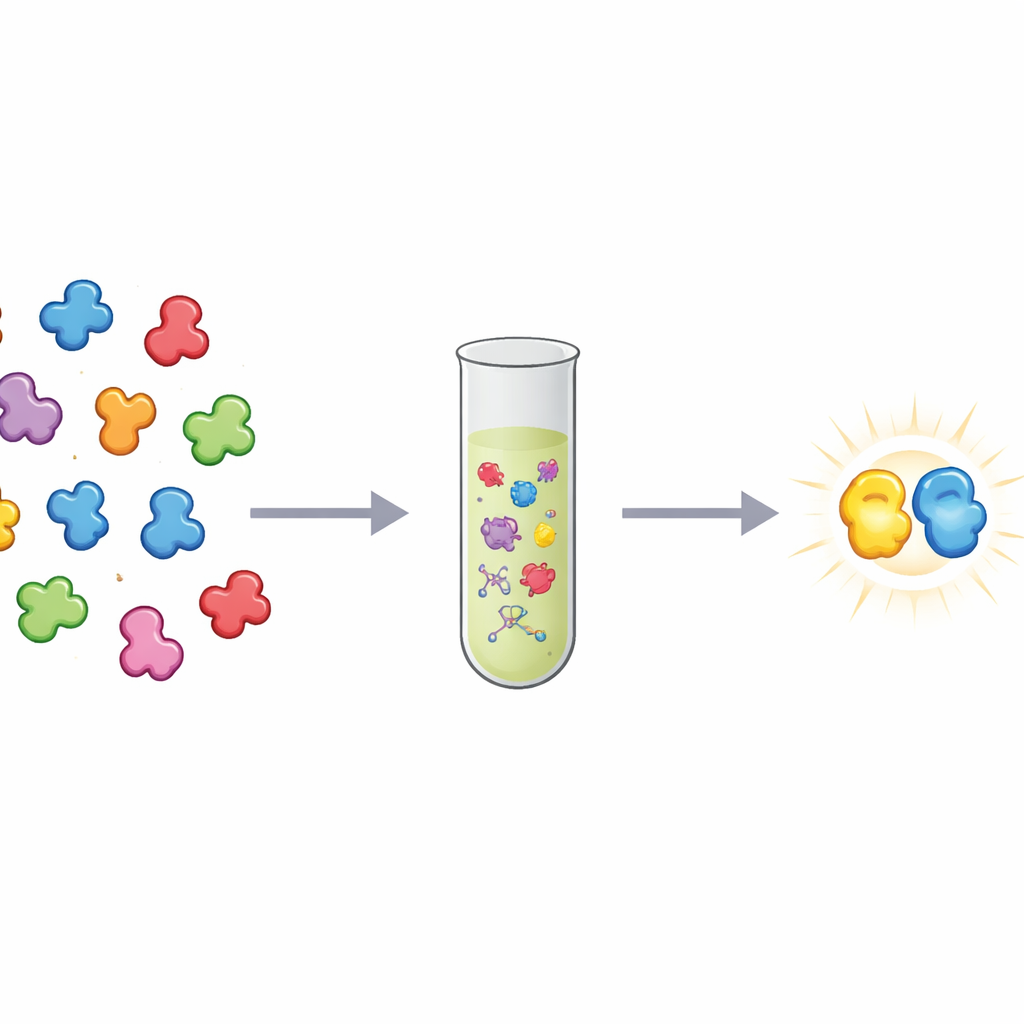
Designing custom proteins that can latch onto disease-related targets is becoming increasingly possible thanks to artificial intelligence. But testing whether these designer molecules actually bind their targets still takes time, money, and specialized equipment. This paper introduces a simple, fast, and low-cost test-tube method called CF2H that lets many labs quickly check whether newly designed proteins stick to the right partners, and even whether they might work as future drugs or diagnostic sensors.
A test-tube stand-in for living cells
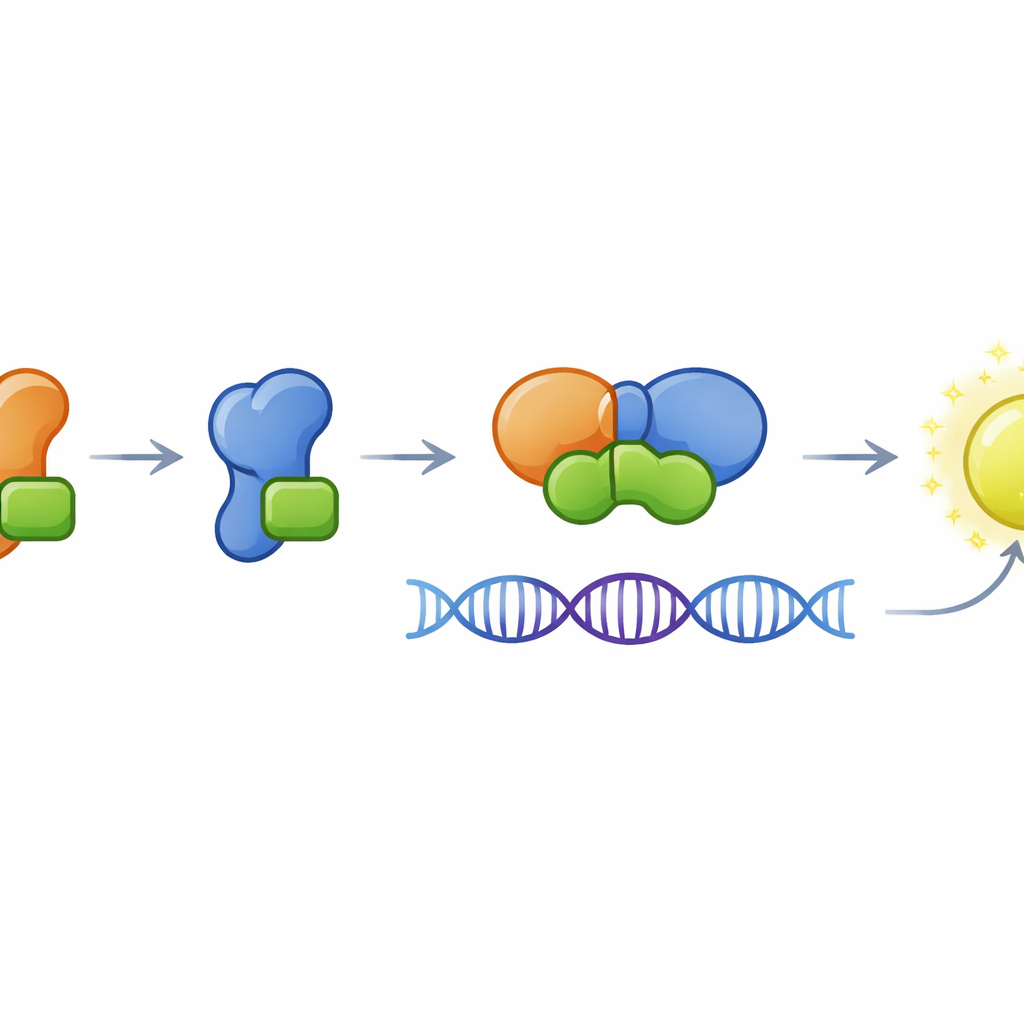
Most current ways to check protein binding rely on living cells or expensive instruments that track how purified proteins interact. CF2H takes a different route by using a cell-free extract made from broken-open bacteria. This extract still contains the molecular machinery needed to read DNA and make proteins, but none of the complexity of living cells. The authors harness a classic viral control protein, called CI, which normally turns genes on only when two copies pair up. They fuse pieces of CI to two proteins of interest: a “target” and a “binder.” If these two proteins recognize each other, they drag the CI pieces together, restoring CI’s ability to bind DNA and switch on a fluorescent reporter. The brighter the glow, the stronger or more frequent the binding events.
From concept to a flexible workhorse
The team first had to fine-tune this setup so that it responded only when true binding occurred. They optimized the CI segment that grabs DNA and added flexible linkers so bulky protein partners could meet without bumping into each other awkwardly. Using designed coiled-coil pairs and a variety of synthetic binders—including nanobodies, monobodies, DARPins, and covalent “catcher–tag” partners—they showed that the system reliably lights up for correct pairs and stays dark for mismatches. Because all components are produced directly from short, linear DNA fragments, no cloning or protein purification is needed, making each assay about as simple as setting up a PCR reaction.
Checking AI-designed binders and finding new cancer blockers
To see how CF2H performs on realistic problems, the researchers tested 48 protein binders previously designed by a deep-learning method to target the human protein Mdm2, which regulates the tumor suppressor p53. CF2H correctly identified most strong binders and even flagged some candidates that an earlier instrument-based test had missed. By comparing subtle changes in signal when specific amino acids were swapped for alanine, the authors showed that CF2H can sense differences in binding strength linked to individual contact points. They then pushed the platform further by designing new binders against PD-L1, a key “brake” in immune checkpoint pathways targeted by cancer immunotherapies. Even though PD-L1 is difficult to produce cleanly, the team devised clever tricks—such as clustering purified PD-L1 on streptavidin scaffolds—to make it work in the assay. CF2H singled out several high-affinity binders, including one that later proved able to block PD-1/PD-L1 signaling in cultured cells.
Probing drugs and turning binding into sensing
Because CF2H reads out any change in protein–protein pairing as a change in fluorescence, it can also be used to study small molecules that disrupt or promote such interactions. The authors showed that approved anticancer drugs targeting Mdm2 and Bcl2 could weaken the signal from their respective protein pairs in a dose-dependent fashion, reflecting competitive inhibition. They also demonstrated the opposite behavior with systems where small molecules encourage dimer formation or stabilize otherwise floppy proteins, such as a caffeine-responsive nanobody and a progesterone-sensitive domain. Finally, by pairing two nanobodies that recognize neighboring sites on the SARS-CoV-2 spike protein, they built a prototype biosensor that specifically detects the viral spike in a cell-free reaction within about an hour.
What this means for future medicine and diagnostics
CF2H turns the difficult, multi-week task of validating protein binders into an overnight, bench-top procedure that many laboratories can afford and run without advanced training. While it works best for relatively tight interactions and depends on good-quality synthetic DNA, its speed, modularity, and low cost make it well suited for iterative design cycles and large binder panels. Beyond simply confirming that two proteins meet, CF2H can reveal promising therapeutic candidates, help screen drug-like molecules that alter protein partnerships, and underpin new biosensors for disease markers. In practical terms, this platform could accelerate the path from computer-designed proteins to real-world tools for diagnostics and treatment.
Citation: Capin, J., Mayonove, P., DeVisch, A. et al. CF2H: a cell-free two-hybrid platform for rapid protein binder screening. Nat Commun 17, 3724 (2026). https://doi.org/10.1038/s41467-026-69741-1
Keywords: cell-free protein screening, protein–protein interactions, de novo protein binders, immune checkpoint PD-L1, biosensor development