Clear Sky Science · en
Solvation chemistry tailored via dielectric constant engineering for stable low-temperature aqueous zinc batteries
Why Cold-Weather Batteries Matter
From electric vehicles in winter to remote sensors in polar regions, we increasingly rely on rechargeable batteries that must work far below freezing. Many safe, water-based zinc batteries stop functioning or quickly fail in the cold: ions move too slowly, ice-like structures form, and the metal surface becomes unstable. This paper reports a new way to redesign the liquid inside such batteries so they remain highly efficient and long-lived even at –50 °C, without resorting to exotic salts or flammable solvents.
Fixing a Hidden Weak Point
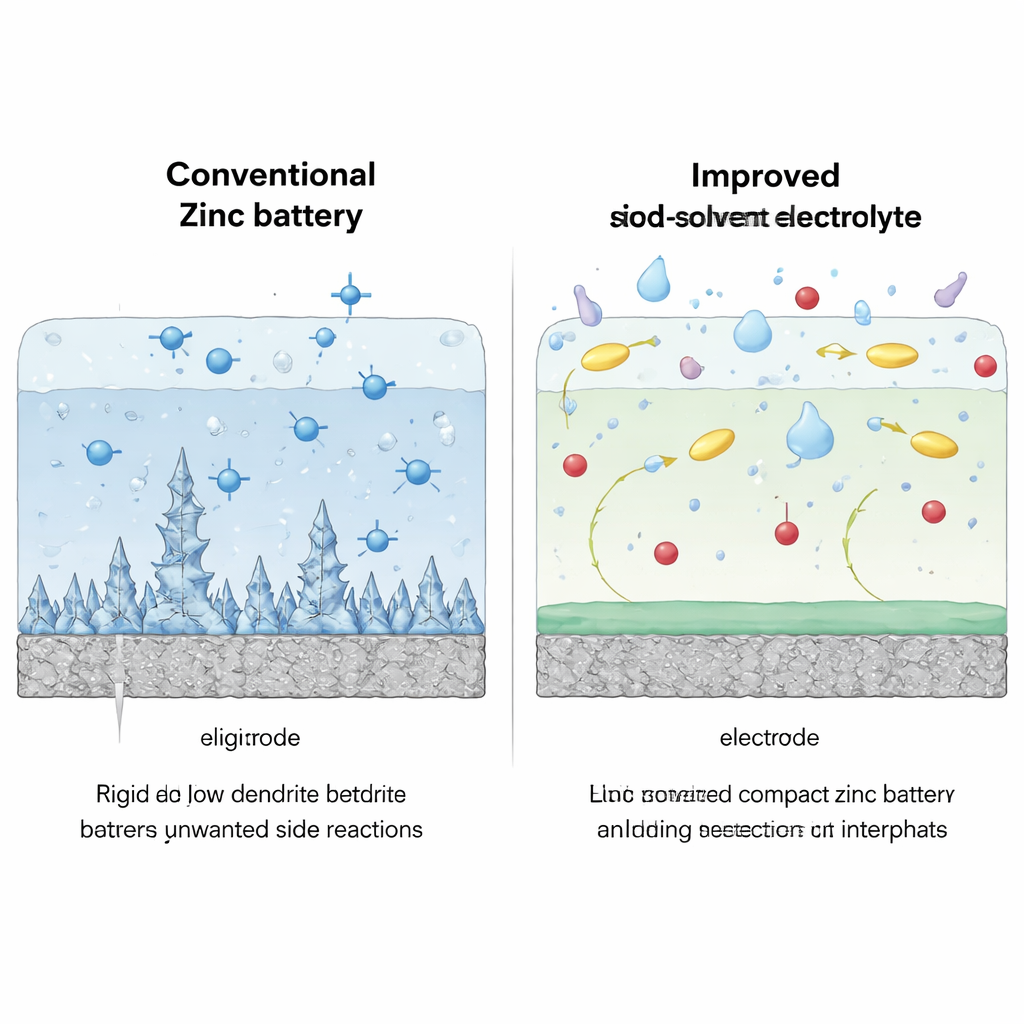
Aqueous zinc-metal batteries are attractive because zinc is abundant, inexpensive, and safer than lithium. However, these batteries suffer from three intertwined problems: needle-like zinc “dendrites” that can short-circuit cells, unwanted hydrogen gas production that corrodes the electrode, and a dramatic slowdown of ion movement at low temperature. Most previous solutions tried to pack in large amounts of salt or build special water-rich mixtures to prevent freezing. While helpful, those approaches often create very corrosive liquids that damage the zinc over time. The authors instead focus on a subtler property of the liquid mixture—the dielectric constant, which describes how strongly the solvent screens electric charges and thereby controls how ions attract or repel each other.
Redesigning the Liquid Environment
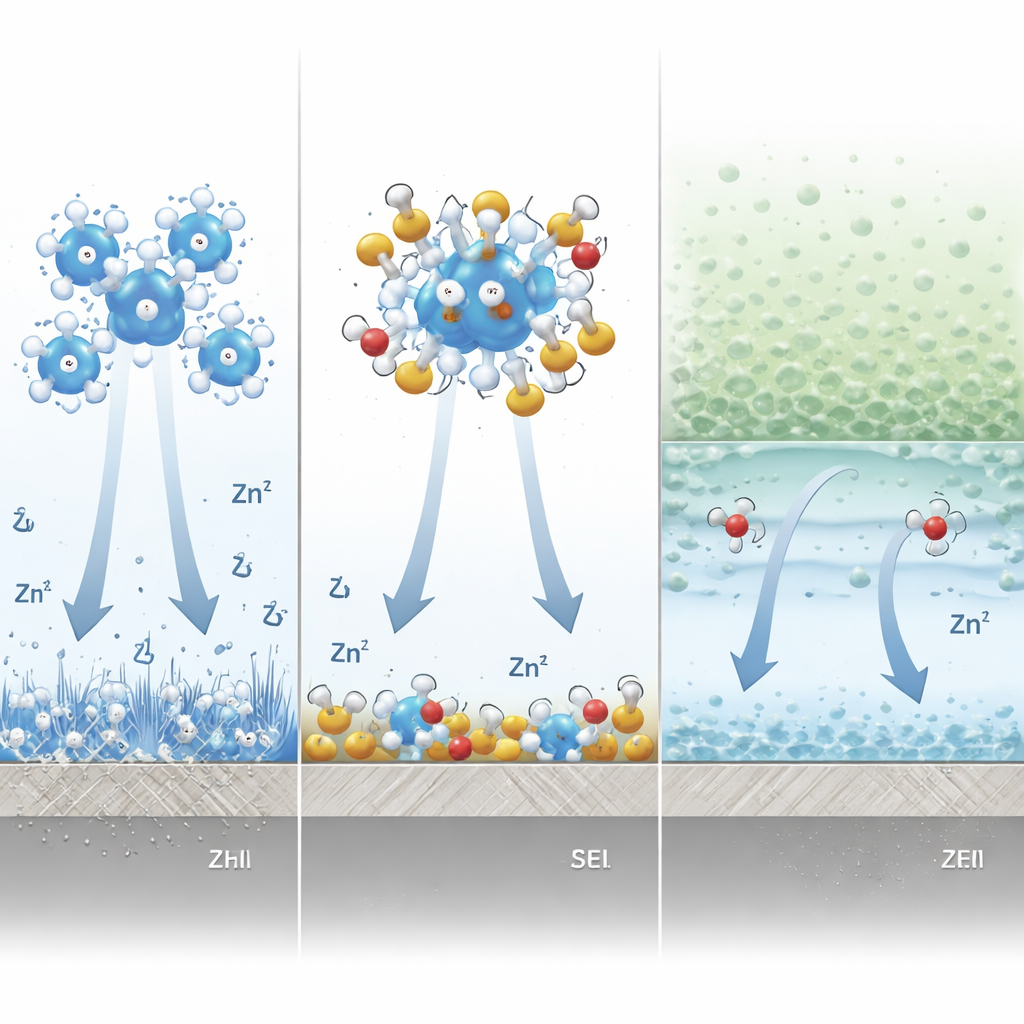
The team’s strategy is to “tune” the dielectric constant by blending ordinary water (which has a very high dielectric constant) with ethyl acetate, a common organic solvent with a much lower value. By mixing these with zinc perchlorate salt in the right ratio, they place the electrolyte in a medium range of dielectric constant rather than at the extremes. Detailed experiments and computer simulations show what happens at the molecular level. Ethyl acetate breaks up water’s normally rigid hydrogen-bond network, preventing it from freezing into ordered structures and keeping the liquid mobile at –50 °C. At the same time, the lower dielectric environment encourages zinc ions and perchlorate anions to pair up more closely instead of remaining completely separated, subtly reshaping how zinc is surrounded by solvent and anions as it moves through the battery.
Helping Ions Move and Protecting the Surface
This tailored liquid structure has two major consequences at the zinc surface. First, zinc ions shed their surrounding molecules more easily when they arrive at the electrode, which is essential for smooth metal plating and stripping. Measurements of charge-transfer energy barriers and computer calculations confirm that the mixed solvent lowers the energetic cost of this “desolvation” step. Second, the rearranged ion pairs and the presence of ethyl acetate lead to the formation of a thin but robust protective layer known as a solid electrolyte interphase (SEI). Using spectroscopy, microscopy, and depth-profiling techniques, the authors show that this SEI is a composite of inorganic zinc–oxygen and zinc–chlorine compounds interwoven with carbon-rich fragments derived from the breakdown of ethyl acetate. The outer organic-rich region blocks water and suppresses hydrogen evolution, while the inner inorganic region guides zinc ions into even, compact deposits instead of random, dendritic growth.
Staying Strong in Extreme Cold
Because the new electrolyte maintains high ionic conductivity and forms a durable SEI, entire batteries behave very differently under harsh conditions. Symmetric zinc–zinc cells using the engineered liquid can plate and strip zinc at room temperature for over 10 months without failure, and for thousands of hours at –50 °C. In contrast, cells using a conventional water-only electrolyte fail quickly, showing irregular deposits and strong signs of side reactions. When paired with a conducting polymer cathode (polyaniline), full zinc batteries using the optimized mixture deliver stable energy storage over 10,000 charge–discharge cycles at both room temperature and –50 °C, while maintaining high efficiency and capacity. The authors further demonstrate practical pouch cells that continue to power a device reliably at around –50 °C.
What This Means for Future Devices
In everyday terms, the study shows that carefully adjusting how “polar” a battery’s liquid is can control how water and ions behave, turning a fragile, freeze-prone system into one that remains fast, stable, and safe in the cold. By engineering the dielectric constant with a simple co-solvent, the researchers disrupt ice-like water structures, speed up ion motion, and encourage the battery to build its own self-protecting skin on the zinc surface. This concept of dielectric constant engineering offers a general blueprint for designing anti-freeze, water-based batteries that could help power electronics, vehicles, and grid storage reliably in some of the coldest environments on Earth.
Citation: Zhu, X., Wang, Z., Zhang, T. et al. Solvation chemistry tailored via dielectric constant engineering for stable low-temperature aqueous zinc batteries. Nat Commun 17, 3170 (2026). https://doi.org/10.1038/s41467-026-69740-2
Keywords: aqueous zinc batteries, low-temperature energy storage, electrolyte design, dielectric constant engineering, solid electrolyte interphase