Clear Sky Science · en
Probing hidden symmetry via nonlinear transport in an altermagnet candidate Ca3Ru2O7
A new way to see hidden order
Many of the most exciting electronic materials hide their secrets in tiny distortions of their atomic lattice—changes so small that even powerful X‑ray or neutron beams can miss them. This paper shows that simple electrical measurements, done in an ordinary lab, can uncover such hidden order. By driving carefully controlled currents through the quantum material Ca3Ru2O7 and looking at subtle nonlinear effects, the authors reveal a previously overlooked phase of matter that behaves like a newly recognized kind of antiferromagnet called an altermagnet.
Why small distortions matter
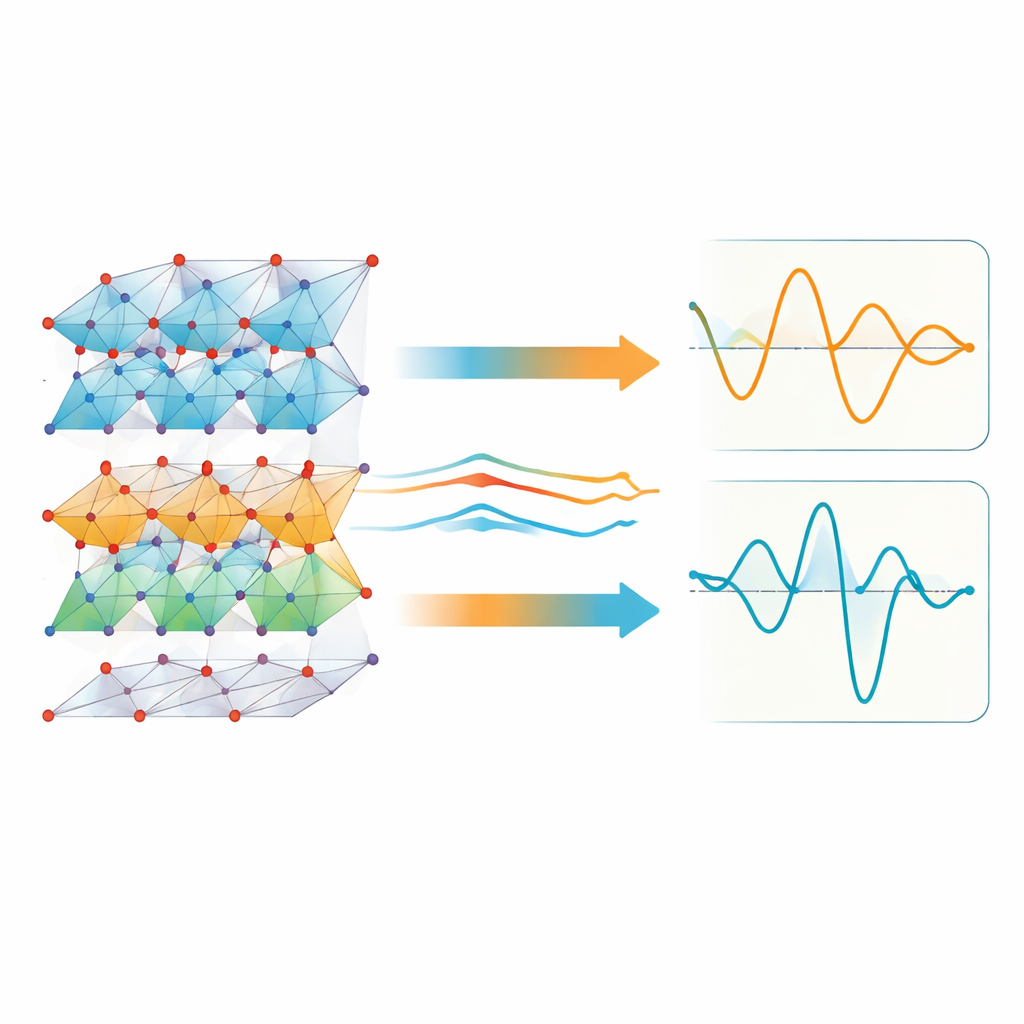
The properties of quantum materials are governed not just by which atoms are present, but by how they are arranged and how that arrangement breaks symmetries such as mirror or time‑reversal. Traditional tools like X‑ray and neutron diffraction are excellent at mapping crystal structures, but they have resolution limits: distortions far below an ångström can be invisible. Yet such small shifts can fundamentally change how electrons move, turning on or off exotic behaviors such as unusual Hall effects or topological states. The compound Ca3Ru2O7 is already known for dramatic magnetoresistance, complex magnetic phases, and Dirac‑like electronic bands, making it an ideal test bed for a new way to detect hidden symmetry breaking.
Using current as a structural probe
The authors focus on “nonlinear transport” — situations where the electrical response does not simply double when the applied voltage is doubled. In certain crystals, symmetry allows or forbids particular nonlinear signals. Ca3Ru2O7 passes through two magnetic transitions as it is cooled. Below about 48 K, standard diffraction says its crystal structure should retain a relatively high symmetry. However, theoretical work suggested that a minute lattice “breathing” distortion, only about a thousandth of an ångström, might actually lower the symmetry further. This tiny change would be enough to convert the material into an altermagnetic state, characterized by a special pattern of opposite spins that breaks a combined translation and time‑reversal symmetry, but is almost invisible to conventional probes.
Nonlinear currents reveal hidden symmetry
To test this idea, the team fabricated micrometer‑scale devices from single crystals and drove alternating current along different crystal directions while measuring second‑harmonic voltages—signals at twice the driving frequency that arise only when the response is nonlinear. Along one in‑plane axis, they detected a clear nonlinear resistance: the voltage contained a strong component that grew roughly with the square of the current. This particular kind of “longitudinal” nonlinear signal is strictly forbidden in the higher‑symmetry structure but allowed once the subtle distortion lowers the symmetry. They also observed sizable nonlinear Hall responses—sideways voltages—when current flowed along two other crystal directions, again appearing only in the low‑temperature magnetic phase and tracking changes when a magnetic field flipped the spin arrangement.
The quantum geometry behind the signal
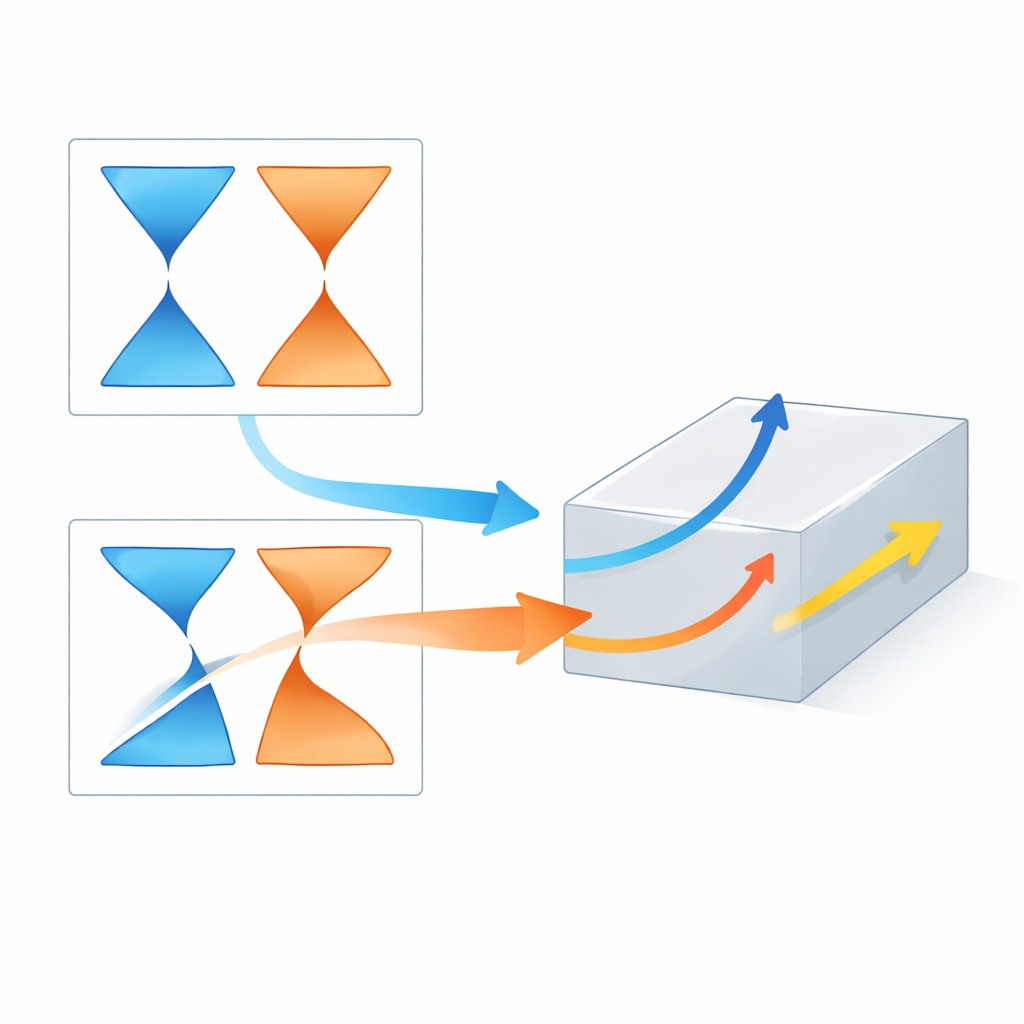
First‑principles calculations show that Ca3Ru2O7 hosts extended chains of special band‑crossing points called Weyl nodes near the energy where electrons live. Around these crossings, the “quantum geometry” of electronic states becomes extreme, captured by a quantity known as the quantum metric. In the high‑symmetry phase, contributions from different parts of the crystal cancel out. When the tiny distortion tilts the electronic bands, that cancellation is lifted, and the quantum metric produces large nonlinear currents both along and across the applied field. The patterns and relative strengths of the measured nonlinear signals match the theoretical expectations for the lower‑symmetry phase, strongly supporting the existence of a hidden, inversion‑breaking altermagnetic state in Ca3Ru2O7.
What this means for future materials
In plain terms, the study shows that by looking at how a material conducts electricity in a slightly “non‑ordinary” regime, one can detect symmetry breaking that is far too subtle for standard structural probes. For Ca3Ru2O7, this resolves a long‑standing puzzle about its true low‑temperature structure and identifies it as an altermagnet in terms of symmetry. More broadly, the work establishes nonlinear electrical transport as a sensitive, scalable tool for hunting hidden phases and topological effects in magnetic and strongly correlated materials—using equipment available in many condensed‑matter labs rather than only at large national facilities.
Citation: Mali, S., Zhao, Y., Wang, Y. et al. Probing hidden symmetry via nonlinear transport in an altermagnet candidate Ca3Ru2O7. Nat Commun 17, 3074 (2026). https://doi.org/10.1038/s41467-026-69739-9
Keywords: nonlinear transport, altermagnetism, Weyl semimetal, quantum materials, symmetry breaking