Clear Sky Science · en
Enhancing microbial metabolic capacity through high-energy electron beam-induced intense structural variations
Hidden Wealth Inside Ordinary Microbes
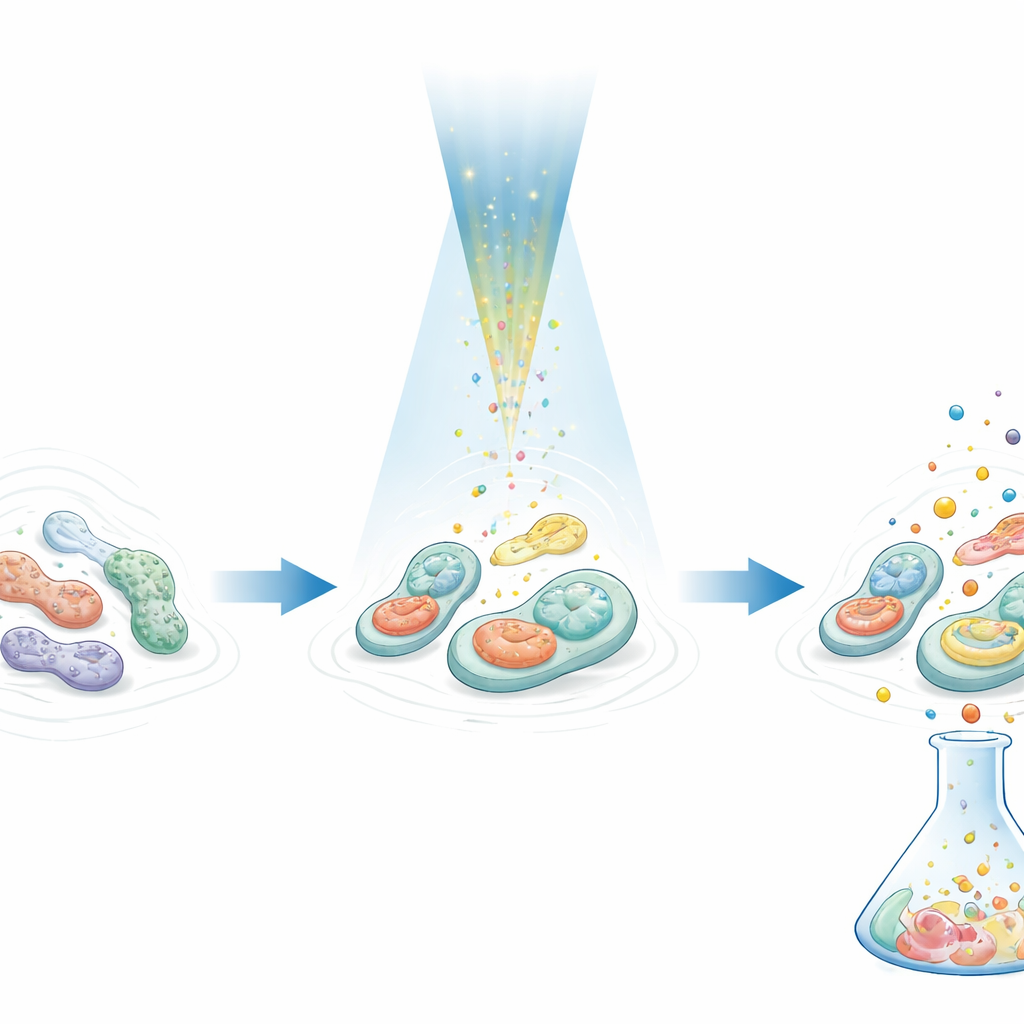
Many of the medicines, food ingredients and industrial chemicals we rely on come from tiny organisms such as bacteria and fungi. Yet most of the useful compounds they can make stay locked away, produced only in trace amounts or not at all under normal conditions. This study explores a new way to "shake awake" that hidden chemistry by carefully blasting microbes with high‑energy electron beams, rewiring their DNA in bulk while still keeping them alive and productive.
A New Kind of Microbial Makeover
Traditional ways of mutating microbes—such as ultraviolet light, X‑rays or special gas plasmas—create DNA damage but face a tough trade‑off: induce too little change and nothing interesting happens; induce too much and the cells die. The researchers compared six irradiation methods in a model bacterium, Streptomyces lividans, and found that high‑energy pulsed electron beams (HEPE) stood out. HEPE punched many double‑strand breaks into the DNA, the kind of damage that forces cells to reshuffle large chunks of their genomes, while surprisingly preserving the overall structure of the cells better than most other methods.
Rewiring Genomes in Three Dimensions
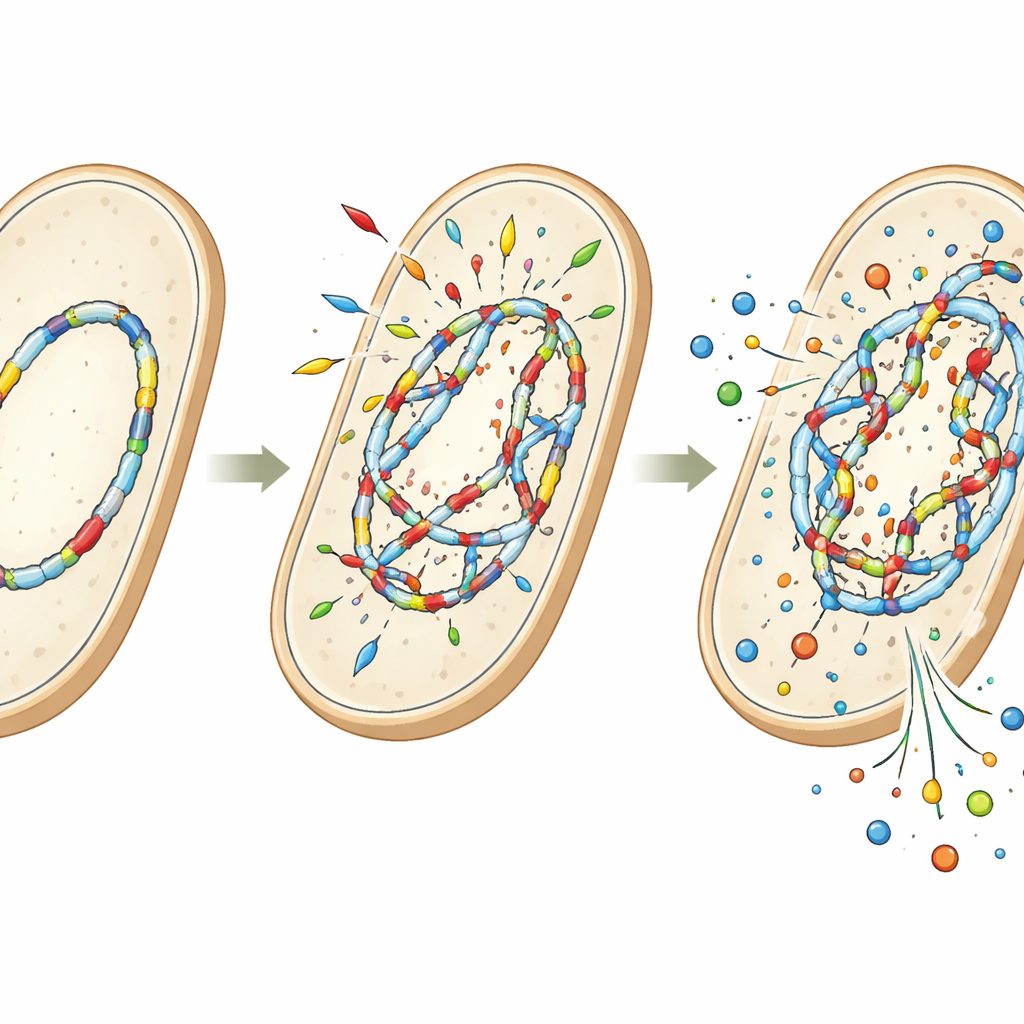
To see what this meant inside the cell, the team sequenced the genomes of dozens of mutants created by different irradiation methods. While simple point mutations were similar across techniques, HEPE produced far more large‑scale changes—deletions, duplications and especially translocations, where distant DNA pieces swap places. These structural changes were spread more evenly across the genome, reaching into core regions as well as the outer arms. Using 3D genome mapping, the scientists showed that a HEPE‑mutated strain no longer packed its chromosome into a tight bundle; instead, the DNA became more relaxed and locally interactive. This looser folding likely made previously quiet gene clusters easier for the cell’s transcription machinery to access, priming them to switch on silent metabolic pathways.
From Silent Genes to New and Stronger Products
The practical payoff appeared when the team looked at what the microbes were actually making. In S. lividans, certain pigment‑producing compounds are usually faint or absent. After HEPE treatment, mutants producing bright blue and red pigments appeared far more often and more stably than with ultraviolet light or plasma, and their yields were higher over many generations. Building on this, the researchers created a workflow called HEPE‑HiTMS that couples HEPE mutagenesis with high‑throughput chemical profiling. Applying it to two other Streptomyces species uncovered entirely new molecules, griseobrucins and fradibactins, with unusual chemical linkages not seen in standard natural products, highlighting the method’s power to reveal cryptic chemistry.
Supercharging Industrial Microbial Factories
The team then asked whether HEPE could improve strains already polished by years of conventional breeding. In an industrial bacterium that makes the antibiotic helper clavulanic acid, a single round of HEPE produced mutants with up to 60 percent higher yield in flasks, and record‑level production in a 5‑liter fermenter, despite only modest numbers of total mutations. The key was again a higher share of large structural changes. Similar gains emerged in a genetically engineered Escherichia coli strain that secretes the antimicrobial peptide microcin J25, where HEPE mutants reached about three times the previous best titer in a 40‑liter fermenter. In a filamentous fungus used to make the cholesterol‑lowering drug lovastatin, HEPE generated mutants with more than six‑fold higher output in solid‑state culture, outperforming older irradiation methods.
Promise and Limits of Controlled DNA Upheaval
Despite these benefits, the authors note that HEPE is not a precision tool like gene editing; it acts more like a controlled storm, randomly rearranging DNA. Some mutants grow more slowly or sporulate poorly, and many newly activated gene clusters may still be held back by broader regulatory and metabolic bottlenecks. Nonetheless, because HEPE creates rich, stable structural variation without introducing foreign DNA, it offers a scalable and regulation‑friendly way to generate better production strains and to uncover previously invisible natural products. For readers, the takeaway is that by changing not just the letters but also the large‑scale layout of microbial genomes, we can coax familiar microbes into acting like new chemical factories, opening fresh routes to drugs and other valuable molecules.
Citation: Feng, X., Li, Z., Zhang, Y. et al. Enhancing microbial metabolic capacity through high-energy electron beam-induced intense structural variations. Nat Commun 17, 2933 (2026). https://doi.org/10.1038/s41467-026-69723-3
Keywords: microbial metabolites, strain improvement, electron beam mutagenesis, structural genome variation, natural product discovery