Clear Sky Science · en
Pm37 as a susceptible Sr22 allele confers resistance to wheat powdery mildew and leaf rust
Protecting a Global Staple
Wheat feeds nearly one in three people on Earth, yet its leaves are constantly under siege from microscopic fungi that cause powdery mildew and rust diseases. These infections can silently steal a substantial share of harvests, threatening food security. This study uncovers a powerful natural shield, a single gene called Pm37, that helps wheat fight off two major diseases—powdery mildew and leaf rust—while revealing an unexpected twist in how closely related genes can battle very different enemies. 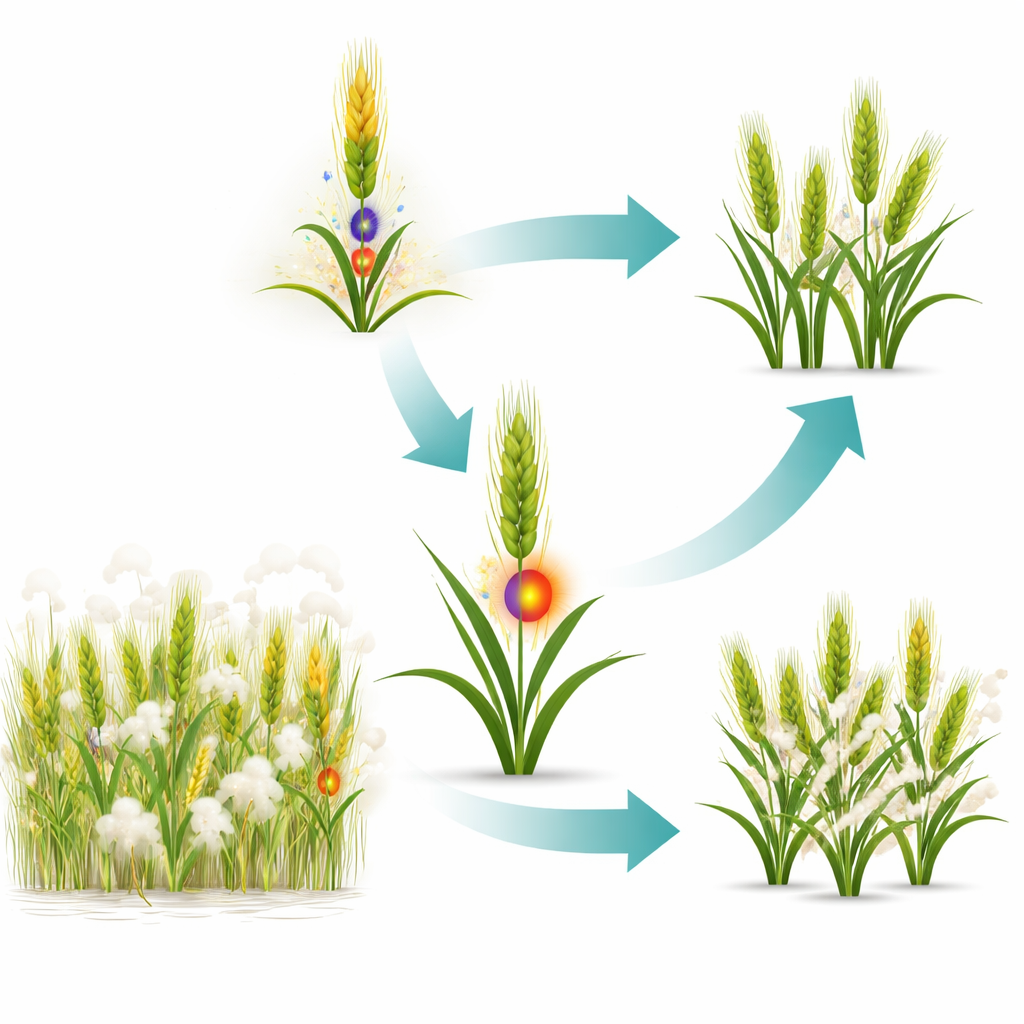
Hidden Defenses in Wheat’s Family Tree
Modern bread wheat is the product of a long and messy family history involving several ancient grass species. Its wild relatives still carry many useful traits, especially strong disease resistance, that breeders want to tap without dragging along poor yield or other drawbacks. Pm37 was originally noticed in a breeding line derived from the wheat relative Triticum timopheevii, where it provided durable resistance to powdery mildew in Chinese fields for more than a decade. The challenge was to pinpoint the exact gene and understand where it came from in the tangled wheat family.
Tracking Down the Resistance Gene
The researchers combined classic genetics with state-of-the-art DNA sequencing to locate Pm37. They crossed a mildew-resistant line carrying Pm37 with a susceptible variety and followed how resistance appeared in thousands of offspring, gradually narrowing the search to a tiny region on wheat chromosome 7A. There, they found a small set of genes and focused on one that encodes an immune receptor protein, part of a large family plants use to recognize invading microbes. Because the usual reference wheat genomes could not cleanly capture this region, the team built a high-quality genome assembly of the donor line using long-read sequencing, revealing that the Pm37 region is a chunk of DNA imported from the ancient einkorn wheat species Triticum monococcum via an intermediate relative. 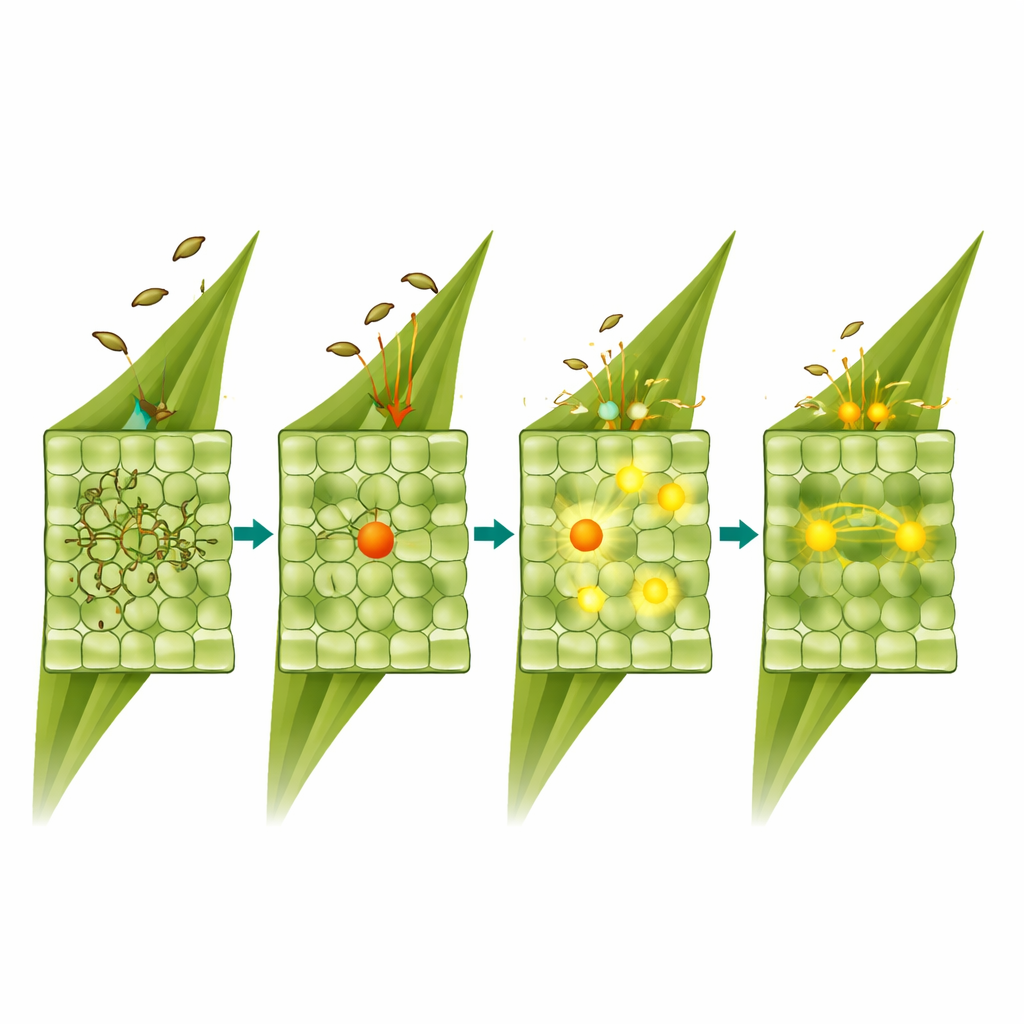
Proving How the Shield Works
To confirm that this receptor gene is truly Pm37, the team used several independent tests. First, they created chemical mutants of the resistant wheat line and looked for plants that had lost resistance. In every susceptible mutant, the candidate gene carried damaging changes, and protein structure modeling showed that these changes would disrupt its shape. Next, they transiently silenced the gene using a virus-based system; once its activity was knocked down, mildew could colonize leaves that were previously immune. Finally, they introduced the Pm37 gene into a normally susceptible wheat variety. The transformed plants became fully resistant to dozens of mildew isolates, demonstrating that this single gene is both necessary and sufficient for strong protection.
From Early Alarm to Cell Suicide
Closer inspection revealed how Pm37 helps wheat stop infection. In resistant plants, fungal spores could not establish themselves, and the leaves showed a burst of reactive molecules and activation of multiple defense-related genes soon after invasion. The Pm37 protein contains a coiled-coil “head” region that acts like a trigger. When the researchers expressed Pm37 and its individual parts in tobacco leaves, only constructs containing this head region were able to cause rapid local cell death. This controlled self-destruction walls off the fungus, sacrificing a few cells to protect the rest of the leaf and, ultimately, the plant.
One Gene, Different Enemies
Perhaps the most surprising finding is that Pm37 is a variant of another well-known wheat gene, Sr22, which protects against the devastating stem rust disease. The two versions of the gene are nearly identical in protein sequence but differ at key positions that change which pathogen they recognize. Pm37 carries features associated with susceptibility to stem rust, yet it provides potent resistance to powdery mildew and moderate resistance to one race of leaf rust. This rare example of “functional divergence” shows how small sequence changes in a single immune receptor can redirect its protective power from one disease to another. The authors identified diagnostic DNA markers that breeders can use to track Pm37 and showed that adding it to high-yielding wheat lines does not hurt important agronomic traits, making it an attractive tool for building more resilient crops.
What This Means for Future Harvests
In accessible terms, this work discovers and validates a natural security switch in wheat’s DNA that can recognize and stop specific fungal invaders before they overwhelm the plant. By tracing its origin in ancient wheat relatives, decoding how it triggers local cell death, and revealing its close kinship to a stem rust resistance gene, the study illustrates how evolution reuses and reshapes the same molecular parts to solve different disease challenges. For farmers and breeders, Pm37 offers a robust new option for protecting wheat from powdery mildew and some leaf rust, and it hints at the possibility of redesigning related genes to fend off multiple diseases at once.
Citation: Jin, Y., Li, W., Li, Y. et al. Pm37 as a susceptible Sr22 allele confers resistance to wheat powdery mildew and leaf rust. Nat Commun 17, 3165 (2026). https://doi.org/10.1038/s41467-026-69717-1
Keywords: wheat disease resistance, powdery mildew, plant immune genes, wild wheat relatives, rust fungi