Clear Sky Science · en
Molecular electronic chirality in copper phthalocyanine induced via twisted π-π stacking on bilayer graphene
Why tiny twists in flat molecules matter
Many of the shapes that define life, from DNA’s double helix to snail shells, come in left- and right-handed forms. This study shows that even the clouds of electrons inside a single flat molecule can become left- or right-handed just by how the molecule rests on a sheet of carbon. Understanding and controlling this subtle “handedness” at the smallest scales could open new ways to design ultra-miniature electronics and sensors that respond differently to left and right.
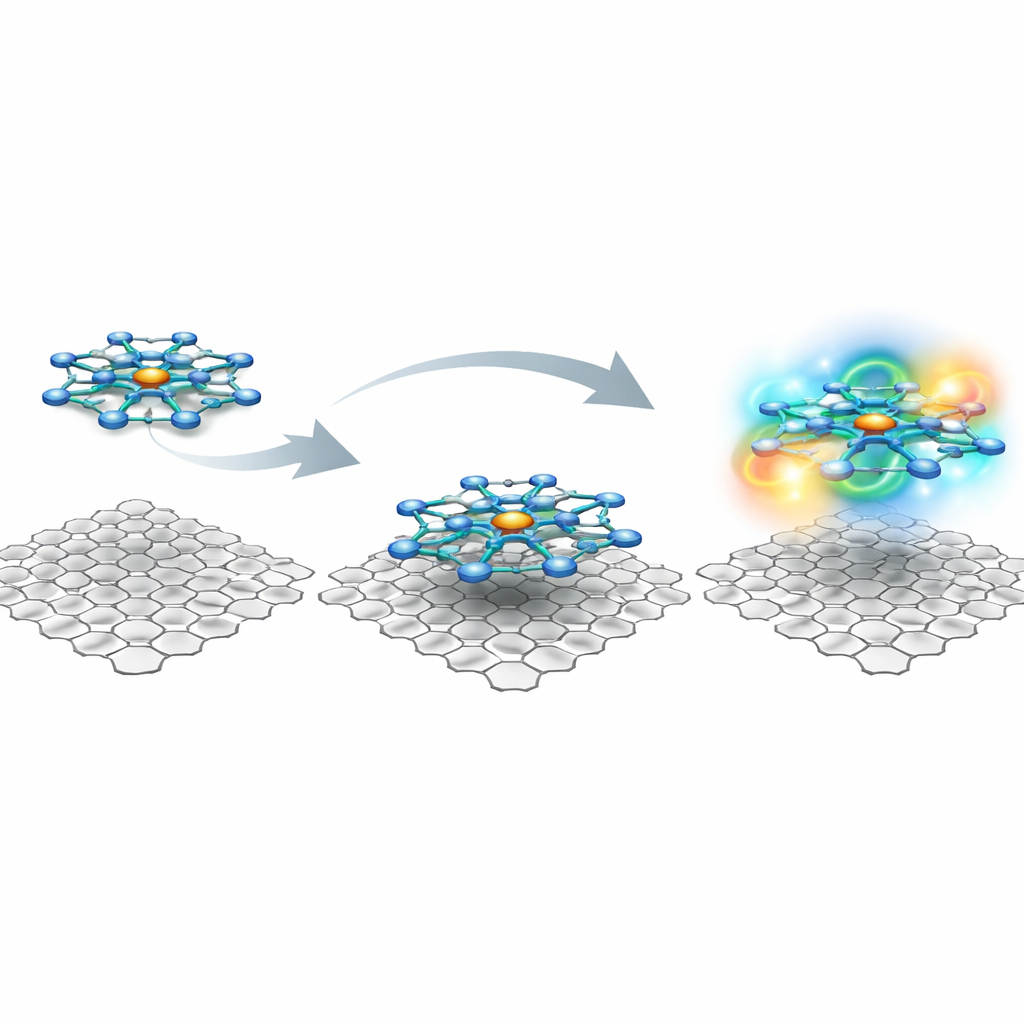
A flat molecule meets a carbon playground
The researchers focus on copper phthalocyanine, a flat, disk-like dye molecule with a copper atom in its center. In free space its shape is perfectly fourfold symmetric, like a square rotated into a circle. They placed these molecules onto a very smooth surface made of bilayer graphene, itself a sheet of carbon atoms arranged in a honeycomb pattern and resting on graphite. This setup provides an almost ideal playground where the electrons in the molecule can interact gently but precisely with the electrons in the carbon sheet.
Seeing handedness with an atomically sharp probe
To inspect individual molecules, the team used scanning tunneling microscopy, which scans a sharp metal tip over the surface and measures tiny currents. At high measuring voltages, images of copper phthalocyanine showed the expected symmetrical “eight-lobed” pattern that reflects its underlying orbitals, confirming that the molecule itself remained essentially undistorted. At lower voltages, however, each molecule suddenly looked asymmetric: two opposite lobes became brighter than the others, and the pattern could be classified as left- or right-handed depending on how the bright lobes were arranged. Crucially, this handedness could be flipped back and forth by nudging the molecules with the tip, showing that the effect is controllable and reversible.
How stacking and angle create an electronic twist
By measuring nearby graphene regions and comparing with atomic-resolution images, the authors determined exactly where each molecule sat relative to the carbon lattice—on hollow, bridge, or top sites—and how much it was rotated (about plus or minus nine degrees) with respect to the underlying grid. They found four distinct combinations of site and rotation that all showed chiral electronic patterns at particular energies. Computer simulations based on quantum mechanical calculations revealed that the key lies in “π–π” stacking: overlapping rings of electrons in the molecule and graphene subtly mix. This hybridization is slightly unbalanced when the molecule sits at special positions and angles, causing the electron cloud of a specific molecular state to become lopsided, even though the atomic skeleton remains symmetric.
Purely electronic handedness without structural bending
The calculations further showed that only certain electronic states, especially one low-lying empty state, become chiral, while other states remain symmetric. The total charge exchanged between molecule and graphene is very small, and the molecule stays essentially flat, so the handedness arises from the pattern of orbital overlap rather than from physical twisting or heavy charge transfer. When the molecule is placed in a perfectly symmetric alignment in the simulations, the chiral pattern disappears, confirming that local symmetry breaking in the overlap region is essential. Similar behavior was observed in related metal-free molecules, indicating that this mechanism is general for such flat, ring-shaped compounds on graphene-like surfaces.
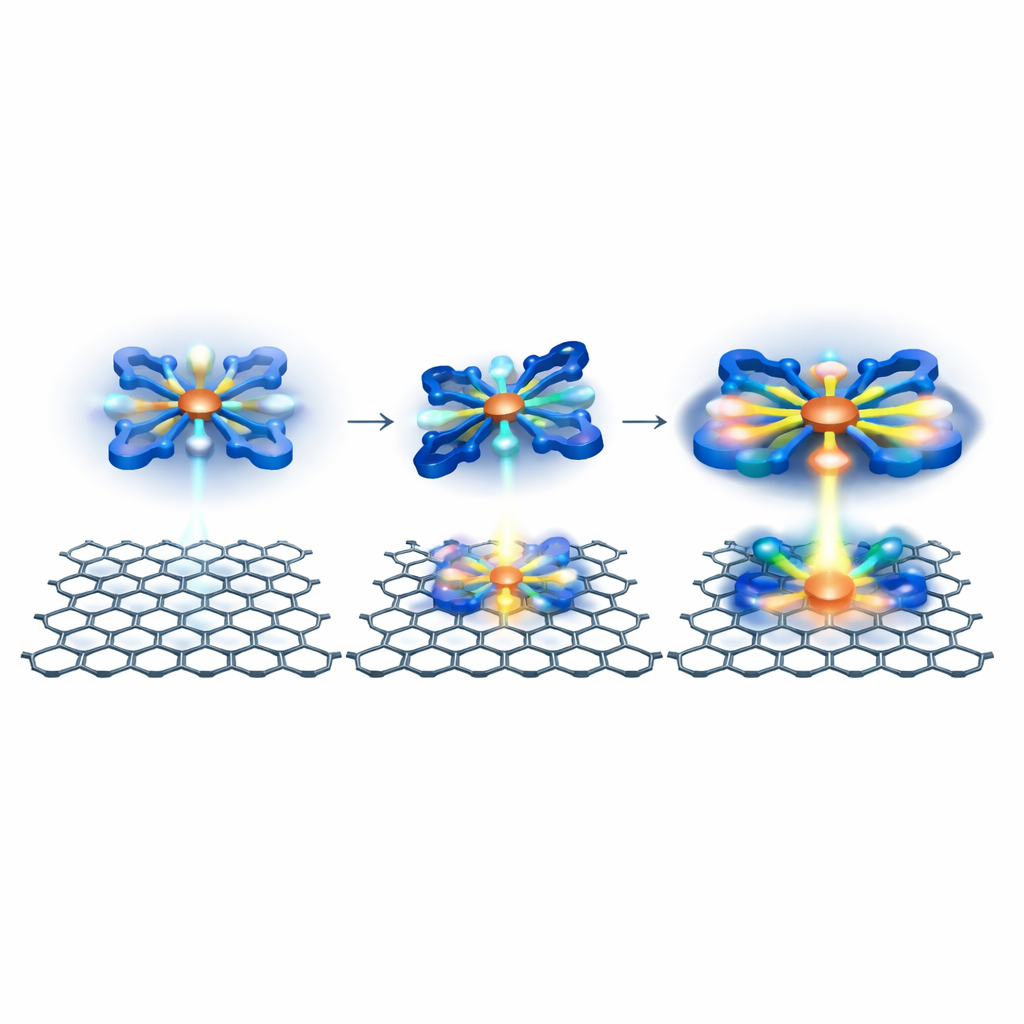
From subtle twists to future devices
The study shows that simply twisting a flat molecule slightly on a carbon sheet can turn its electronic states into left- or right-handed versions, and that this handedness can be switched on demand with a scanning probe. For non-specialists, the key message is that “handed electrons” can be engineered not by reshaping molecules, but by carefully arranging how they stack and interact with a surface. This offers a new design principle for future molecular electronics and sensors, where information or signals could be encoded in the handedness of electron clouds rather than in conventional charge alone.
Citation: Qin, HJ., Sun, RJ., Liu, JJ. et al. Molecular electronic chirality in copper phthalocyanine induced via twisted π-π stacking on bilayer graphene. Nat Commun 17, 3130 (2026). https://doi.org/10.1038/s41467-026-69713-5
Keywords: molecular chirality, graphene interfaces, pi stacking, scanning tunneling microscopy, molecular electronics