Clear Sky Science · en
Localized quasiparticles in a fluxonium with quasi-two-dimensional amorphous kinetic inductors
Why tiny flaws in superconductors matter
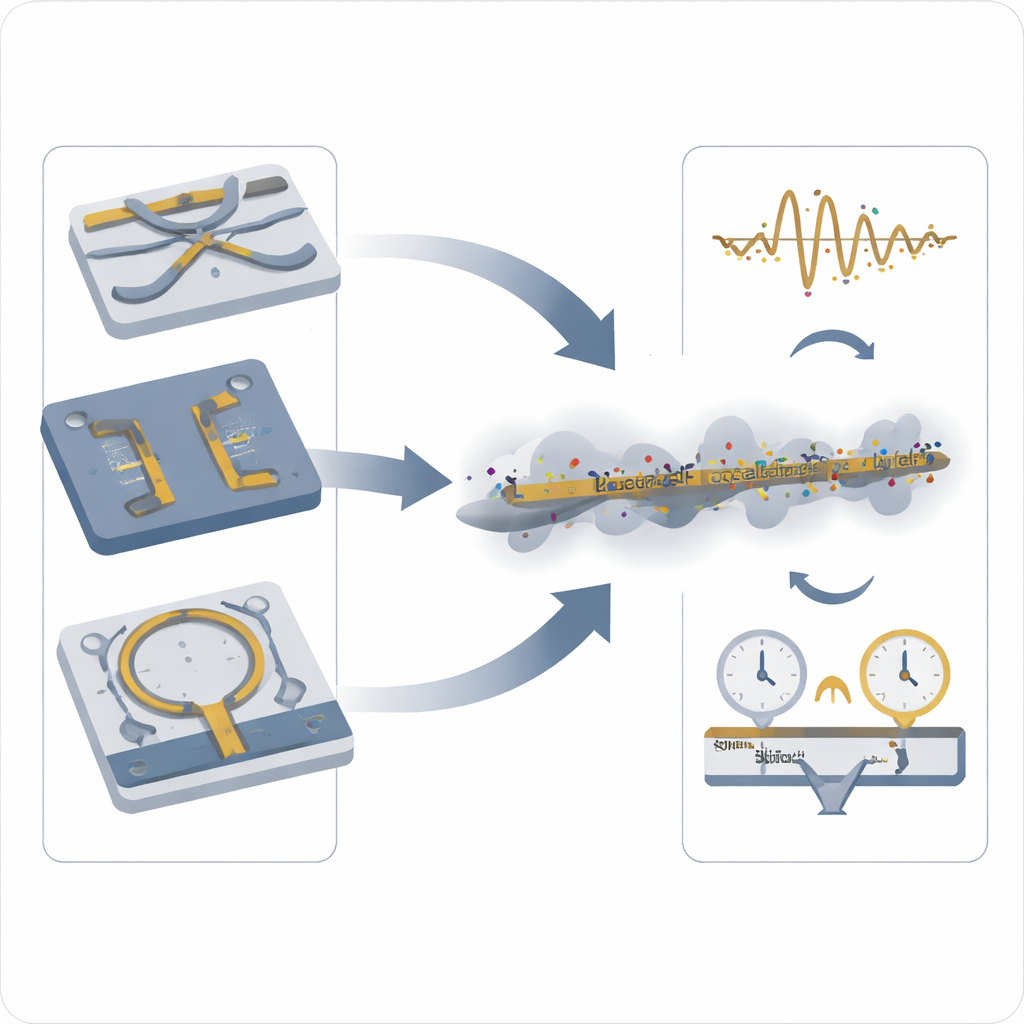
Superconducting circuits are leading candidates for building quantum computers and ultrasensitive detectors, but they are vulnerable to tiny disturbances that sap their energy. This paper explores how a promising material, tungsten silicide (WSi), behaves inside state-of-the-art quantum circuits, and shows that microscopic “stray particles” inside the superconductor are a key source of loss. Understanding and controlling these hidden troublemakers is crucial for building more reliable quantum technologies.
Making wires that behave like powerful springs
In ordinary electronics, inductors are wire coils that store energy in magnetic fields. In special superconducting materials, however, energy can also be stored in the inertia of electron pairs flowing without resistance, a contribution known as kinetic inductance. Disordered superconductors such as WSi can provide extremely large kinetic inductance in a very small footprint, which is attractive for compact, strongly nonlinear quantum circuits. WSi is also amorphous and structurally uniform, making it compatible with modern chip fabrication and attractive for both high-performance single-photon detectors and superconducting qubits.
Building test circuits from ultra-thin WSi films
The researchers deposited very thin WSi films—only a few nanometers thick—on sapphire chips and patterned them into long, narrow wires. These wires served as the inductive elements in two kinds of microwave circuits: resonators, which are tiny “ringing” structures used widely in quantum hardware, and fluxonium qubits, a type of quantum bit that combines a Josephson junction with a large inductor. By keeping the WSi composition fixed and varying only the film thickness and geometry, they could systematically change the kinetic inductance and degree of disorder while measuring how much energy the circuits lost.
Tracing energy loss to trapped quasiparticles
When the team measured the resonators at very low temperatures and low power, they found internal quality factors between about ten thousand and one hundred thousand—comparable to other disordered superconductors used in quantum devices. Several clues pointed away from defects in insulating layers and toward excitations in the WSi itself. Devices with very different electric-field exposure of the WSi surfaces showed similar loss, and making the film thinner (and more disordered) clearly worsened performance. Moreover, loss decreased steadily with increasing resonance frequency, a fingerprint expected when it is dominated by quasiparticles—broken Cooper pairs that carry energy in a superconductor.
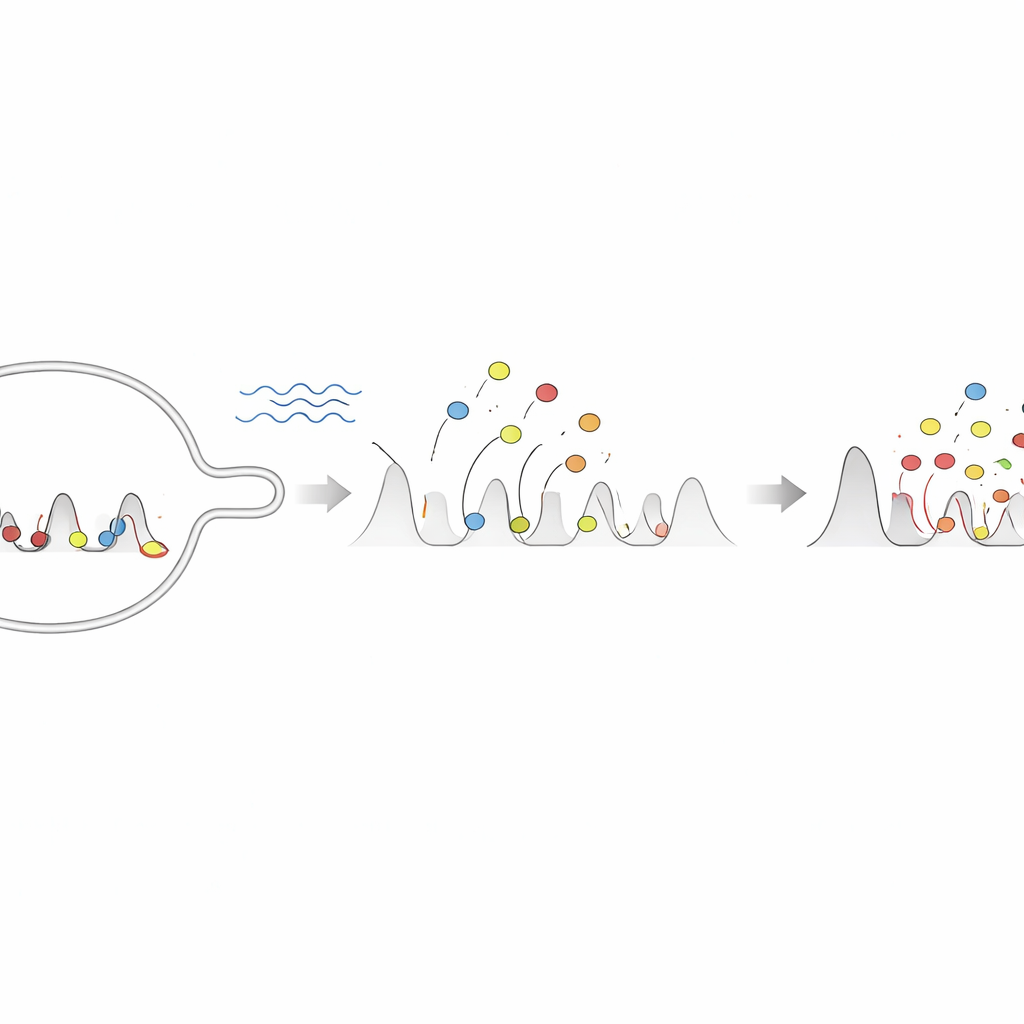
By varying the microwave power, the authors observed that resonator loss initially improved as the circulating photon number increased, then degraded again near the onset of nonlinear behavior. This nonmonotonic trend matches a picture in which many quasiparticles are trapped in shallow “pockets” created by spatial fluctuations of the superconducting gap in a disordered film. Gentle microwave drive shakes some of these quasiparticles loose, allowing them to recombine and thus reducing their number and the loss. At higher drive, the current becomes strong enough to break additional Cooper pairs, creating more quasiparticles and increasing dissipation once more.
Testing WSi inside working quantum bits
To see whether the same physics appears in real qubits, the team incorporated long WSi wires as the inductors in two fluxonium devices with different film thicknesses but comparable nominal inductance. They mapped out each qubit’s energy levels as a function of magnetic flux and then measured how long the first excited state survived (the relaxation time, T1) at various qubit frequencies. In both devices, higher qubit frequencies corresponded to longer lifetimes, and the qubit made from the thinner, more disordered WSi film decayed faster overall. Detailed modeling of several candidate loss mechanisms showed that inductive loss from quasiparticles in the WSi wires could explain both the frequency dependence and the magnitude of the observed lifetimes, with quasiparticle densities similar to those inferred from the resonators.
What this means for future quantum hardware
The combined resonator and qubit measurements paint a consistent picture: in ultra-thin disordered WSi films, localized quasiparticles are the dominant source of microwave energy loss. While this limits the performance of these first-generation WSi-based quantum circuits, it also provides a clear roadmap for improvement. Strategies such as adding dedicated quasiparticle traps, reducing how strongly the circuit depends on the lossy inductive element, and tuning the film’s composition and thickness could all lead to longer-lived qubits. Because WSi is already a workhorse material for single-photon detectors, demonstrating its integration with fluxonium qubits opens the door to hybrid chips where detectors and quantum processors share the same material platform.
Citation: Larson, T.F.Q., Jones, S.G., Kalmár, T. et al. Localized quasiparticles in a fluxonium with quasi-two-dimensional amorphous kinetic inductors. Nat Commun 17, 3022 (2026). https://doi.org/10.1038/s41467-026-69709-1
Keywords: superconducting qubits, kinetic inductance, quasiparticles, tungsten silicide, fluxonium